Moorish Idol
Zanclus cornutus
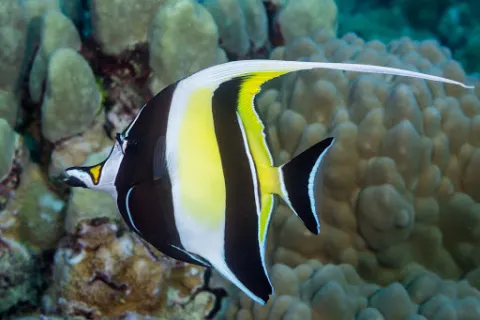
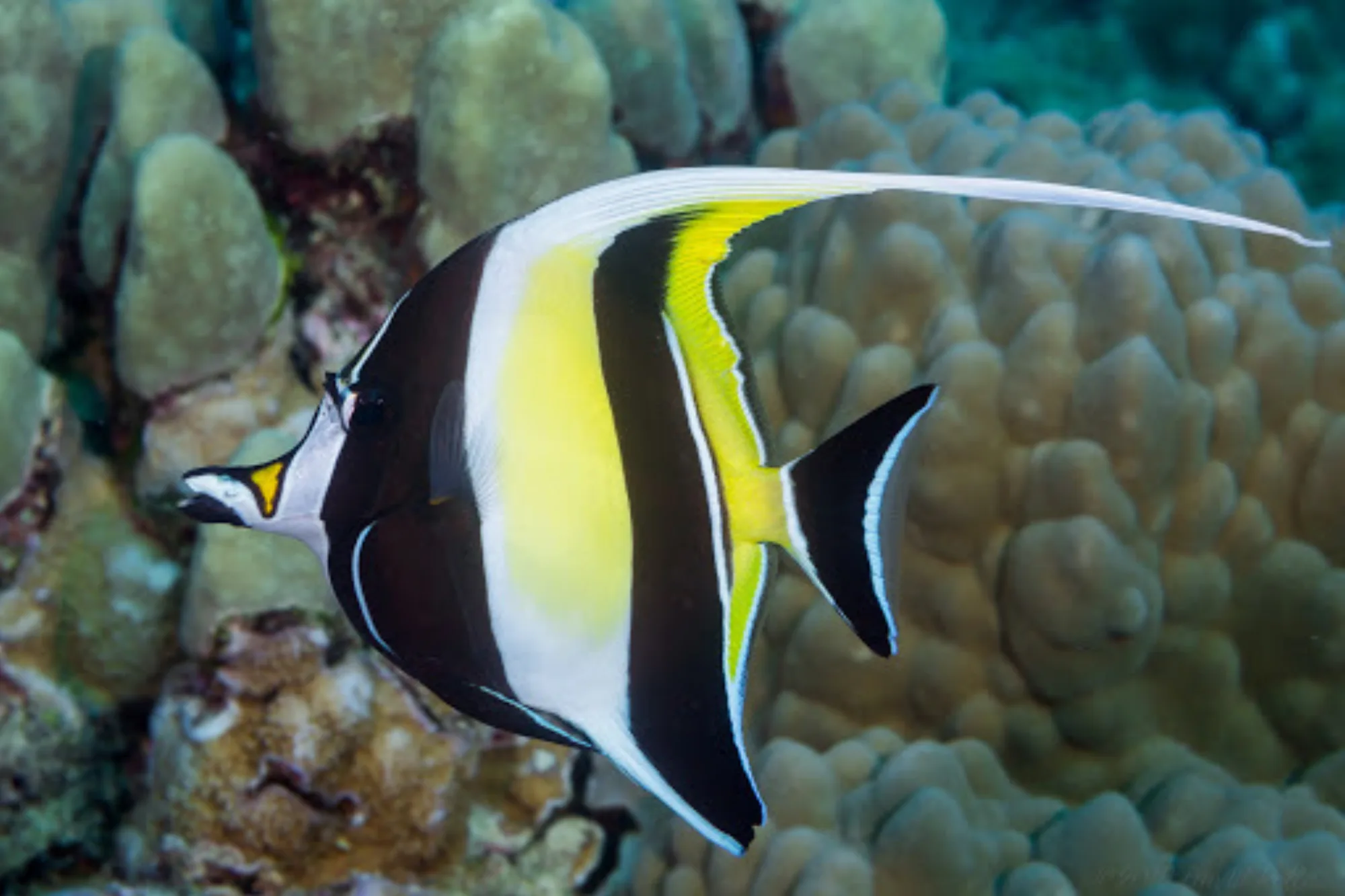
With its flattened, disc-shaped body and long, whip-like fin, the Moorish Idol is a distinctive sight on an Indo-Pacific reef. Its white body carries two broad black bands, with yellow towards the rear and across the snout. The tail is black with a white edge, and adults have small bony bumps above their eyes. A typical fish measures 21 cm, although the largest published length is 23 cm.
Its range stretches from the east coast of Africa to Hawaii and Easter Island, and from Peru north to the southern Gulf of California in the eastern Pacific. It also occurs around islands including the Galapagos and Cocos Island. Look for it in cloudy lagoons, on reef flats and around clear-water rocky and coral reefs, at depths of 1 to 180 metres. Moorish idols usually travel in small groups of 2 or 3, but may also be seen alone or in large schools. Sponges make up most of their diet, supplemented by algae, coral polyps, tunicates and other small animals that live on the seabed.
During breeding, eggs drift away on ocean currents, and the young spend a long early stage in open water. In Palau, hundreds gather to spawn during winter, moving together along the reef in the morning before heading towards the open ocean. Large predatory fish hunt these gatherings, and grey reef sharks can eat most of a school once it reaches open water. No major threats to the species were identified in its last assessment, but coral reefs, an important habitat, are declining because of climate change. Moorish idols have also been found doing well on restored coral reefs and artificial reef structures.
Written from the English Wikipedia article Moorish idol (CC BY-SA 4.0).
- Records
- 8,575
- Countries
- 25
- Atlas places
- 6
These are open occurrence records, so they show where people looked for and recorded the Moorish Idol as much as where it lives. Cells are up to 25 km across, and every location is generalised to its cell.
Generalised encounter areas, not exact locations. Each shape is a grid cell coloured by how likely the species is there.
- Very likelyUnited States25 km zone · high confidence · 2734 records · updated 80 days ago
- Very likelyAustralia25 km zone · medium confidence · 1162 records · updated 80 days ago
- Very likelyNorthern Mariana Islands25 km zone · medium confidence · 753 records · updated 80 days ago
- Very likelyU.S. Outlying Islands25 km zone · high confidence · 721 records · updated 80 days ago
- Very likelyTonga25 km zone · high confidence · 700 records · updated 80 days ago
- Very likelyAmerican Samoa25 km zone · high confidence · 683 records · updated 80 days ago
- Very likelyFrench Polynesia25 km zone · medium confidence · 337 records · updated 80 days ago
- Very likelyGuam25 km zone · high confidence · 282 records · updated 80 days ago
- Very likelySolomon Islands25 km zone · medium confidence · 226 records · updated 80 days ago
- Very likelyRéunion25 km zone · medium confidence · 174 records · updated 80 days ago
Conservation status not assessed here yet, so every location is generalised to its grid cell.