Spectral Bat
Vampyrum spectrum
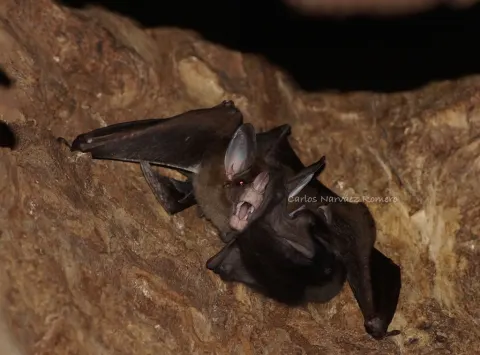
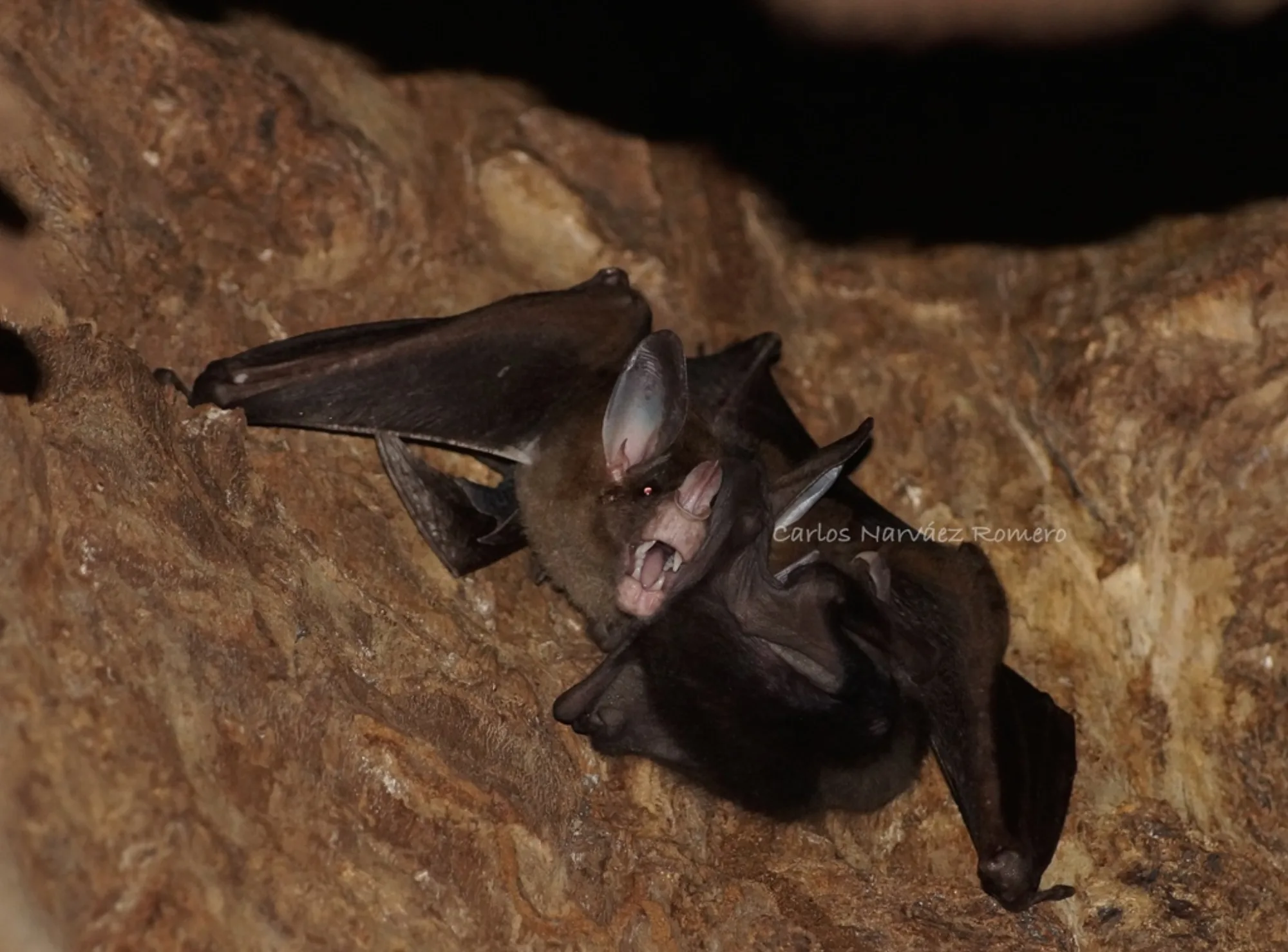
With a wingspan of 0.7 to 1.0 m, the Spectral Bat is the New World's largest bat and the biggest carnivorous bat anywhere. Its long, soft back fur is reddish-brown, while the fur on its belly is shorter and paler. Look for large, rounded ears, broad wings with almost square tips, and a prominent nose-leaf. There is no visible tail. It ranges from Mexico through Central America and into South America, and is associated with tropical rainforests. It has also been recorded in Brazil's Cerrado and is occasionally found in pastures and orchards.
Birds are frequent prey, but this bat also eats rodents, insects and other bats. It uses echolocation to navigate and has been compared to an owl in the way it hunts. After stalking prey, it lands from above, catches it with its claws and delivers a powerful bite. Prey is often carried back to the roost to be eaten, leaving feathers, wings or tails beneath it. Spectral bats roost alone or in small groups of up to five in hollow trees, and individuals have also been found roosting in caves. They form monogamous pairs, and males bring food to the female and their young. Females give birth to one pup as the dry season ends or the rainy season begins; the male often stays close and may sleep with mother and pup wrapped in his wings. Habitat destruction threatens the species, and people sometimes destroy its roosts in Trinidad, where the bats can be mistaken for ghosts. It is rarely encountered, and its population is thought to be decreasing.
Written from the English Wikipedia article Spectral bat (CC BY-SA 4.0).
- Records
- 5
- Countries
- 2
- Atlas places
- 3
These are open occurrence records, so they show where people looked for and recorded the Spectral Bat as much as where it lives. Cells are up to 25 km across, and every location is generalised to its cell.
Generalised encounter areas, not exact locations. Each shape is a grid cell coloured by how likely the species is there.
- Very likelyCosta Rica25 km zone · medium confidence · 5 records · updated 80 days ago
- PossibleBrazil25 km zone · low confidence · 0 records · updated 80 days ago
Conservation status not assessed here yet, so every location is generalised to its grid cell.