Oilbird
Steatornis caripensis
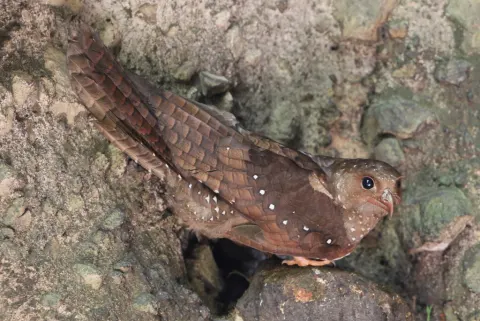
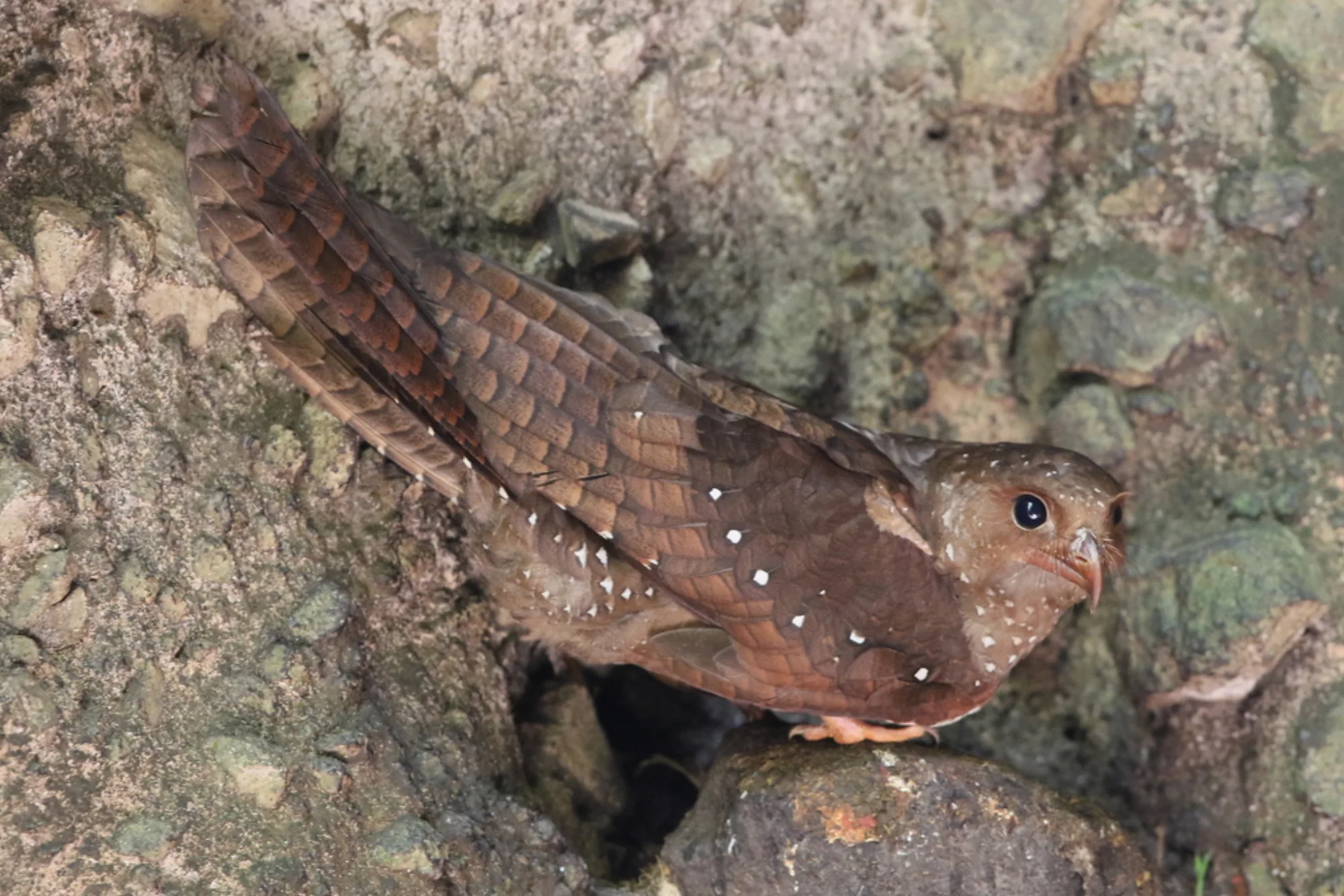
After dark, the Oilbird leaves its daytime shelter to search for fruit, using eyesight adapted to low light and sharp clicks to navigate when it is too dark to see well. Its calls can also betray a colony: harsh screams echo inside caves, especially when someone enters with a light, and can be heard before the birds leave at dusk. Large and slim, it measures 40 to 49 cm long, with a wingspan of 95 cm. Look for reddish-brown plumage, white spots on the nape and wings, and cinnamon-buff underparts marked with black-edged white diamonds. Its strongly hooked beak is surrounded by deep chestnut bristles, while its long wings allow it to hover and twist through confined cave spaces.
Oilbirds range across northern South America, including Trinidad and Tobago, from sea level to 3,400 m. They need forest with fruiting trees as well as caves where they can breed and often roost. Where suitable caves are missing, they may breed and roost on rock shelves in narrow gorges and grottos; non-breeding birds also regularly roost in forest trees. They feed on fruit, including that of oil palms and tropical laurels, and in some areas move seasonally from breeding caves to find fruit trees. Colonies nest on cave ledges, making heaps of droppings, usually above water, where they lay 2 to 4 white eggs that soon become stained brown. Before fledging, chicks grow very fat on the fruit their parents bring. Forest-roosting birds may face predators, while those in caves expend energy competing with rivals and defending ledges.
Written from the English Wikipedia article Oilbird (CC BY-SA 4.0).
- Records
- 7,228
- Countries
- 10
- Atlas places
- 9
These are open occurrence records, so they show where people looked for and recorded the Oilbird as much as where it lives. Cells are up to 25 km across, and every location is generalised to its cell.
Generalised encounter areas, not exact locations. Each shape is a grid cell coloured by how likely the species is there.
- Very likelyColombia25 km zone · medium confidence · 1946 records · updated 80 days ago
- Very likelyEcuador25 km zone · high confidence · 1717 records · updated 80 days ago
- Very likelyTrinidad & Tobago25 km zone · high confidence · 1517 records · updated 80 days ago
- Very likelyPeru25 km zone · high confidence · 1158 records · updated 80 days ago
- Very likelyVenezuela25 km zone · high confidence · 311 records · updated 80 days ago
- Very likelyCosta Rica25 km zone · high confidence · 307 records · updated 80 days ago
- Very likelyPanama25 km zone · high confidence · 131 records · updated 80 days ago
- Very likelyBolivia25 km zone · high confidence · 111 records · updated 80 days ago
- LikelyGuyana25 km zone · medium confidence · 27 records · updated 80 days ago
- UncommonChile25 km zone · medium confidence · 3 records · updated 80 days ago
Conservation status not assessed here yet, so every location is generalised to its grid cell.