King Vulture
Sarcoramphus papa
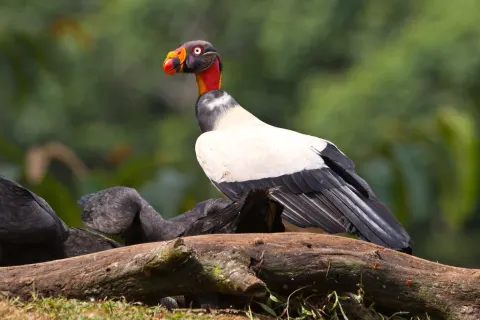
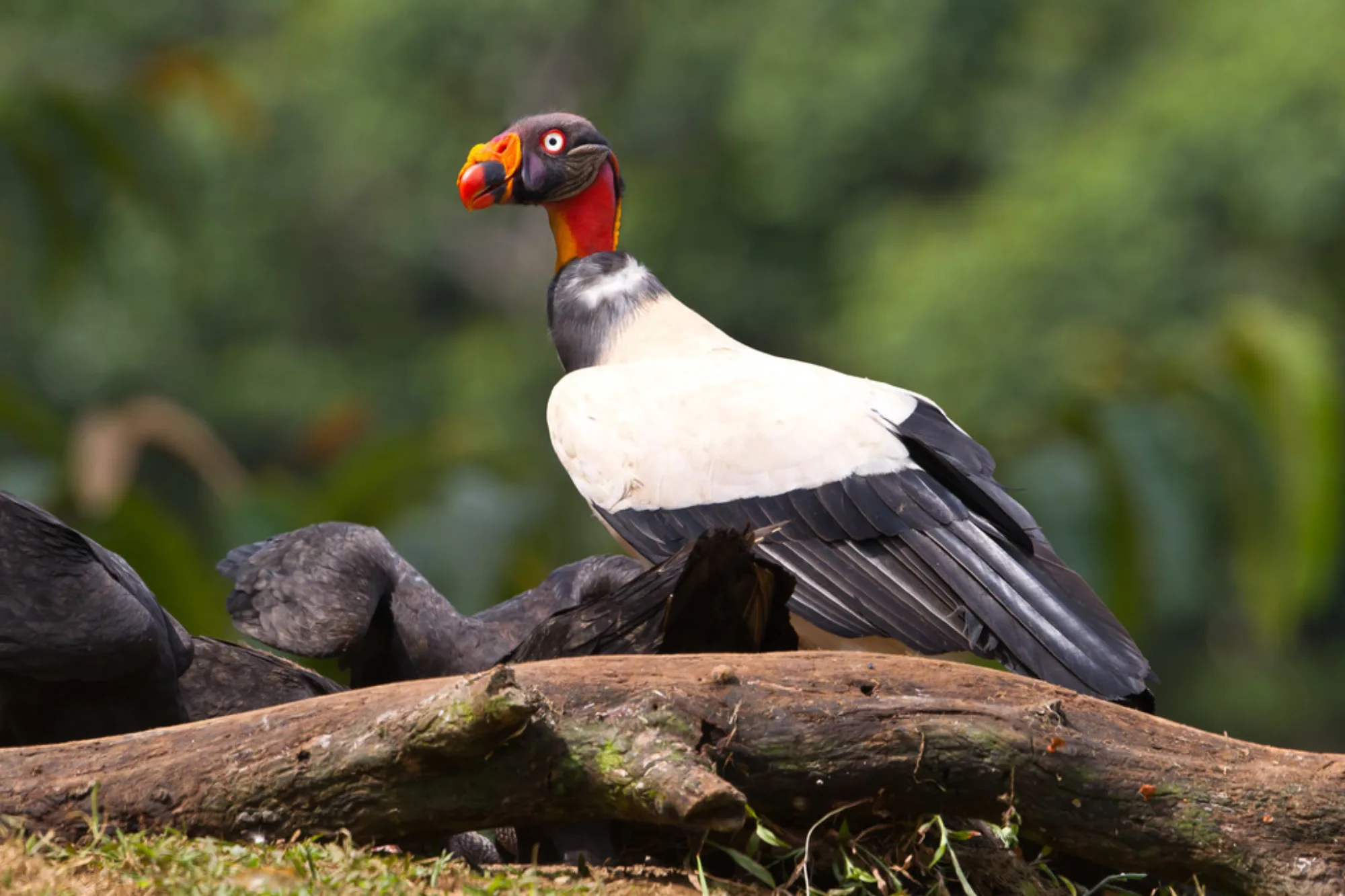
High above the forests of Central and South America, the King Vulture can soar for hours with barely a wingbeat. In flight, its broad wings are held flat with their tips slightly raised, while a bird perched in a tree can be surprisingly inconspicuous. Adults are mostly white, with a dark grey to black neck ruff, flight feathers and tail. Their bare heads and necks carry shades of red, purple, orange and yellow, and a conspicuous fleshy growth sits above the bill. Younger birds are slate grey overall and take around five or six years to acquire their full adult plumage.
The species ranges from southern Mexico to northern Argentina, favouring undisturbed tropical lowland forest, but also using savannas and grasslands near forest. Look for it near forest swamps or marshes, at the top of the forest or above the canopy. It does not migrate and is usually solitary or found with a few family members. A scavenger, it feeds mostly on carrion in the forest, from cattle carcasses to dead monkeys, fish and lizards. Its strong bill can open a fresh carcass, and its size allows it to displace smaller vultures until it has fed.
Breeding in the wild is poorly understood, although the birds mainly breed in the dry season. A pair generally lays one white egg in a tree hollow, and both parents share incubation and care of the chick. Young birds first fly when they are roughly three months old. Habitat destruction and poaching are driving a decline in the population; perching high in trees and flying at altitude also make the birds difficult to monitor.
Written from the English Wikipedia article King vulture (CC BY-SA 4.0).
- Records
- 78,552
- Countries
- 17
- Atlas places
- 16
- Osa Peninsula· Costa Rica
- Tambopata National Reserve· Peru
- Corcovado· Costa Rica
- Cuyabeno Wildlife Reserve· Ecuador
- Iguazú National Park· Argentina
- Manú National Park· Peru
- Yasuní National Park· Ecuador
- Arenal· Costa Rica
- Tortuguero· Costa Rica
- Iguaçu National Park· Brazil
- Manuel Antonio· Costa Rica
- Calilegua National Park· Argentina
- Chapada dos Guimarães National Park· Brazil
- Monteverde· Costa Rica
- Serra da Canastra National Park· Brazil
- Machalilla National Park· Ecuador
These are open occurrence records, so they show where people looked for and recorded the King Vulture as much as where it lives. Cells are up to 25 km across, and every location is generalised to its cell.
Generalised encounter areas, not exact locations. Each shape is a grid cell coloured by how likely the species is there.
- Very likelyCosta Rica25 km zone · high confidence · 26956 records · updated 80 days ago
- Very likelyBelize25 km zone · high confidence · 16813 records · updated 80 days ago
- Very likelyPanama25 km zone · high confidence · 7362 records · updated 80 days ago
- Very likelyColombia25 km zone · high confidence · 5322 records · updated 80 days ago
- Very likelyPeru25 km zone · high confidence · 4316 records · updated 80 days ago
- Very likelyBrazil25 km zone · high confidence · 3500 records · updated 80 days ago
- Very likelyEcuador25 km zone · high confidence · 2965 records · updated 80 days ago
- Very likelyGuatemala25 km zone · high confidence · 2731 records · updated 80 days ago
- Very likelyMexico25 km zone · high confidence · 2553 records · updated 80 days ago
- Very likelyNicaragua25 km zone · high confidence · 1657 records · updated 80 days ago
Conservation status not assessed here yet, so every location is generalised to its grid cell.