Common Potoo
Nyctibius griseus
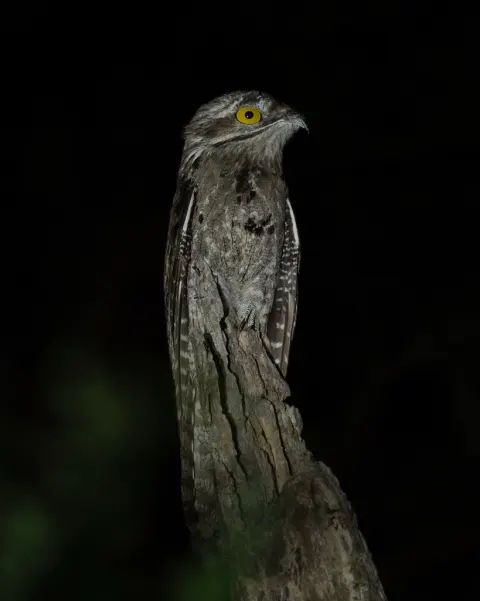
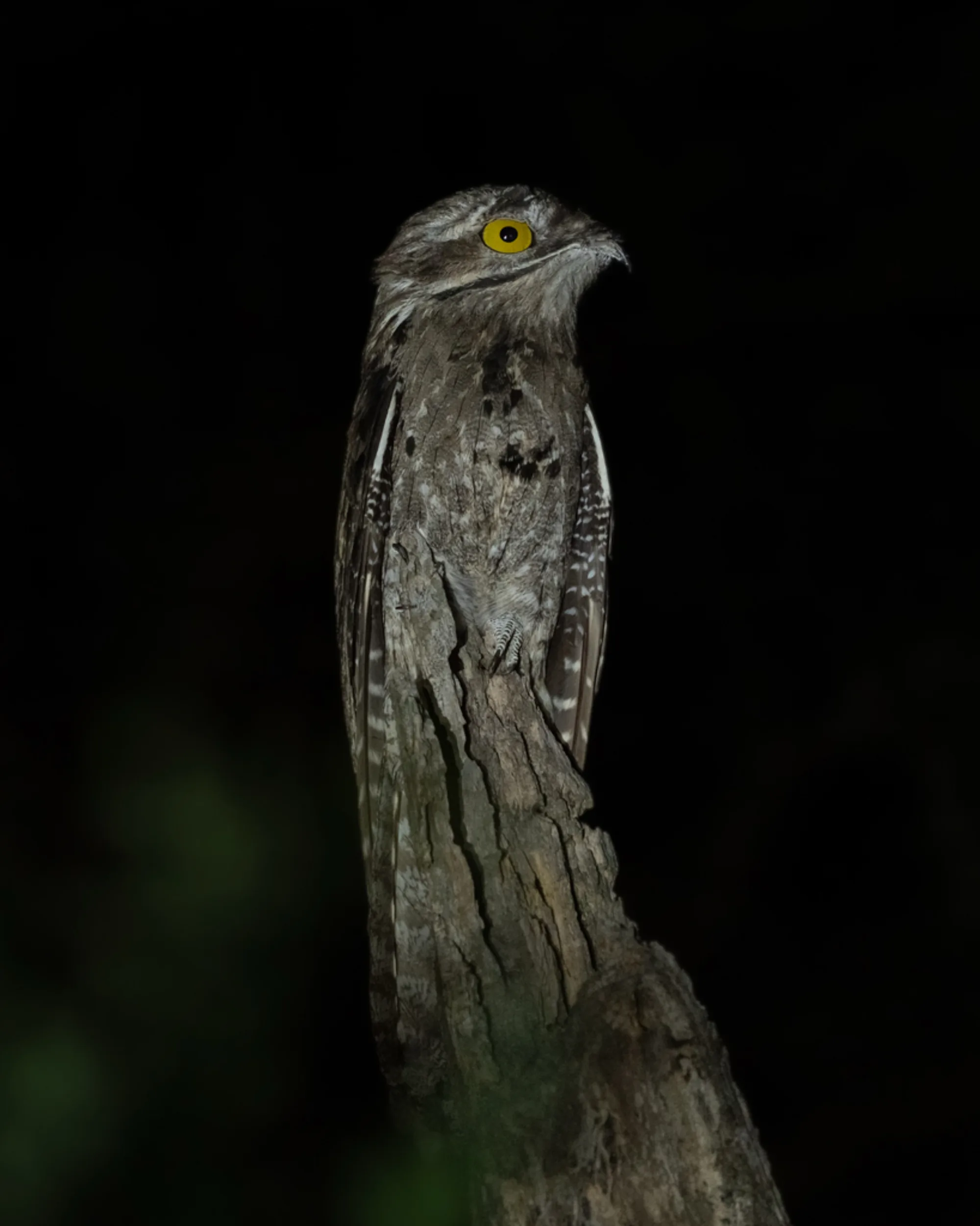
At night, the Common Potoo hunts insects from a perch, using its wide mouth to catch flies, moths, termites and grasshoppers. This nocturnal bird measures 34 to 38 cm long and has mottled red-brown, white, black and grey plumage that helps it blend into branches. Its large eyes can look mostly black with a narrow yellow ring, or show broad yellow irises around small pupils. Its melancholy song drops in pitch and volume as it goes on.
The species lives from eastern Nicaragua through much of South America, as well as on Trinidad and Tobago. It breeds in open woodland and savannah, generally avoiding dry areas and cooler mountain regions. By day, a resting potoo can be difficult to pick out: it chooses a perch similar in width to its body and adjusts its angle to resemble the stump. When disturbed, it may point its bill upwards, close its eyes and hold still, though it can still see through slits in its eyelids. A bird disturbed by a person may instead fly away or open its beak in intimidation.
For breeding, the pair uses a small hollow in a branch stump without adding nesting material. The female lays one white egg marked with lilac spots, and both parents share the work of brooding while the other finds insects. After about 33 days, the chick hatches with pale brown and white stripes and is fed by its parents. It makes several flights before leaving the nest for good, about 25 days after hatching. The population is declining, probably because of habitat destruction.
Written from the English Wikipedia article Common potoo (CC BY-SA 4.0).
- Records
- 49,554
- Countries
- 14
- Atlas places
- 15
- Cuyabeno Wildlife Reserve· Ecuador
- Yasuní National Park· Ecuador
- Iguazú National Park· Argentina
- Osa Peninsula· Costa Rica
- Iguaçu National Park· Brazil
- Manú National Park· Peru
- Tambopata National Reserve· Peru
- Corcovado· Costa Rica
- Manuel Antonio· Costa Rica
- Iberá Park· Argentina
- Pacaya-Samiria National Reserve· Peru
- Arenal· Costa Rica
- Calilegua National Park· Argentina
- Chapada dos Guimarães National Park· Brazil
- Serra da Bodoquena National Park· Brazil
These are open occurrence records, so they show where people looked for and recorded the Common Potoo as much as where it lives. Cells are up to 25 km across, and every location is generalised to its cell.
Generalised encounter areas, not exact locations. Each shape is a grid cell coloured by how likely the species is there.
- Very likelyColombia25 km zone · high confidence · 14610 records · updated 80 days ago
- Very likelyEcuador25 km zone · high confidence · 10042 records · updated 80 days ago
- Very likelyCosta Rica25 km zone · high confidence · 6312 records · updated 80 days ago
- Very likelyBrazil25 km zone · high confidence · 6264 records · updated 80 days ago
- Very likelyPanama25 km zone · high confidence · 3502 records · updated 80 days ago
- Very likelyPeru25 km zone · high confidence · 2589 records · updated 80 days ago
- Very likelyTrinidad & Tobago25 km zone · high confidence · 2233 records · updated 80 days ago
- Very likelyArgentina25 km zone · high confidence · 2128 records · updated 80 days ago
- Very likelyParaguay25 km zone · high confidence · 1065 records · updated 80 days ago
- Very likelyGuyana25 km zone · high confidence · 427 records · updated 80 days ago
Conservation status not assessed here yet, so every location is generalised to its grid cell.