Manta Ray
Mobula birostris
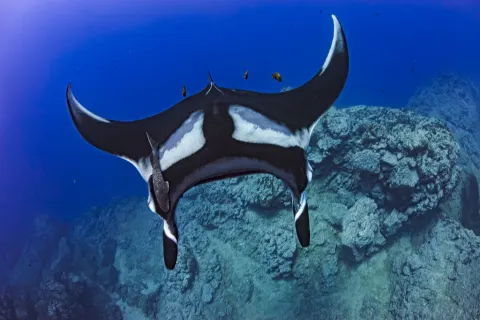
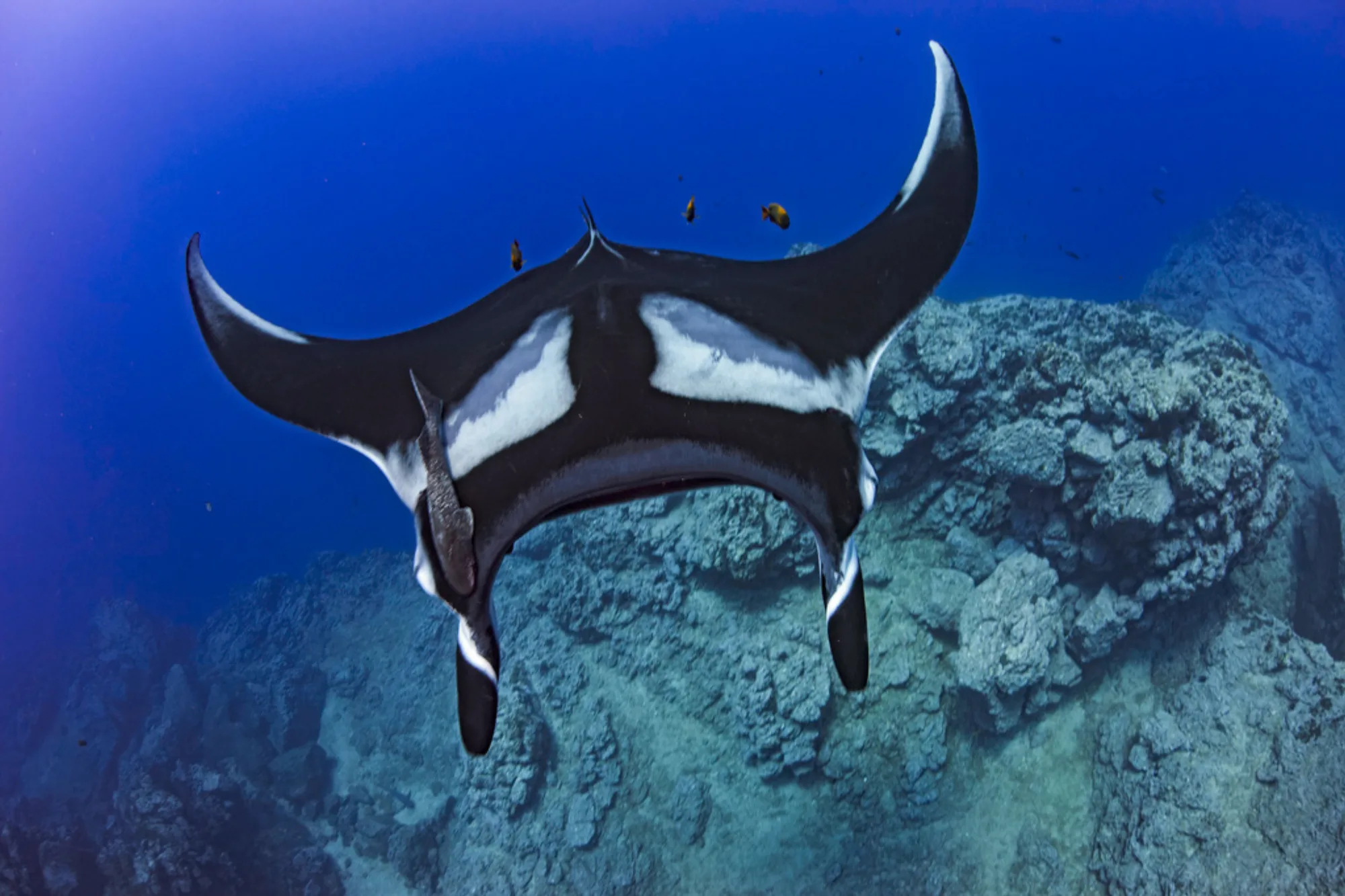
With broad triangular fins and a long, whip-like tail, the Manta Ray is the world's largest ray. Its typical size is 4.5 m, although it can grow to 9 m long and 7 m across. Its upper surface can be black, dark brown or steely blue, while its white underside sometimes carries dark spots and blotches. These markings can help identify individual rays.
This ocean-going species ranges around the world, mostly in tropical and subtropical waters, but also in temperate seas. It spends much of its life far from land and is often found near offshore oceanic islands. Travelling with currents, it moves towards areas where nutrient-rich water rises and zooplankton becomes more plentiful. In deep water it swims steadily in a straight line, while nearer shore it often basks or swims idly. Mantas travel alone or in groups, and as many as 50 may gather at a feeding site rich in plankton. They eat zooplankton and fish, with much of their diet coming from deep water. At coral reefs, they sometimes pause for several minutes while cleaner fish remove loose skin and parasites. Females usually have one pup at a time and reproduce every two to three years. The young are usually born near the coast and spend their first few years in shallow water.
Fishing has driven a drastic population decline, and rays feeding in shallow water risk becoming caught in nets. Their slow reproduction makes it difficult for populations to replace those lost. Microplastics are another concern: rays can swallow them directly or through plankton, potentially exposing themselves to pollutants.
Written from the English Wikipedia article Giant oceanic manta ray (CC BY-SA 4.0).
- Records
- 1,582
- Countries
- 23
- Atlas places
- 6
These are open occurrence records, so they show where people looked for and recorded the Manta Ray as much as where it lives. Cells are up to 25 km across, and every location is generalised to its cell.
Generalised encounter areas, not exact locations. Each shape is a grid cell coloured by how likely the species is there.
- Very likelyEcuador25 km zone · medium confidence · 949 records · updated 80 days ago
- Very likelyPeru25 km zone · medium confidence · 172 records · updated 80 days ago
- Very likelyUnited States25 km zone · medium confidence · 161 records · updated 80 days ago
- Very likelyFrench Guiana25 km zone · medium confidence · 89 records · updated 80 days ago
- Very likelyMexico25 km zone · medium confidence · 70 records · updated 80 days ago
- Very likelyPhilippines25 km zone · medium confidence · 26 records · updated 80 days ago
- Very likelyCosta Rica25 km zone · medium confidence · 24 records · updated 80 days ago
- LikelyIndonesia25 km zone · medium confidence · 20 records · updated 80 days ago
- LikelyAustralia25 km zone · medium confidence · 14 records · updated 80 days ago
- LikelyPanama25 km zone · medium confidence · 8 records · updated 80 days ago
Conservation status not assessed here yet, so every location is generalised to its grid cell.