Olive Ridley
Lepidochelys olivacea
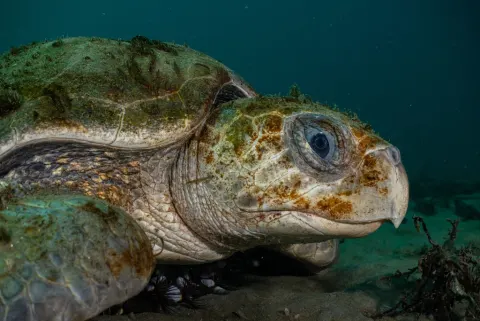
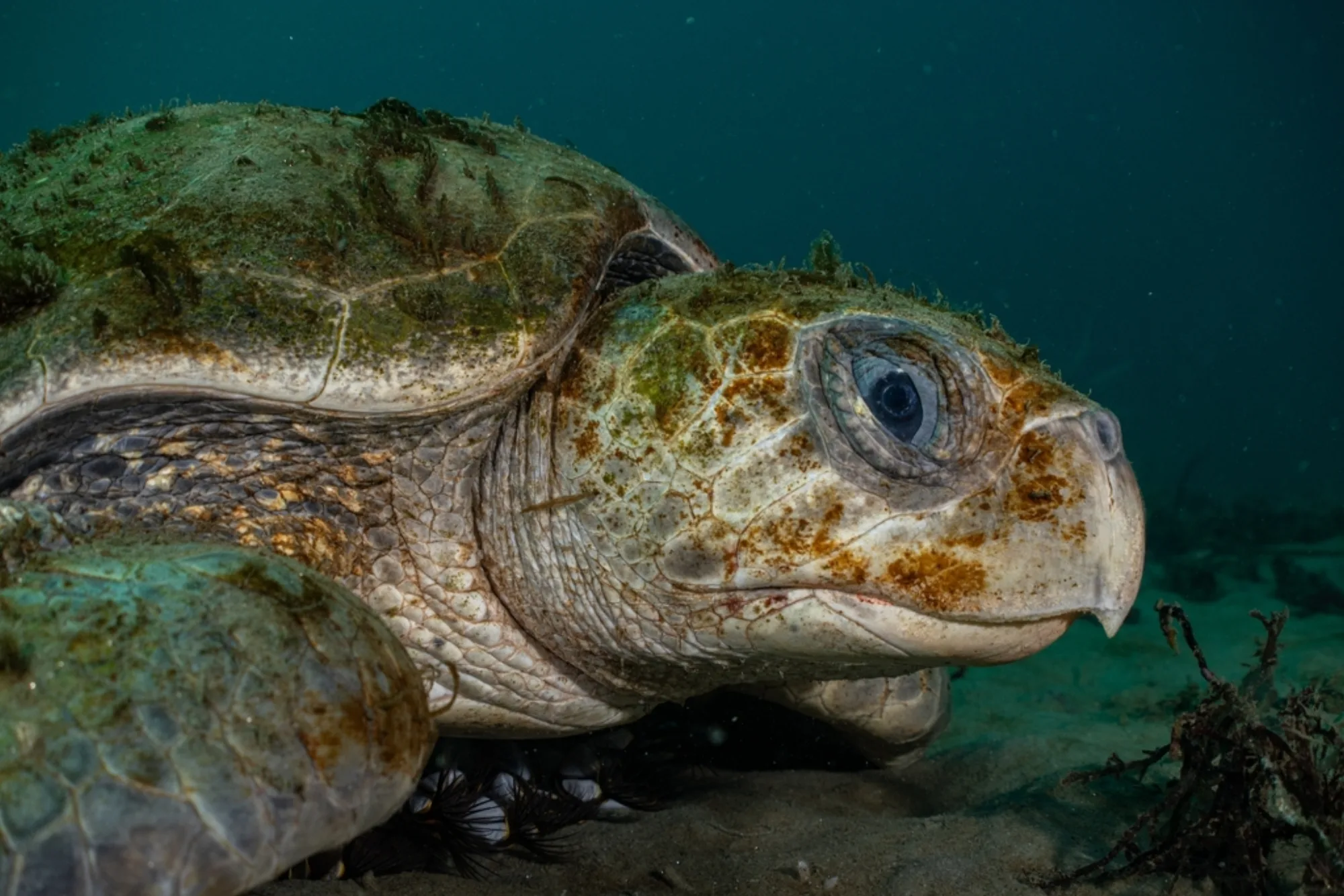
With its rounded, heart-shaped olive shell and broad head, the Olive Ridley is one of the smaller sea turtles, growing to about 61 cm in shell length. Its upper parts range from greyish green to olive, although algae can give the shell a reddish appearance. Hatchlings are dark grey and look black when wet, with a thin white border around the shell and the back edges of their flippers.
Olive Ridleys live in warm and tropical seas, primarily across the Indian and Pacific Oceans, with a range that extends into the Atlantic. Most sightings are in sheltered, relatively shallow waters near mainland shores, though the turtles sometimes venture into the open ocean. They feed mainly on animals, including crabs, shrimp, squid, sea urchins and snails, and may also eat jellyfish and fish. Where other food is absent, they can feed on algae. Females usually nest alone, but the species is known for mass nesting events called arribadas, when thousands gather on one beach to lay eggs. Nesting usually happens at night, although it can take place during the day, particularly at large arribadas. Females dig nests with their hind flippers, and most lay one or two clutches in a season.
Fishing gear, boat collisions and the collection of eggs and adults all threaten these turtles. Marine debris can entangle them or be swallowed, while coastal development and erosion threaten nesting beaches. Artificial light can lead hatchlings away from the sea, leaving them at risk of exhaustion, dehydration or traffic. Even at crowded arribadas, nesting females can accidentally dig up and destroy eggs laid earlier by others.
Written from the English Wikipedia article Olive ridley sea turtle (CC BY-SA 4.0).
- Records
- 5,152
- Countries
- 14
- Atlas places
- 4
These are open occurrence records, so they show where people looked for and recorded the Olive Ridley as much as where it lives. Cells are up to 25 km across, and every location is generalised to its cell.
Generalised encounter areas, not exact locations. Each shape is a grid cell coloured by how likely the species is there.
- Very likelyEcuador25 km zone · high confidence · 1976 records · updated 80 days ago
- Very likelyAustralia25 km zone · medium confidence · 1772 records · updated 80 days ago
- Very likelyCosta Rica25 km zone · high confidence · 858 records · updated 80 days ago
- Very likelyMexico25 km zone · medium confidence · 320 records · updated 80 days ago
- Very likelyBenin25 km zone · high confidence · 158 records · updated 80 days ago
- LikelyColombia25 km zone · medium confidence · 16 records · updated 80 days ago
- LikelyNicaragua25 km zone · medium confidence · 13 records · updated 80 days ago
- LikelyGuatemala25 km zone · medium confidence · 12 records · updated 80 days ago
- LikelyIndia25 km zone · medium confidence · 12 records · updated 80 days ago
- LikelyFrench Guiana25 km zone · medium confidence · 4 records · updated 80 days ago
Conservation status not assessed here yet, so every location is generalised to its grid cell.