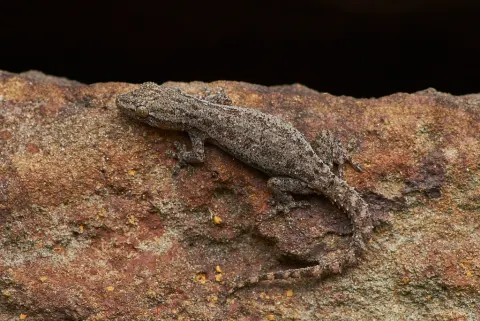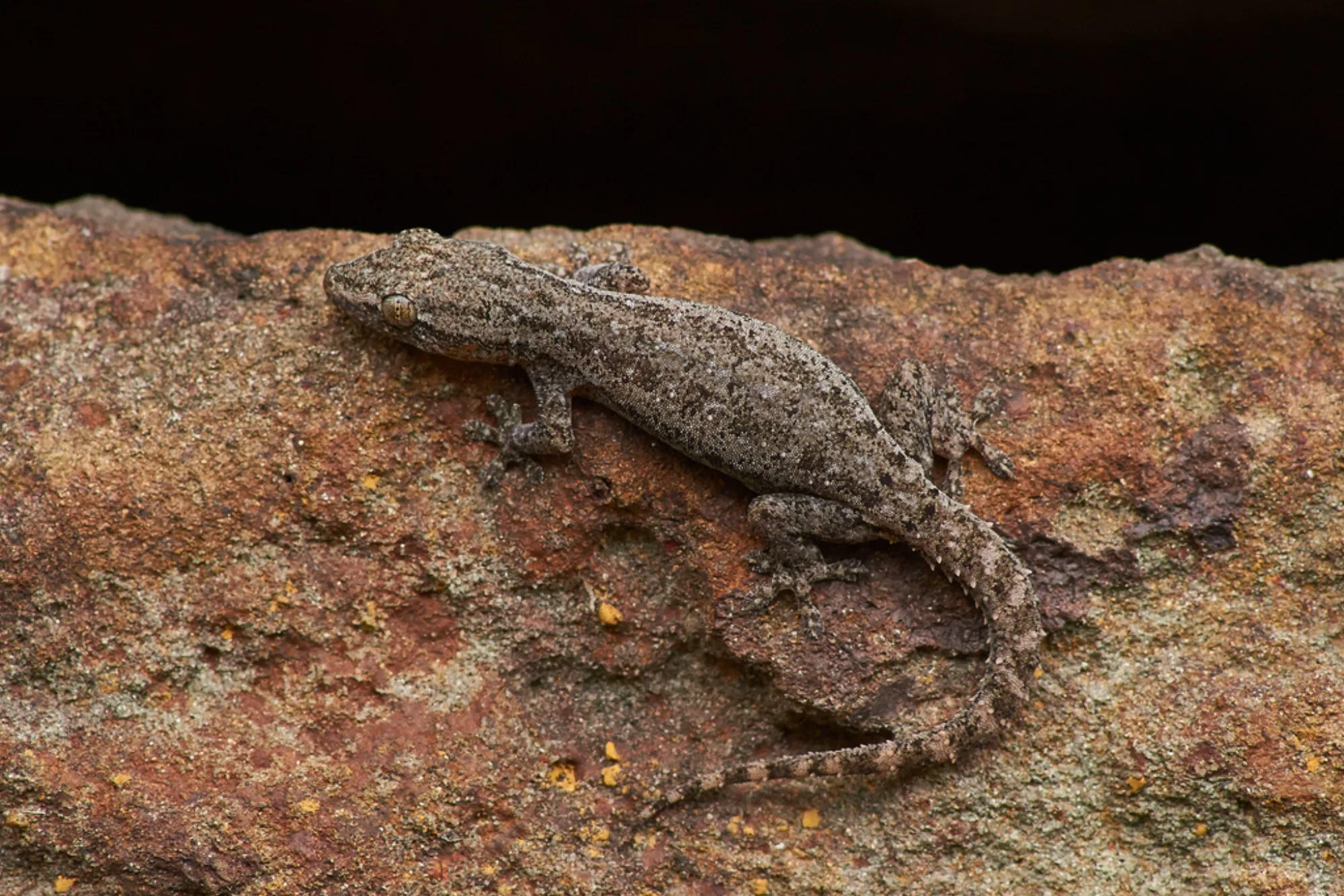
Common House Gecko
Hemidactylus frenatus
Listen for a characteristic chirping after dark, then look for the Common House Gecko climbing a wall near a porch light. This nocturnal lizard grows to 7.5 to 15 cm long and has dark streaks along the sides of its head, between the eyes and nostrils. It is non-venomous and harmless to humans. Its native range spans Near Oceania and southern and southeastern Asia; introductions have also brought it to tropical and subtropical Australia, the southern United States, the Caribbean and parts of Africa. In Mexico, travellers may encounter it on buildings in cities and towns, including homes and hotels.
The gecko favours warm, humid conditions and often lives close to people, although it has also been found in bushland. Away from urban areas, it appears to favour dense forest or eucalypt woodland near closed forest. By day it often hides, while at night it hunts insects attracted to lights, usually choosing illuminated spots close to cracks or other escape routes. Its prey includes cockroaches, termites, moths, flies, spiders and beetles, as well as molluscs and smaller geckos. Activity is highest just after sunset and gradually falls towards dawn. Females lay up to two hard-shelled eggs at a time; where food and warm temperatures are constant throughout the year, they are more likely to breed continuously.
Rain and wind can reduce sightings, while limited adaptations against water loss may restrict the gecko in arid and semi-arid environments. In places where its introduction could threaten native geckos, efforts are being made to limit its arrival and presence. The Common House Gecko can displace other geckos through competition, particularly in the urban areas it favours.
Written from the English Wikipedia article Common house gecko (CC BY-SA 4.0).
- Records
- 6,736
- Countries
- 40
- Atlas places
- 6
These are open occurrence records, so they show where people looked for and recorded the Common House Gecko as much as where it lives. Cells are up to 25 km across, and every location is generalised to its cell.
Generalised encounter areas, not exact locations. Each shape is a grid cell coloured by how likely the species is there.
- Very likelyTaiwan25 km zone · medium confidence · 1969 records · updated 80 days ago
- Very likelyAustralia25 km zone · medium confidence · 1381 records · updated 80 days ago
- Very likelyUnited States25 km zone · medium confidence · 332 records · updated 80 days ago
- Very likelyPhilippines25 km zone · medium confidence · 307 records · updated 80 days ago
- Very likelyMexico25 km zone · medium confidence · 277 records · updated 80 days ago
- Very likelyMyanmar (Burma)25 km zone · medium confidence · 244 records · updated 80 days ago
- Very likelyPalau25 km zone · medium confidence · 225 records · updated 80 days ago
- Very likelyPapua New Guinea25 km zone · medium confidence · 212 records · updated 80 days ago
- Very likelyNew Caledonia25 km zone · medium confidence · 153 records · updated 80 days ago
- Very likelySingapore25 km zone · medium confidence · 129 records · updated 80 days ago
Conservation status not assessed here yet, so every location is generalised to its grid cell.