Hawksbill Turtle
Eretmochelys imbricata
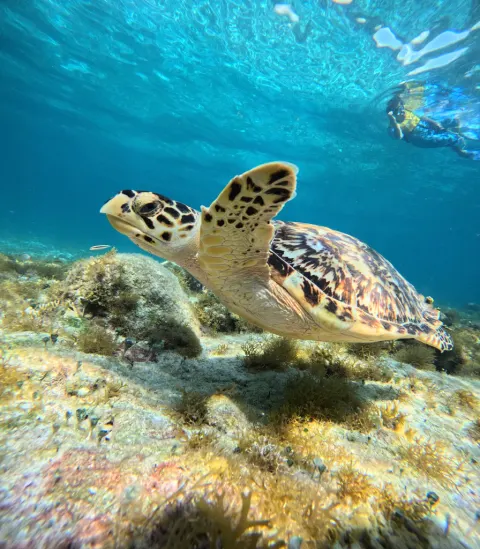
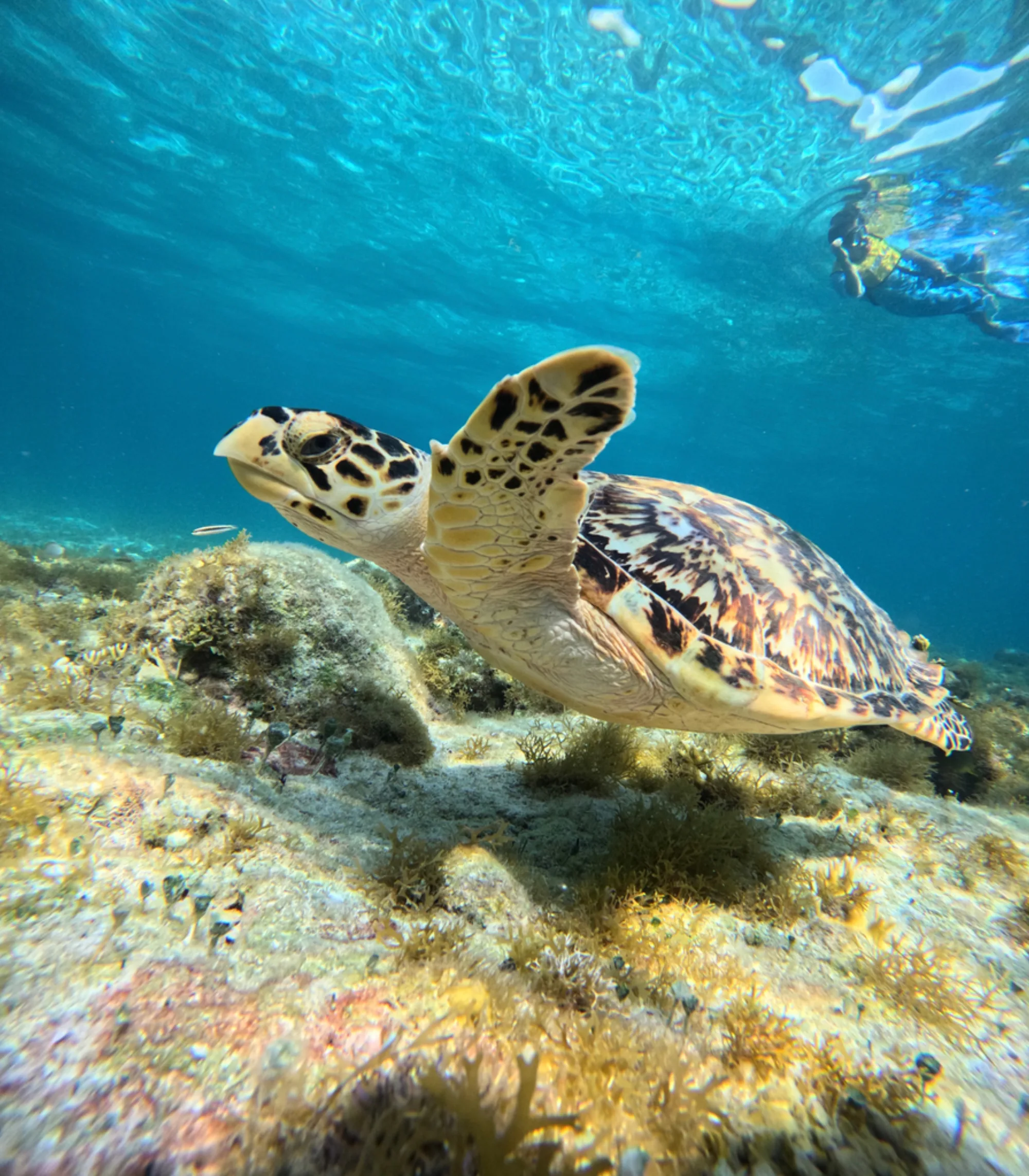
A sharp, hooked beak and a shell with a saw-toothed rear edge distinguish the Hawksbill Turtle (Eretmochelys imbricata) from other sea turtles. Its shell has an amber background, with irregular light and dark streaks and mottled brown and black colouring towards the sides. Adults typically reach 1 m in length and weigh around 80 kg on average. Their flippers propel them through the open ocean, although they spend more of their lives around coral reefs and in shallow lagoons.
Hawksbills range across tropical and subtropical seas, including the Indian, Pacific and Atlantic Oceans. Adults are often found on tropical reefs, where they may rest in caves or beneath ledges during the day. In the eastern Pacific, they also feed and nest in mangrove estuaries, including the Gulf of Fonseca. They are highly migratory and spend most of their lives alone, coming together to mate. Sponges make up most of their diet, but they also eat foods ranging from algae and seagrasses to jellyfish, fish and crabs. On reefs, a hawksbill may use its sturdy shell to squeeze into tight spaces.
At night, females come ashore, dig a hole with their rear flippers and cover their eggs with sand. In Florida and the Caribbean, a typical nest contains about 140 eggs, with hatchlings emerging after approximately 60 days. Artificial lights can disrupt the hatchlings as they make their way towards the sea, and those still ashore at daybreak face predators. People have hunted hawksbills for their patterned shells and continue to exploit turtles and eggs for food in some places. Accidental killing, pollution and the loss of nesting beaches to coastal development also threaten them.
Written from the English Wikipedia article Hawksbill sea turtle (CC BY-SA 4.0).
- Records
- 8,883
- Countries
- 22
- Atlas places
- 8
These are open occurrence records, so they show where people looked for and recorded the Hawksbill Turtle as much as where it lives. Cells are up to 25 km across, and every location is generalised to its cell.
Generalised encounter areas, not exact locations. Each shape is a grid cell coloured by how likely the species is there.
- Very likelyAustralia25 km zone · medium confidence · 7126 records · updated 80 days ago
- Very likelyMexico25 km zone · high confidence · 922 records · updated 80 days ago
- Very likelyPanama25 km zone · medium confidence · 143 records · updated 80 days ago
- Very likelyGuadeloupe25 km zone · high confidence · 110 records · updated 80 days ago
- Very likelyColombia25 km zone · medium confidence · 102 records · updated 80 days ago
- Very likelyCayman Islands25 km zone · medium confidence · 76 records · updated 80 days ago
- Very likelyEgypt25 km zone · medium confidence · 68 records · updated 80 days ago
- Very likelyMartinique25 km zone · medium confidence · 57 records · updated 80 days ago
- Very likelyFrench Polynesia25 km zone · medium confidence · 50 records · updated 80 days ago
- Very likelyEcuador25 km zone · medium confidence · 40 records · updated 80 days ago
Conservation status not assessed here yet, so every location is generalised to its grid cell.