Black Iguana
Ctenosaura similis
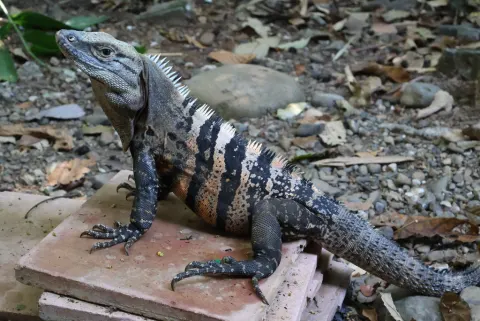
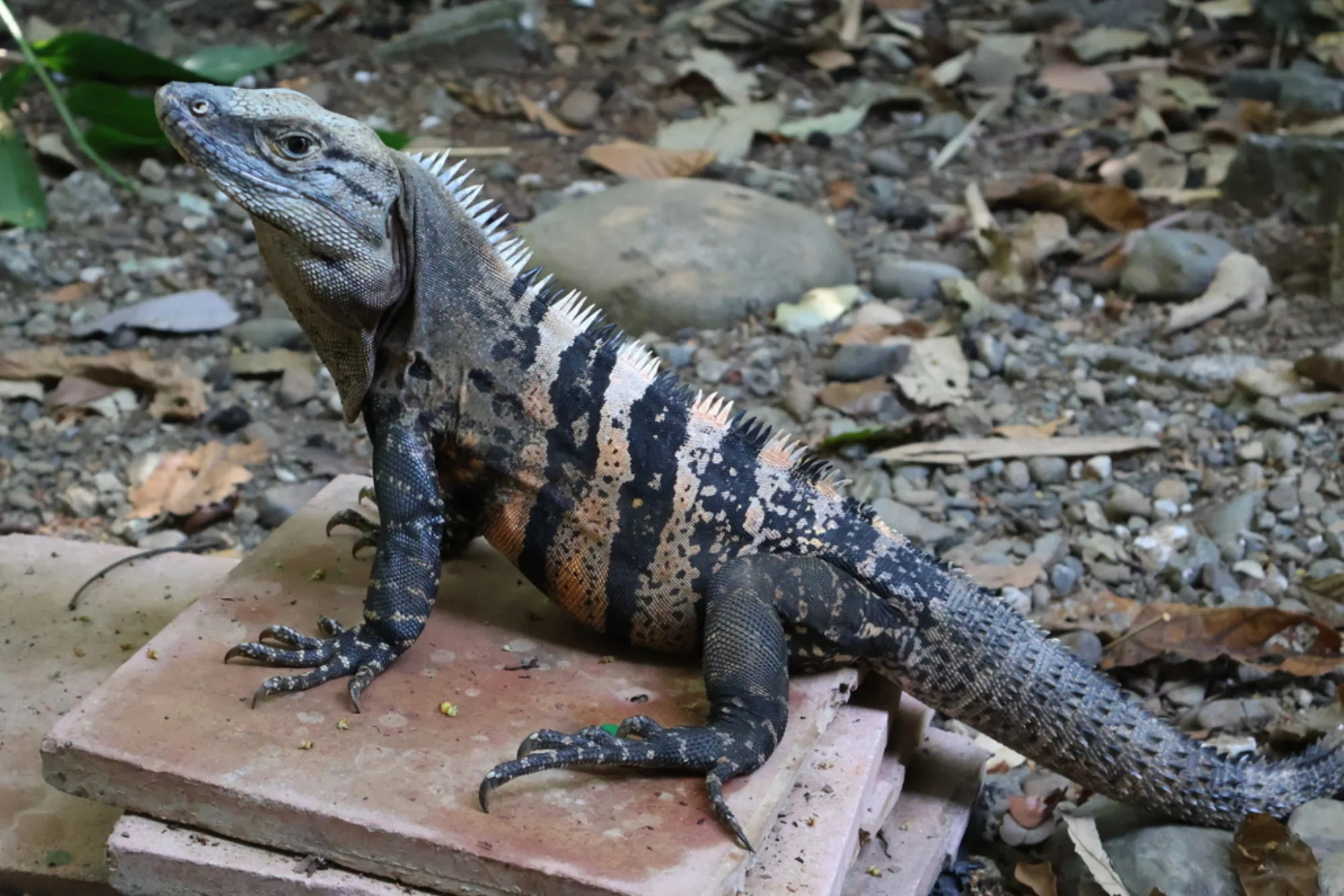
A long crest of spines and a dark, spiny tail help identify the Black Iguana, a large lizard native to Mexico and Central America. Adults are usually whitish grey or tan, with 4 to 12 dark bands across the back, although their colours vary considerably. Males can reach 1.3 meters in length, while females are slightly shorter. During the breeding season, males develop orange around the head and throat, with blue and peach on the jowls.
The species ranges from southern Mexico to Panama and occurs on many Caribbean and Pacific islands. It lives in grasslands and forests, favouring rocky places with crevices for shelter, rocks for basking and trees to climb. Active by day, it is a quick mover and an excellent climber. It usually escapes predators by running, but may bite or lash its tail if cornered. In South Florida, introduced populations reproduce in the wild and live in both natural and disturbed areas.
Flowers, leaves, stems and fruit make up much of its diet, though it also takes small animals, eggs and arthropods when the opportunity arises. Young iguanas tend to eat insects and become more plant-eating as they grow. After breeding, females travel to shared nesting sites and each may lay as many as 30 eggs. After 90 days, hatchlings emerge and dig their way out of the sand. Hatchlings are typically green with brown markings, though some are entirely brown. The species is heavily hunted and, in parts of Central America, is farmed for food and export to the pet trade.
Written from the English Wikipedia article Ctenosaura similis (CC BY-SA 4.0).
- Records
- 3,443
- Countries
- 11
- Atlas places
- 6
These are open occurrence records, so they show where people looked for and recorded the Black Iguana as much as where it lives. Cells are up to 25 km across, and every location is generalised to its cell.
Generalised encounter areas, not exact locations. Each shape is a grid cell coloured by how likely the species is there.
- Very likelyMexico25 km zone · medium confidence · 1513 records · updated 80 days ago
- Very likelyCosta Rica25 km zone · medium confidence · 1083 records · updated 80 days ago
- Very likelyUnited States25 km zone · medium confidence · 283 records · updated 80 days ago
- Very likelyBelize25 km zone · medium confidence · 195 records · updated 80 days ago
- Very likelyHonduras25 km zone · medium confidence · 138 records · updated 80 days ago
- Very likelyPanama25 km zone · medium confidence · 134 records · updated 80 days ago
- Very likelyGuatemala25 km zone · medium confidence · 27 records · updated 80 days ago
- LikelyEl Salvador25 km zone · medium confidence · 25 records · updated 80 days ago
- LikelyNicaragua25 km zone · medium confidence · 24 records · updated 80 days ago
- LikelyColombia25 km zone · medium confidence · 15 records · updated 80 days ago
Conservation status not assessed here yet, so every location is generalised to its grid cell.