American Crocodile
Crocodylus acutus
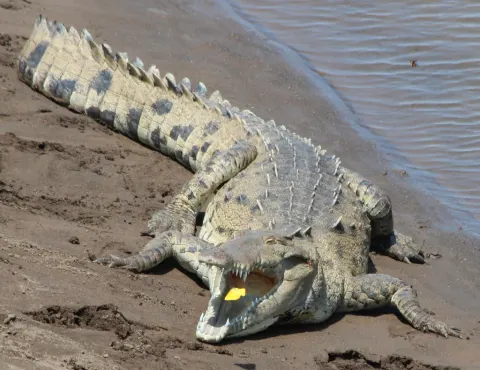
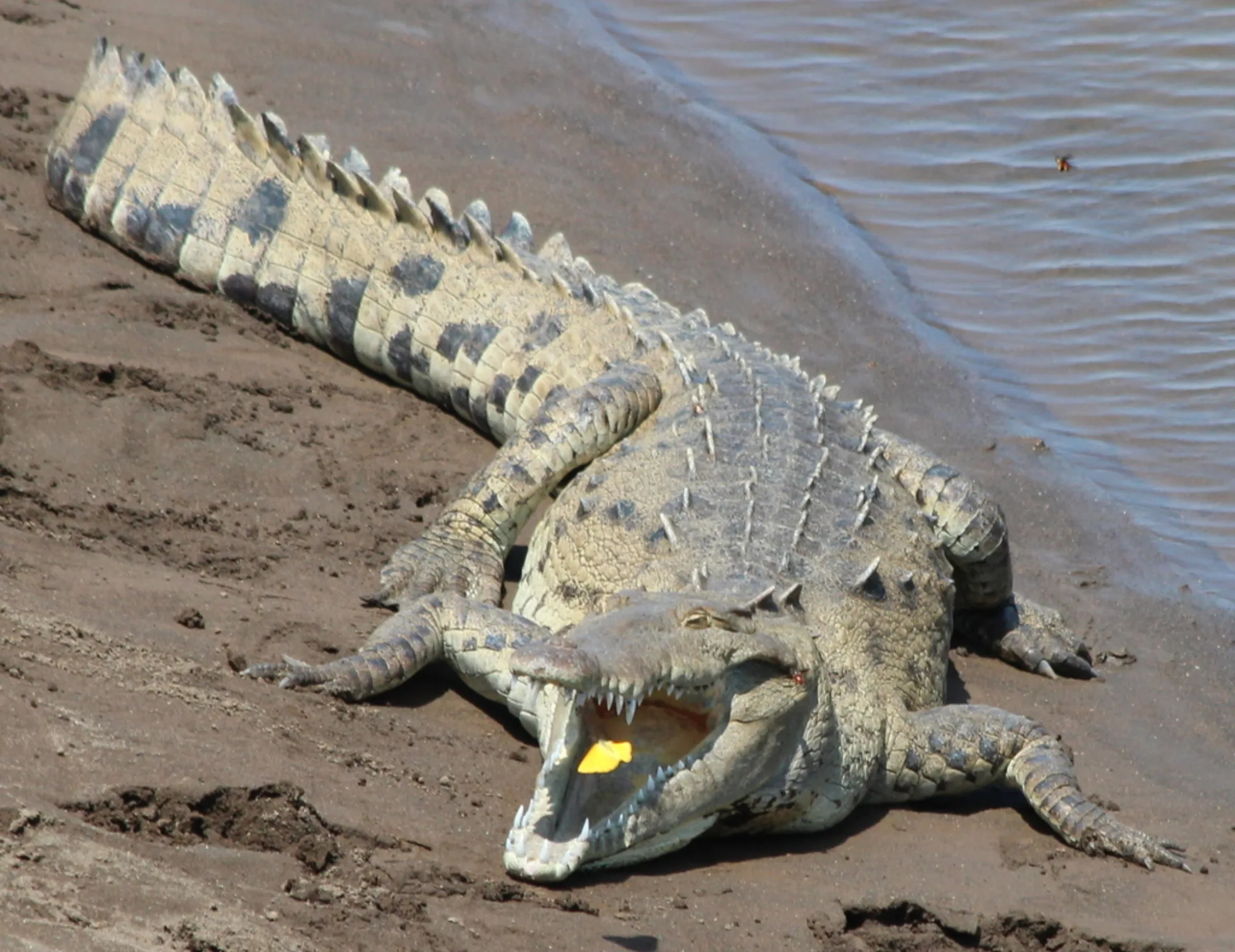
A long, narrow snout and a greyish colour help distinguish the American Crocodile from the darker American alligator. Look for a distinctive bump on the snout in front of the eyes, while young crocodiles also show dark cross-marks that usually fade with age. Mature males average 2.9 to 4.1 m in length, while females are smaller and rarely exceed 3.8 m.
Its range extends from southern Florida and Caribbean islands through coastal Mexico and Central America to countries including Colombia, Ecuador, Peru and Venezuela. Saltwater tolerance allows it to inhabit mangrove swamps, lagoons, river mouths and salt lakes, as well as beaches and small islands without freshwater. In the Dominican Republic, a large population lives in Lago Enriquillo, a hypersaline lake. Crocodiles sometimes gather to bask or feed during the day, though they do not form social groups. They may rest with their mouths open while basking, helping to regulate their body temperature. Their varied diet includes fish, crabs, birds and mammals, with young animals taking insects and other small prey. They ambush animals at the water's edge or hunt aquatic prey from near the surface.
Females build nests of sand, mud and dead vegetation near water, then lay 30 to 70 eggs. Parents guard the nest during incubation, and mothers help hatchlings reach water. Hunting for hides, poaching for meat, pollution and habitat loss threaten populations, while road collisions account for many deaths in southern Florida. In Florida and Biscayne Bays, canals have reduced freshwater flow, increasing the frequency and duration of hypersaline conditions.
Written from the English Wikipedia article American crocodile (CC BY-SA 4.0).
- Records
- 1,276
- Countries
- 15
- Atlas places
- 7
These are open occurrence records, so they show where people looked for and recorded the American Crocodile as much as where it lives. Cells are up to 25 km across, and every location is generalised to its cell.
Generalised encounter areas, not exact locations. Each shape is a grid cell coloured by how likely the species is there.
- Very likelyCosta Rica25 km zone · medium confidence · 587 records · updated 80 days ago
- Very likelyMexico25 km zone · medium confidence · 277 records · updated 80 days ago
- Very likelyUnited States25 km zone · medium confidence · 271 records · updated 80 days ago
- Very likelyPanama25 km zone · medium confidence · 105 records · updated 80 days ago
- LikelyDominican Republic25 km zone · medium confidence · 11 records · updated 80 days ago
- LikelyColombia25 km zone · medium confidence · 9 records · updated 80 days ago
- LikelyNicaragua25 km zone · medium confidence · 4 records · updated 80 days ago
- PossibleJamaica25 km zone · medium confidence · 4 records · updated 80 days ago
- PossibleHonduras25 km zone · medium confidence · 3 records · updated 80 days ago
- PossibleEcuador25 km zone · medium confidence · 2 records · updated 80 days ago
Conservation status not assessed here yet, so every location is generalised to its grid cell.