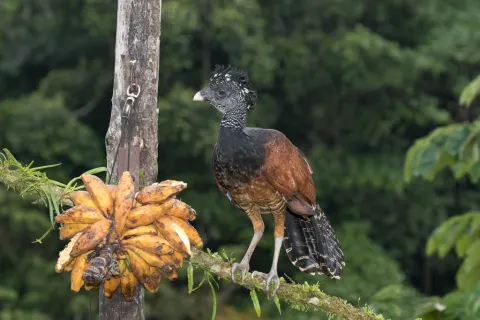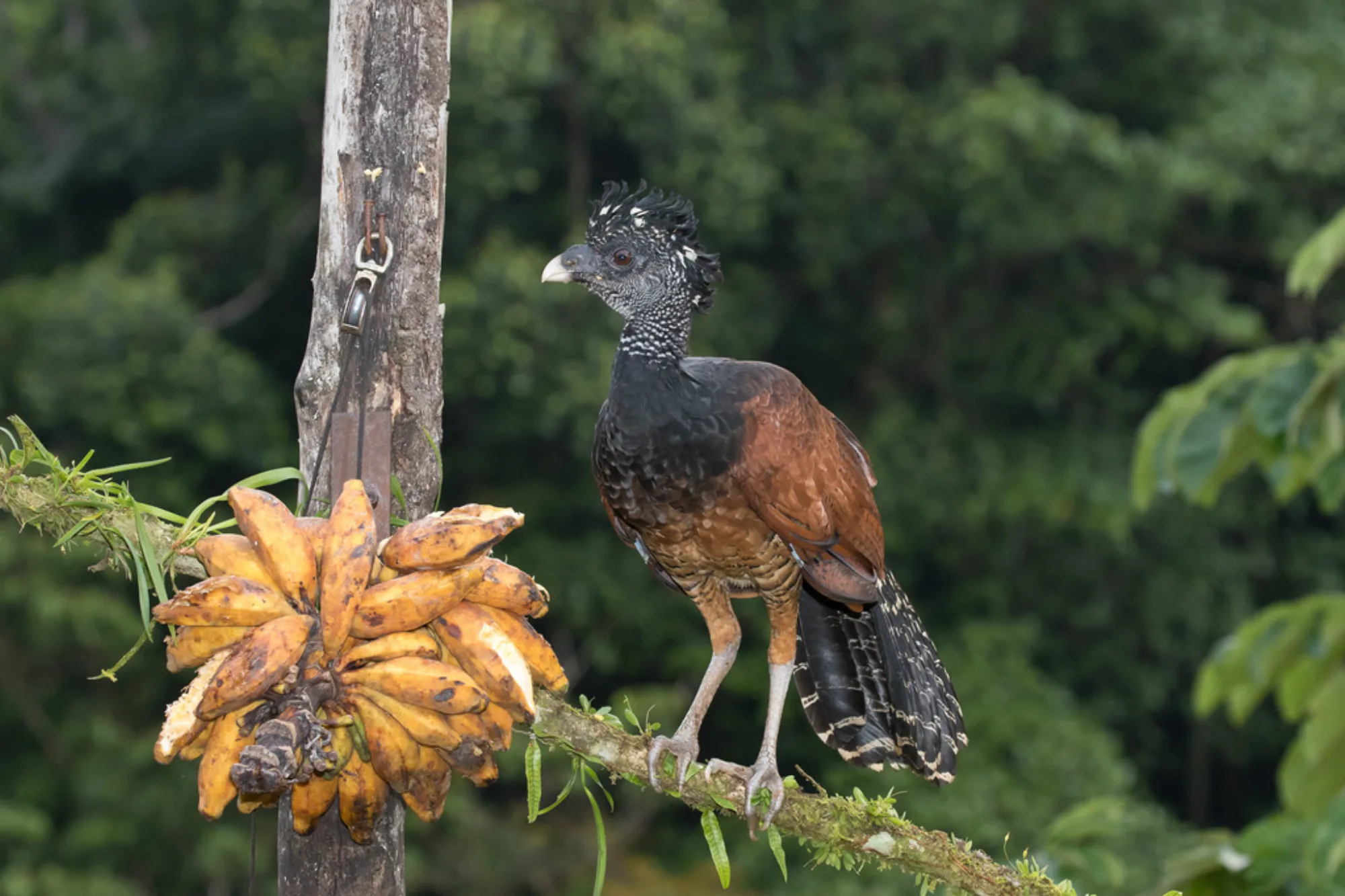
Great Curassow
Crax rubra
A large, pheasant-like bird of Neotropical rainforests, the Great Curassow lives in eastern Mexico and across Central America, reaching western Colombia and northwestern Ecuador. It measures 78 to 100 cm in length and weighs 3.1 to 4.8 kg, with females somewhat smaller than males. Males are black, with a curly crest, white belly and a yellow knob on the bill. Females come in three colour forms: barred, reddish brown with a barred tail, or dark with a blackish neck and tail and some barring on the wings. Usually, only one or two of these forms occur in a region, although some females show features between forms. Its call is a lingering whistle, similar to those of several other curassows.
Great Curassows gather in small groups and spend much of their foraging time on the ground, though they roost and nest in trees. They eat mainly fruit, figs and arthropods, with small vertebrates, including rodents, taken occasionally. Much of their fruit is gathered after it has fallen, and in some places the birds favour the red berries of Chione trees. Pairs are monogamous, and the male may build the nest and draw a female's attention to it, although both birds sometimes build it together. The relatively small nest is usually made largely of leaves and typically holds two eggs. Near their young, adults may pretend to be injured as a distraction when a potential predator approaches. Habitat loss and overhunting threaten the species, while the small population on Cozumel Island is also at risk from hurricanes.
Written from the English Wikipedia article Great curassow (CC BY-SA 4.0).
- Records
- 60,356
- Countries
- 9
- Atlas places
- 6
These are open occurrence records, so they show where people looked for and recorded the Great Curassow as much as where it lives. Cells are up to 25 km across, and every location is generalised to its cell.
Generalised encounter areas, not exact locations. Each shape is a grid cell coloured by how likely the species is there.
- Very likelyCosta Rica25 km zone · high confidence · 45427 records · updated 80 days ago
- Very likelyBelize25 km zone · high confidence · 7229 records · updated 80 days ago
- Very likelyGuatemala25 km zone · high confidence · 3488 records · updated 80 days ago
- Very likelyMexico25 km zone · high confidence · 2569 records · updated 80 days ago
- Very likelyPanama25 km zone · high confidence · 1064 records · updated 80 days ago
- LikelyColombia25 km zone · medium confidence · 261 records · updated 80 days ago
- LikelyHonduras25 km zone · high confidence · 151 records · updated 80 days ago
- LikelyEl Salvador25 km zone · high confidence · 87 records · updated 80 days ago
- LikelyNicaragua25 km zone · medium confidence · 80 records · updated 80 days ago
Conservation status not assessed here yet, so every location is generalised to its grid cell.