Milkfish
Chanos chanos
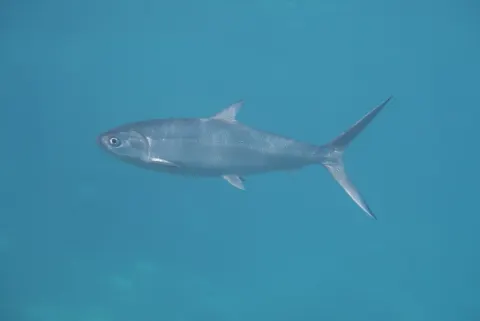
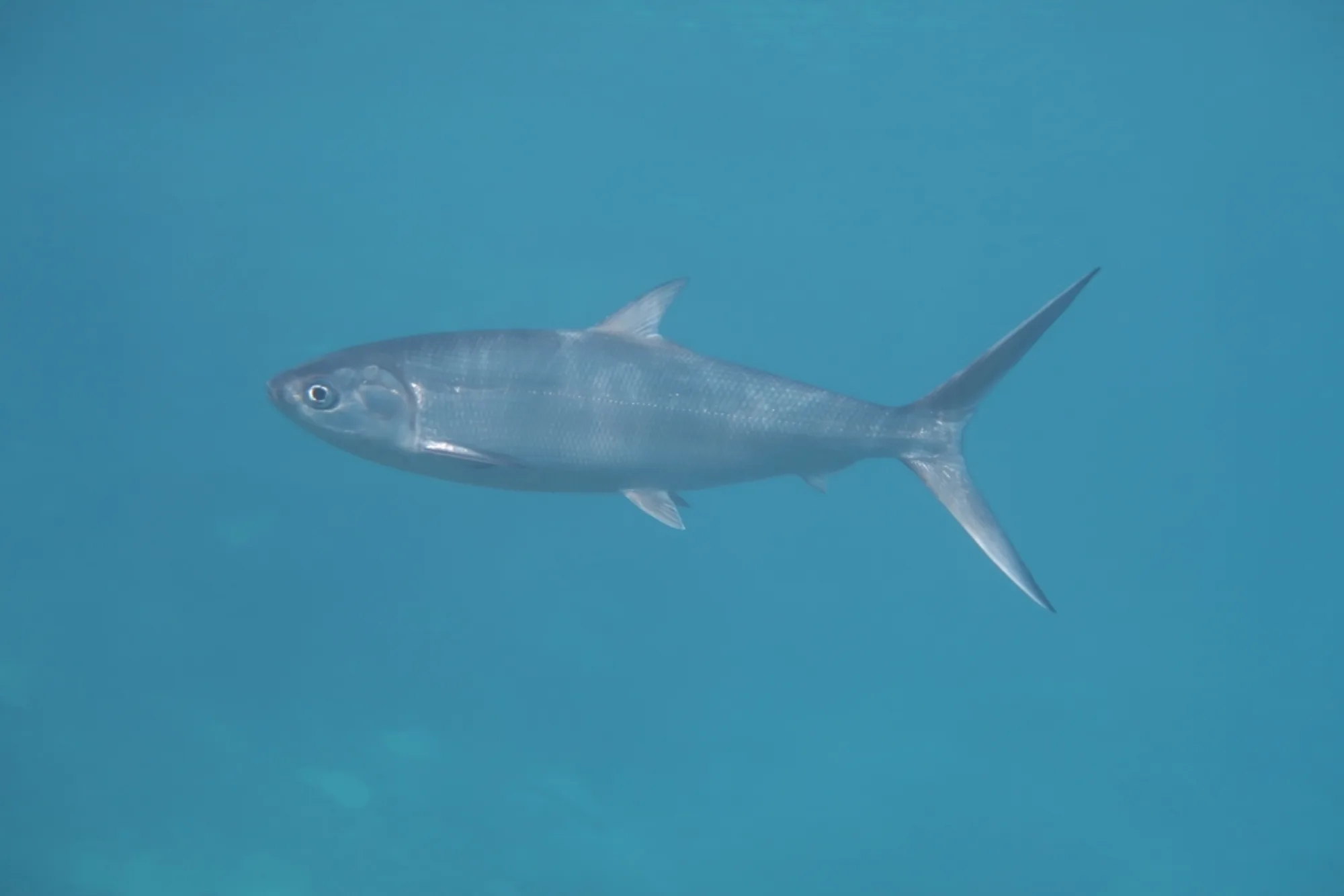
Silvery flanks and an olive-green back give the Milkfish its colour, while its streamlined body ends in a large forked tail. It has a relatively small head and a small, toothless mouth, and its fins have dark edges. Most are no longer than 1 m, although they can reach 1.80 m. Other Indo-Pacific fish share its silvery appearance, so colour alone can make identification difficult. Milkfish occur across the Indian and Pacific oceans, ranging between South Africa and the islands of Hawaii and the Marquesas, as well as between California and the Galapagos. Their range also reaches north to Japan and south to Australia. They commonly inhabit tropical waters offshore around islands and along continental shelves, usually at depths of 1 to 30 m, but also enter estuaries and rivers.
Adults tend to gather in schools near coasts and islands with coral reefs. Young fry spend two to three weeks at sea before moving into mangrove swamps, estuaries and sometimes lakes; they later return to the sea to mature and reproduce. Juveniles favour calm, shallow, sheltered coastal habitats with plenty of aquatic vegetation. Opportunistic feeders, young fish eat plankton, green algae and small invertebrates, while adults also take bottom-dwelling invertebrates and young fish. Spawning occurs at night in warm, clear, shallow water over sand or coral reefs, and is strongly seasonal. Females can spawn more than once a year. Little is known about wild stocks, but pollution poses a threat: milkfish can ingest or absorb contaminants from industrial waste, runoff and plastics. In the Philippines, adult fish are still caught accidentally in fish corrals and as bycatch.
Written from the English Wikipedia article Milkfish (CC BY-SA 4.0).
- Records
- 806
- Countries
- 25
- Atlas places
- 5
These are open occurrence records, so they show where people looked for and recorded the Milkfish as much as where it lives. Cells are up to 25 km across, and every location is generalised to its cell.
Generalised encounter areas, not exact locations. Each shape is a grid cell coloured by how likely the species is there.
- Very likelyPanama25 km zone · high confidence · 148 records · updated 80 days ago
- Very likelyAustralia25 km zone · medium confidence · 130 records · updated 80 days ago
- Very likelyTaiwan25 km zone · medium confidence · 95 records · updated 80 days ago
- Very likelyU.S. Outlying Islands25 km zone · medium confidence · 91 records · updated 80 days ago
- Very likelyNew Caledonia25 km zone · high confidence · 84 records · updated 80 days ago
- Very likelySeychelles25 km zone · medium confidence · 70 records · updated 80 days ago
- Very likelyEcuador25 km zone · medium confidence · 48 records · updated 80 days ago
- Very likelyFrench Polynesia25 km zone · medium confidence · 23 records · updated 80 days ago
- LikelyUnited States25 km zone · medium confidence · 19 records · updated 80 days ago
- LikelyMexico25 km zone · medium confidence · 17 records · updated 80 days ago
Conservation status not assessed here yet, so every location is generalised to its grid cell.