Common Caiman
Caiman crocodilus
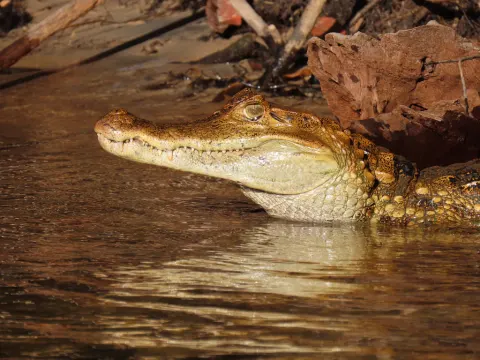
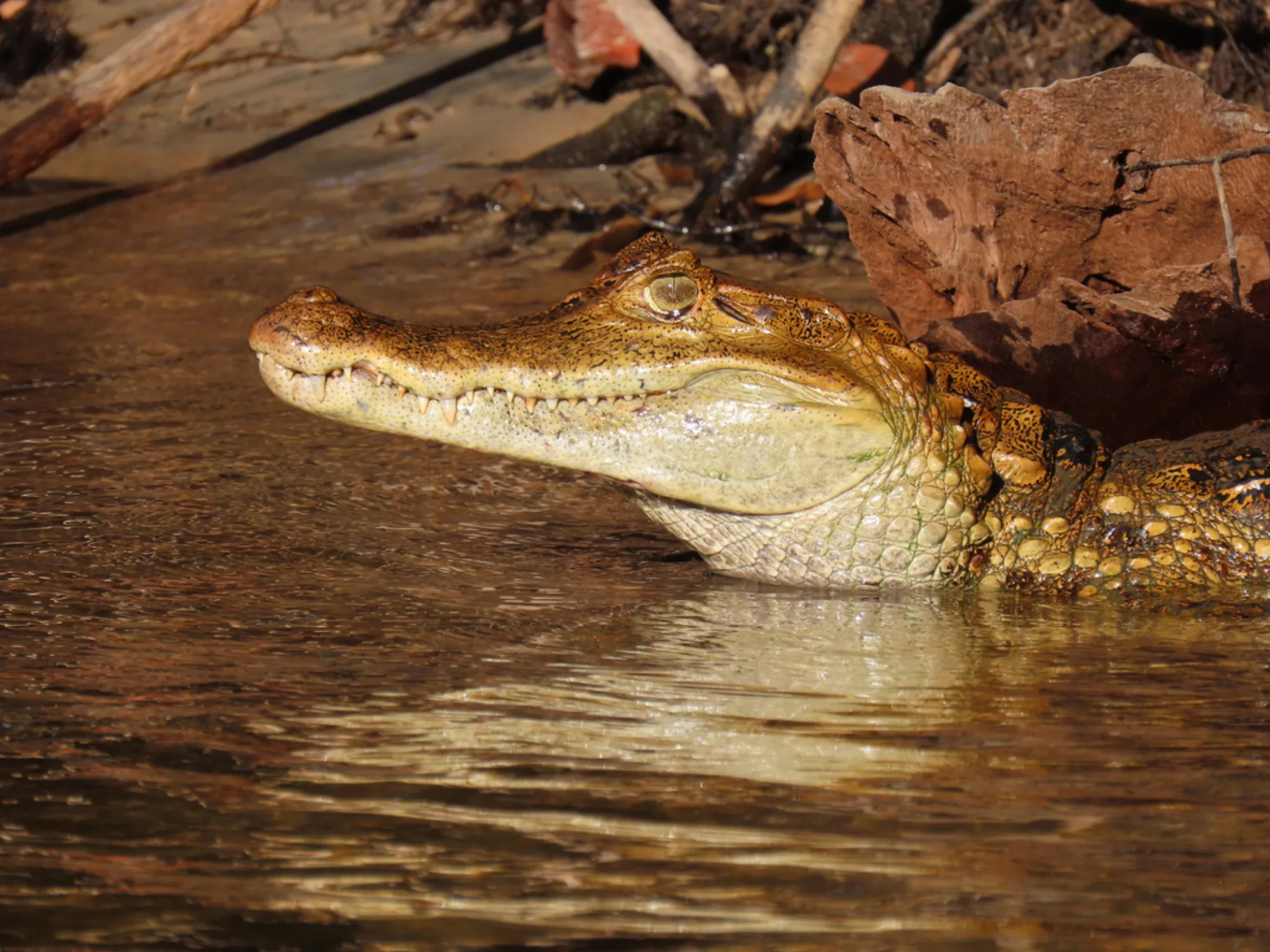
A ridge between the eyes gives the Common Caiman the appearance of wearing spectacles, and its other common name, spectacled caiman. This small to medium-sized crocodilian has a brownish, greenish or yellowish-grey back with dark brown bands and a lighter underside. Males are generally longer and heavier than females, and large mature males can reach 2.0 to 2.5 m.
Native to much of Latin America, the caiman lives from Mexico through parts of Central and South America, and has also been introduced to Cuba, Puerto Rico and Florida. It uses many habitats, including forests, wetlands, rivers, grasslands and savannas, favouring calm water with floating vegetation in places that flood and dry with the seasons. Low-lying areas hold the greatest numbers, and the caiman can also live near people. Usually still while resting on a shore or partly in the water, it can move quickly when threatened. It usually hunts at night, eating mainly snails and freshwater crabs in the wet season and mostly fish in the dry season. Insects and freshwater shrimp make up more of the diet of smaller caimans, while larger ones more often take mammals and fish.
Females build mounds of vegetation near water and lay 14 to 40 eggs in July and August. They stay near their nests during incubation, and parents care for the young in groups for 12 to 18 months. Nest raiders include lizards, coatis and foxes, while flooding and human egg collecting also threaten eggs. Young caimans face predators including birds, large fish, snakes and other crocodilians. Hunting for skins has reduced some populations, and the species is severely threatened in Colombia.
Written from the English Wikipedia article Spectacled caiman (CC BY-SA 4.0).
- Records
- 975
- Countries
- 16
- Atlas places
- 12
- Osa Peninsula· Costa Rica
- Tambopata National Reserve· Peru
- Tortuguero· Costa Rica
- Cuyabeno Wildlife Reserve· Ecuador
- Manú National Park· Peru
- Corcovado· Costa Rica
- Yasuní National Park· Ecuador
- Manuel Antonio· Costa Rica
- Anavilhanas National Park· Brazil
- Arenal· Costa Rica
- Everglades National Park· United States
- Pacaya-Samiria National Reserve· Peru
These are open occurrence records, so they show where people looked for and recorded the Common Caiman as much as where it lives. Cells are up to 25 km across, and every location is generalised to its cell.
Generalised encounter areas, not exact locations. Each shape is a grid cell coloured by how likely the species is there.
- Very likelyCosta Rica25 km zone · medium confidence · 322 records · updated 80 days ago
- Very likelyPanama25 km zone · medium confidence · 175 records · updated 80 days ago
- Very likelyVenezuela25 km zone · high confidence · 128 records · updated 80 days ago
- Very likelyColombia25 km zone · medium confidence · 106 records · updated 80 days ago
- Very likelyBrazil25 km zone · medium confidence · 59 records · updated 80 days ago
- Very likelyPeru25 km zone · medium confidence · 56 records · updated 80 days ago
- Very likelyFrench Guiana25 km zone · medium confidence · 38 records · updated 80 days ago
- Very likelyEcuador25 km zone · medium confidence · 27 records · updated 80 days ago
- Very likelyTrinidad & Tobago25 km zone · medium confidence · 20 records · updated 80 days ago
- Very likelyNicaragua25 km zone · medium confidence · 12 records · updated 80 days ago
Conservation status not assessed here yet, so every location is generalised to its grid cell.