Terciopelo
Bothrops asper
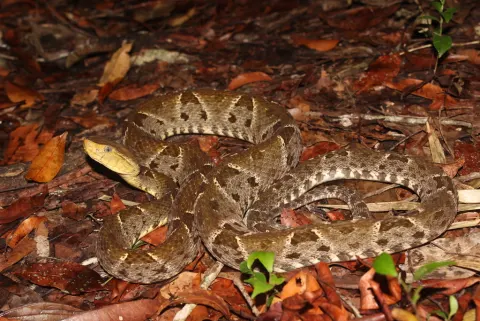
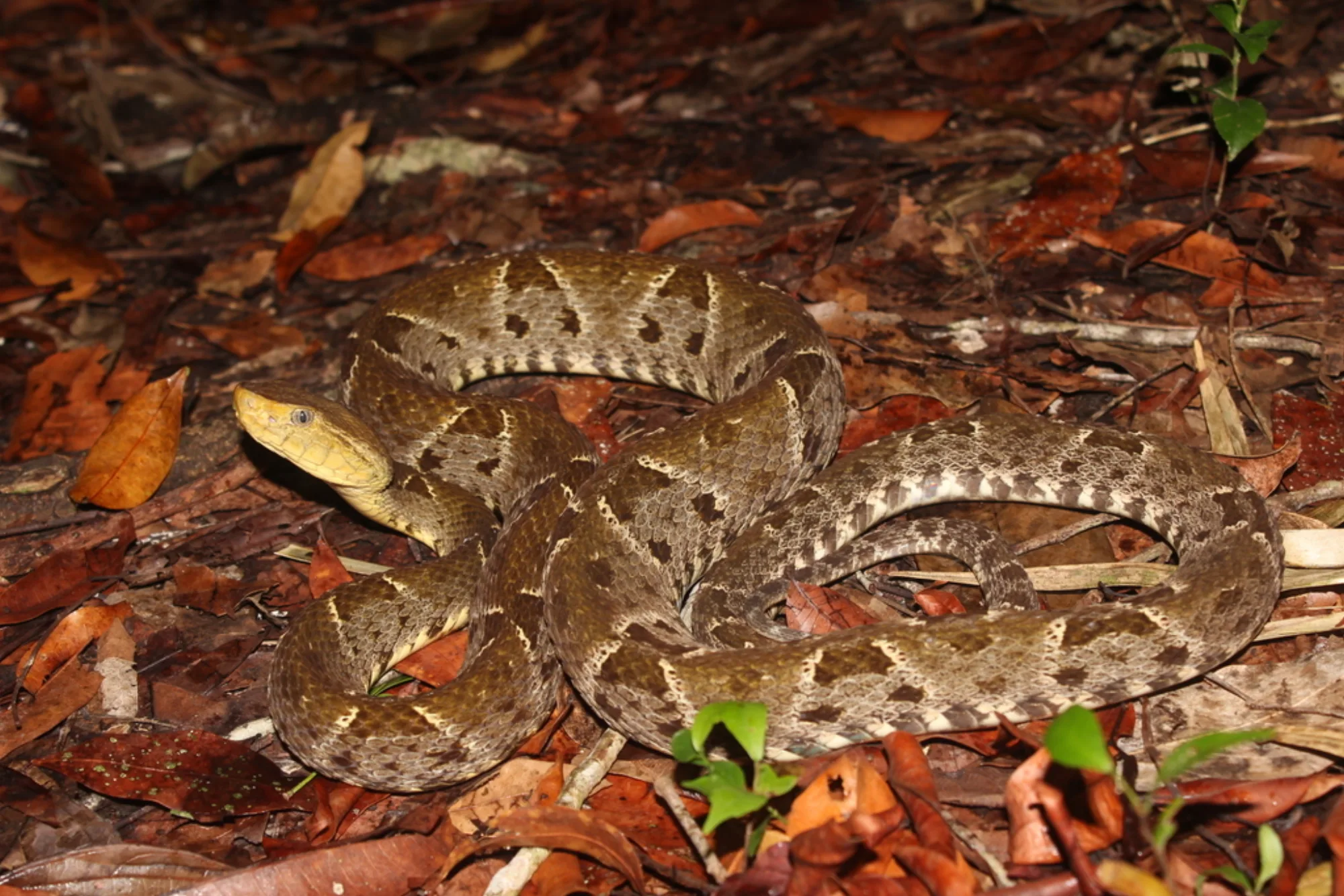
Brown, heavily built and often marked with yellow zigzags, the Terciopelo (Bothrops asper) is a large venomous pit viper of Central and northern South America. Its colour ranges from olive and grey to brown or nearly black, and dark triangles with pale edges mark its sides. Most measure 1.2 to 1.8 metres, though exceptionally large females can reach 2.5 metres. Its range extends from north-east Mexico through Central America to countries including Colombia, Ecuador, Guyana and Venezuela, with a few records from northern coastal Peru. It also occurs on Trinidad and Gorgona, an island off Colombia's Pacific coast. Mostly a lowland snake, it favours moist places, especially tropical rainforest and evergreen forest. It also uses drier forests and pine savannah near water, and has been recorded in cloud forest and other higher-elevation habitats.
Usually solitary and active at night, the Terciopelo may bask by day near rivers and streams. At night it waits, concealed in leaf litter or beneath forest cover, to ambush animals such as rats and mice. Young snakes often spend time in vegetation and use their contrasting tail tips to lure prey; adults are sometimes found in bushes and low trees too. Its varied diet includes frogs, lizards, birds and small mammals, and it also scavenges dead frogs and rodents. Breeding is seasonal, with birth times and litter sizes varying between populations; in Costa Rica, reproductive cycles are closely linked to rainfall. The snake generally avoids people and other large animals, but can defend itself vigorously when cornered or threatened.
Written from the English Wikipedia article Bothrops asper (CC BY-SA 4.0).
- Records
- 755
- Countries
- 9
- Atlas places
- 7
These are open occurrence records, so they show where people looked for and recorded the Terciopelo as much as where it lives. Cells are up to 25 km across, and every location is generalised to its cell.
Generalised encounter areas, not exact locations. Each shape is a grid cell coloured by how likely the species is there.
- Very likelyCosta Rica25 km zone · medium confidence · 289 records · updated 80 days ago
- Very likelyMexico25 km zone · medium confidence · 200 records · updated 80 days ago
- Very likelyColombia25 km zone · medium confidence · 149 records · updated 80 days ago
- Very likelyPanama25 km zone · medium confidence · 58 records · updated 80 days ago
- Very likelyEcuador25 km zone · medium confidence · 20 records · updated 80 days ago
- Very likelyNicaragua25 km zone · medium confidence · 8 records · updated 80 days ago
- LikelyBelize25 km zone · medium confidence · 15 records · updated 80 days ago
- LikelyHonduras25 km zone · medium confidence · 15 records · updated 80 days ago
- PossibleGuatemala25 km zone · low confidence · 1 record · updated 80 days ago
Conservation status not assessed here yet, so every location is generalised to its grid cell.