Central American Boa
Boa imperator
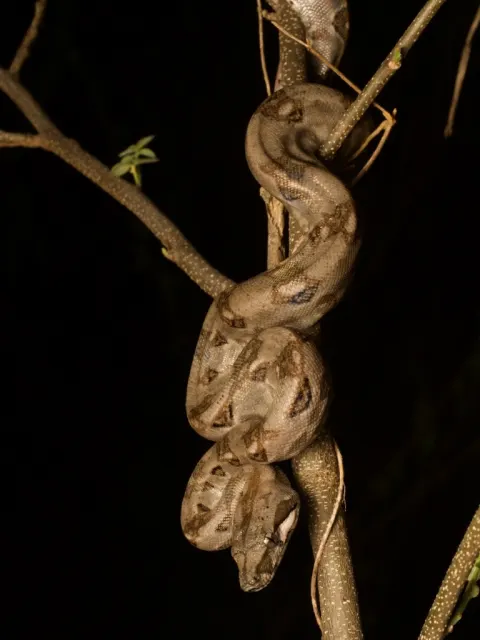
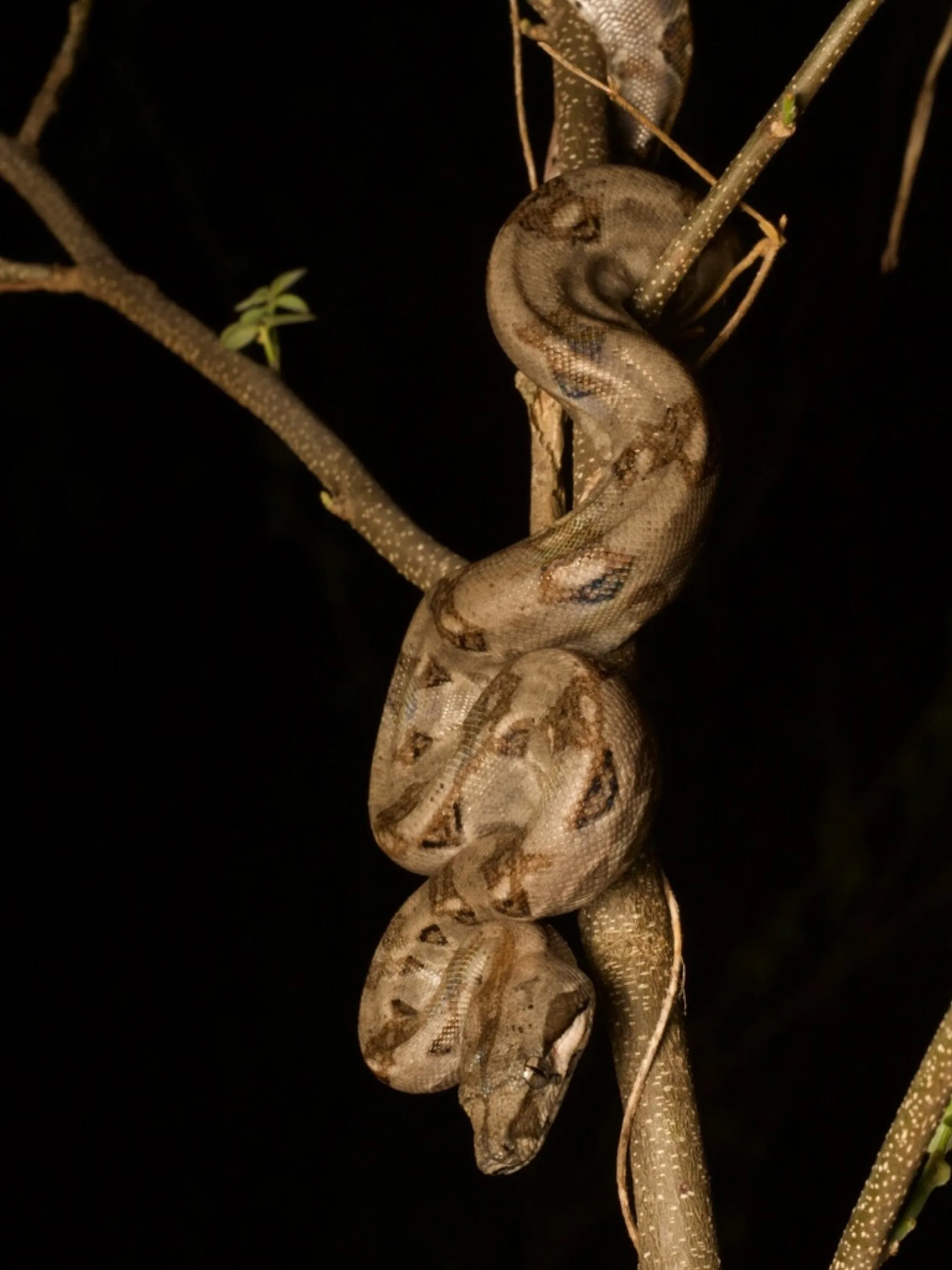
Heavy-bodied and nonvenomous, the Central American Boa is a constrictor whose appearance can change considerably from one locality to another. Fully grown snakes average 1.3 m to 2.5 m long, though some reach 3.7 m, and females are considerably larger than males. The tail is often dark brown or very dark red, while boas from Nicaragua typically have compact saddle markings with rounded shapes across their backs. On the Cayos Cochinos off northern Honduras, a naturally lighter population retains a darkened tail tip that can range from salmon-pink to orange.
Its range extends from parts of Mexico through Central America to northwestern Colombia, including several islands off those coasts. It favours rainforest, where humidity, temperature, cover and plentiful prey suit it. Usually solitary, it is active around twilight, although it may bask during the day when nights are too cold. Young boas climb trees and shrubs in search of food, while older, heavier snakes spend most of their time on the ground. They hunt by ambush and use constriction to subdue prey, taking mainly mammals, birds and lizards. Bats may be caught in trees, at cave entrances or in abandoned houses, and the prey taken grows larger as the snake ages.
Boas strike when threatened, and those from Central America may hiss loudly and strike repeatedly if disturbed. The species has long been common in the pet trade, and wild snakes are sometimes captured illegally for that trade. Confinement and stress during shipping can kill captured snakes, although widespread captive breeding has reduced pressure on wild populations.
Written from the English Wikipedia article Boa imperator (CC BY-SA 4.0).
- Records
- 653
- Countries
- 10
- Atlas places
- 7
These are open occurrence records, so they show where people looked for and recorded the Central American Boa as much as where it lives. Cells are up to 25 km across, and every location is generalised to its cell.
Generalised encounter areas, not exact locations. Each shape is a grid cell coloured by how likely the species is there.
- Very likelyEcuador25 km zone · medium confidence · 323 records · updated 80 days ago
- Very likelyMexico25 km zone · medium confidence · 165 records · updated 80 days ago
- Very likelyCosta Rica25 km zone · medium confidence · 86 records · updated 80 days ago
- Very likelyPanama25 km zone · medium confidence · 45 records · updated 80 days ago
- Very likelyHonduras25 km zone · medium confidence · 13 records · updated 80 days ago
- Very likelyGuatemala25 km zone · medium confidence · 3 records · updated 80 days ago
- LikelyBelize25 km zone · medium confidence · 12 records · updated 80 days ago
- LikelyEl Salvador25 km zone · medium confidence · 3 records · updated 80 days ago
- LikelyNicaragua25 km zone · medium confidence · 2 records · updated 80 days ago
- PossibleColombia25 km zone · medium confidence · 1 record · updated 80 days ago
Conservation status not assessed here yet, so every location is generalised to its grid cell.