Common Basilisk
Basiliscus basiliscus
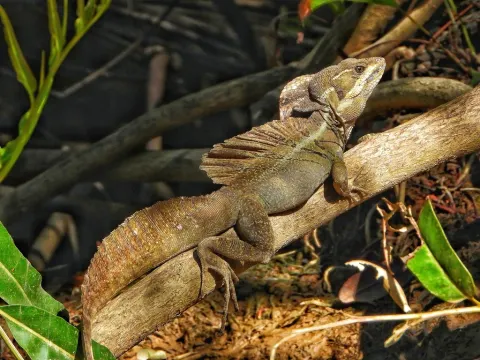
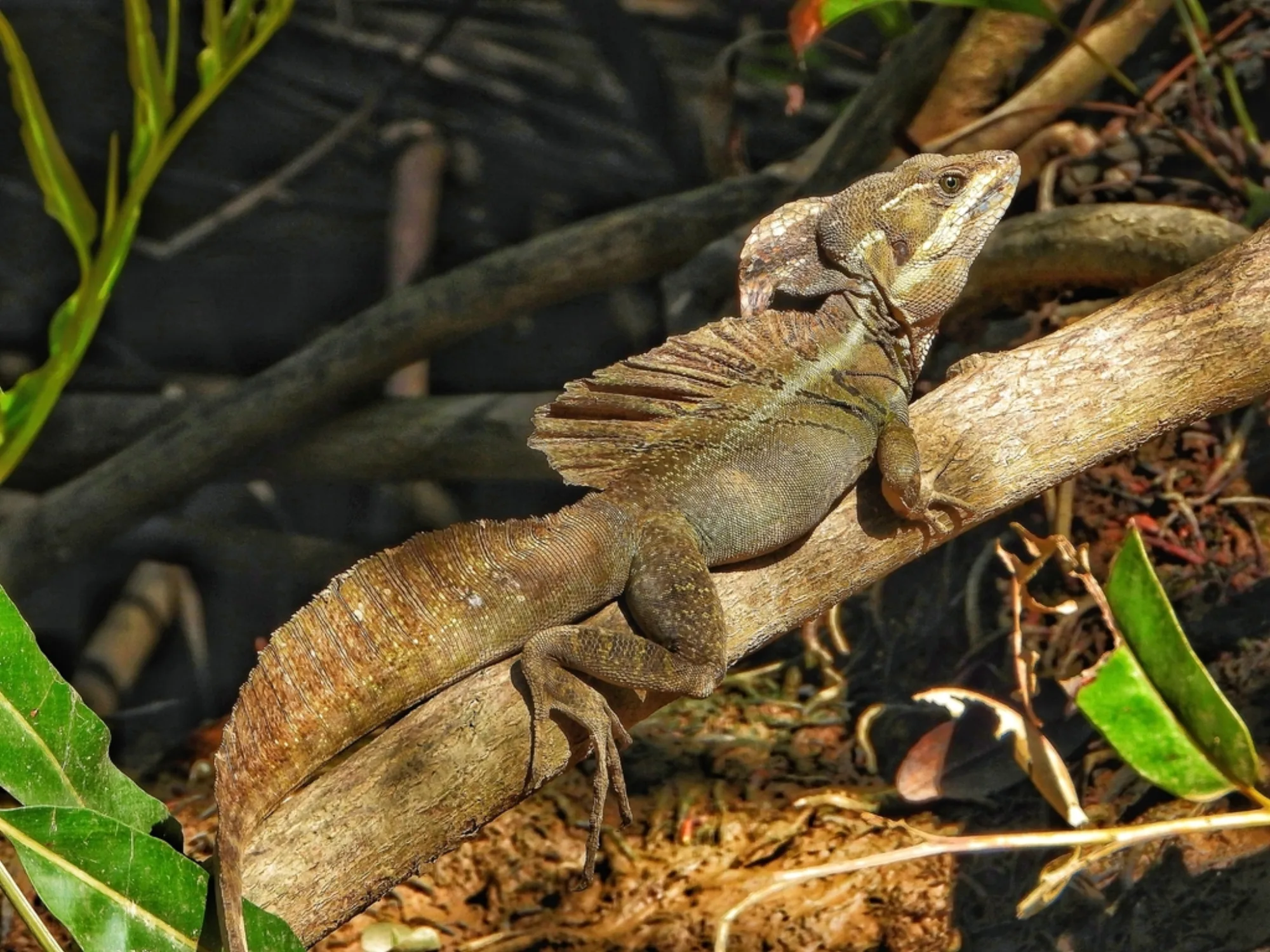
Along rainforest rivers and streams in Central America and northwestern South America, the Common Basilisk can be recognised by its large size and high, fin-like crest along its back. This lizard is usually brown and cream, with a pale stripe on its upper lip and another along each side of its body. The stripes stand out more in young lizards and fade with age, while males also have high crests on their heads and tails. Adults can reach 76 cm in total length, including the tail.
Look for it in tropical rainforest at low elevations, usually from sea level to 600 m, although in parts of Costa Rica it occurs as high as 1,200 m. On the Pacific side, its range stretches between southwestern Nicaragua and northwestern Colombia; on the Atlantic side, it runs between central Panama and northwestern Venezuela. Within Costa Rica, most records are on the Pacific side. It eats insects such as beetles and dragonflies, as well as flowers, eggs, fish, snakes and birds. Females lay three to four clutches of 10 to 20 eggs each year, and the eggs hatch after about three months.
When startled, a basilisk may race towards the water and continue across its surface on its hind legs. Younger lizards can cover 10 to 20 m this way, while adults travel only a few metres before sinking. It is also a capable climber and swimmer, able to remain submerged for as long as half an hour. Large reptiles, birds and some mammals prey on it, and aquatic animals pose a danger too. To avoid predators, it can hide beneath leaves on the forest floor and stay motionless for a long time.
Written from the English Wikipedia article Common basilisk (CC BY-SA 4.0).
- Records
- 1,035
- Countries
- 3
- Atlas places
- 5
These are open occurrence records, so they show where people looked for and recorded the Common Basilisk as much as where it lives. Cells are up to 25 km across, and every location is generalised to its cell.
Generalised encounter areas, not exact locations. Each shape is a grid cell coloured by how likely the species is there.
- Very likelyCosta Rica25 km zone · medium confidence · 612 records · updated 80 days ago
- Very likelyPanama25 km zone · high confidence · 325 records · updated 80 days ago
- Very likelyColombia25 km zone · medium confidence · 98 records · updated 80 days ago
Conservation status not assessed here yet, so every location is generalised to its grid cell.