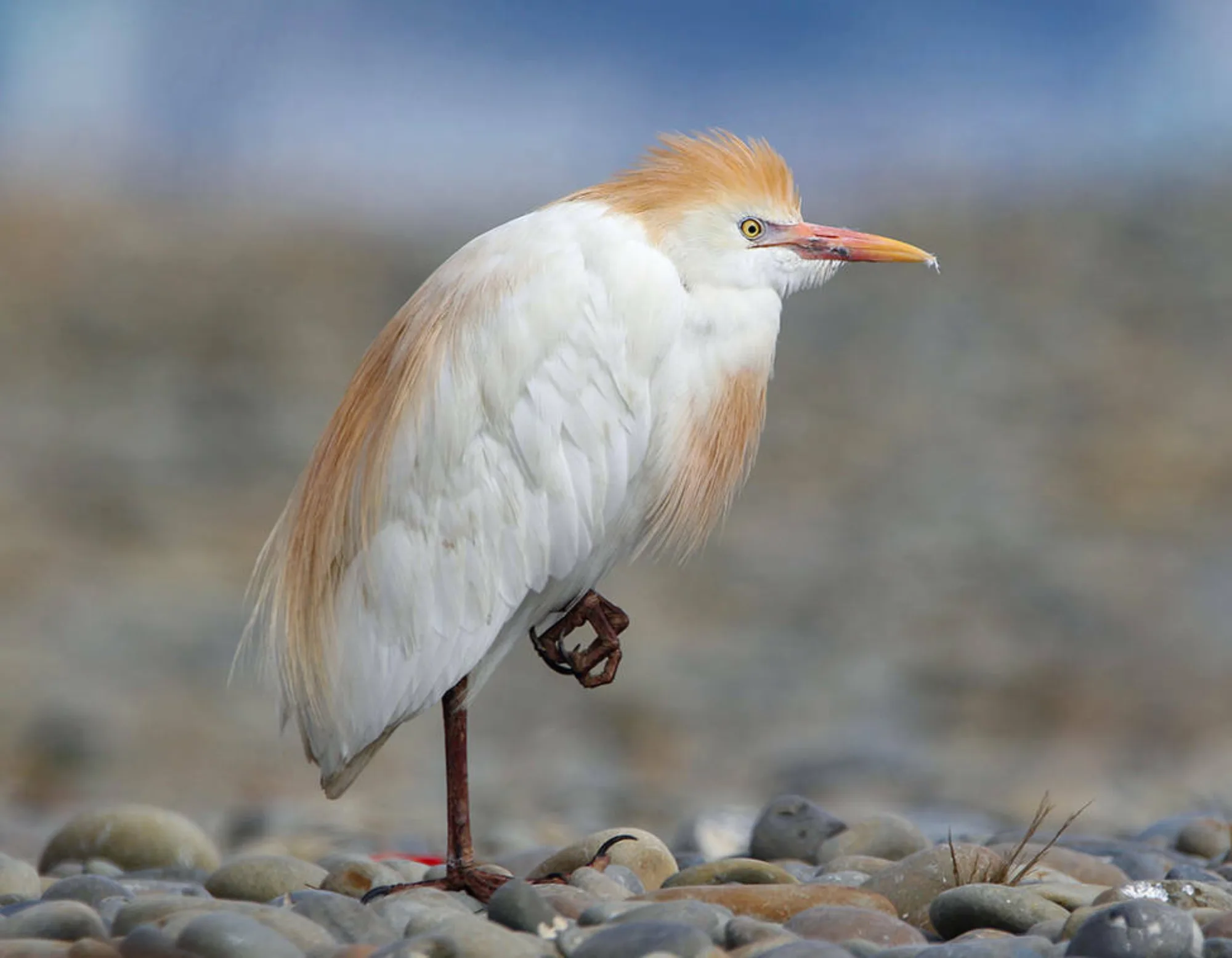
Ardea ibis
Look for the western cattle egret, Ardea ibis, in open country, often close to grazing animals. This stocky white heron holds its compact neck and strong bill in a hunched posture; outside the breeding season, adults have a yellow bill and greyish-yellow legs. In the western subspecies, breeding adults develop orange-buff feathers across the crown, breast and back; juveniles have black bills and no coloured plumes. Away from its breeding colony, it is largely silent.
Native to parts of Africa, western Asia and southern Europe, the species has expanded across much of the New World and into other parts of Europe. It favours fields and dry grassland, but also feeds in pastures, farmland, wetlands, rice paddies and seasonally flooded grasslands. Some populations migrate, while others disperse after breeding, and birds can travel across seas and oceans.
Cattle egrets often follow cattle and other large mammals, catching small creatures disturbed as the animals move. Their varied diet includes grasshoppers, crickets, flies, moths, spiders, frogs and earthworms; they also take ticks and flies from cattle. They nest in colonies, often near water and sometimes alongside other wetland birds, building small platforms of sticks in trees or shrubs. Both parents incubate the eggs, usually three or four, and the young become independent at around 45 days. Adult birds have few predators, but starvation is a major cause of nesting deaths, and chicks can also suffer from calcium deficiency. Birds and mammals may raid nests, while nearby large birds can dislodge nests or cause chicks to fall.
Written from the English Wikipedia article Western cattle egret (CC BY-SA 4.0).
- Records
- 1,015,445
- Countries
- 25
- Atlas places
- 8
These are open occurrence records, so they show where people looked for and recorded the Ardea ibis as much as where it lives. Cells are up to 25 km across, and every location is generalised to its cell.
Generalised encounter areas, not exact locations. Each shape is a grid cell coloured by how likely the species is there.
- Very likelyUnited States25 km zone · high confidence · 563764 records · updated 80 days ago
- Very likelyColombia25 km zone · high confidence · 73360 records · updated 80 days ago
- Very likelyCosta Rica25 km zone · high confidence · 66186 records · updated 80 days ago
- Very likelySpain25 km zone · high confidence · 65042 records · updated 80 days ago
- Very likelySouth Africa25 km zone · high confidence · 55656 records · updated 80 days ago
- Very likelyPortugal25 km zone · high confidence · 26718 records · updated 80 days ago
- Very likelyMexico25 km zone · high confidence · 26658 records · updated 80 days ago
- Very likelyIsrael25 km zone · high confidence · 22185 records · updated 80 days ago
- Very likelyPuerto Rico25 km zone · high confidence · 14646 records · updated 80 days ago
- Very likelyEcuador25 km zone · high confidence · 12533 records · updated 80 days ago
Conservation status not assessed here yet, so every location is generalised to its grid cell.