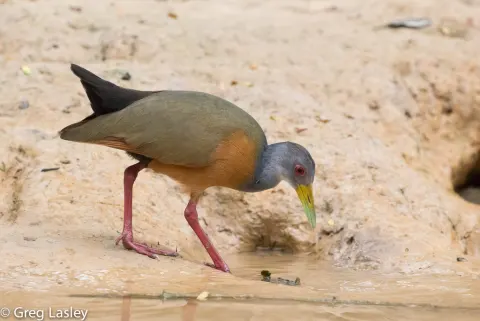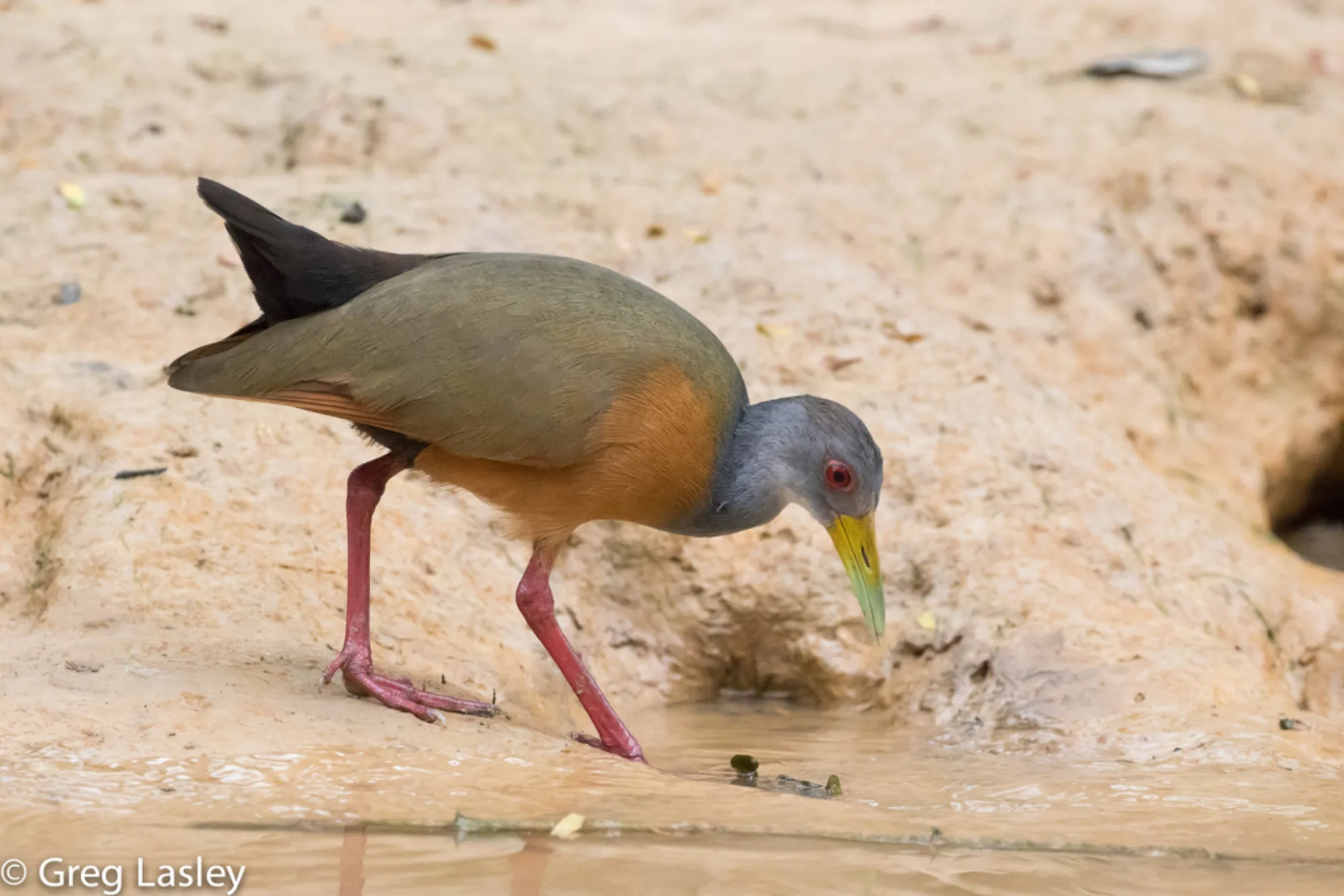
Aramides cajaneus
A grey head, coral-red legs and a bright greenish-yellow bill make the grey-cowled wood rail, Aramides cajaneus, a striking bird to look for in Central and South America. Large for a wood rail, it usually measures 33 to 40 centimetres long. Its back ranges from olive-green to dark brown, while its chest and sides are rufous and its belly, rump and tail are black. The sexes look alike, but young birds are duller, with dusky bills and legs and brownish eyes.
Its range extends from Costa Rica through parts of South America to northern Argentina and Uruguay, as well as Trinidad. Look for it in moist lowland forest, mangroves and swamps, generally from sea level to around 2,000 metres. It can perch in shrubs or trees and rarely flies, though a startled bird will usually retreat to a low branch. Listen around dawn and dusk for its loud, repetitive cackling, sometimes given as a duet or chorus. Generally wary and secretive, it has nevertheless been seen feeding in short grass near thickets, in streams and on muddy tracks.
The rail feeds at night, taking crabs in mangroves and a varied diet elsewhere that includes snails, frogs, seeds, berries and palm fruits. It hammers snail shells to reach their contents and probes through leaf litter with its bill. Pairs remain together year-round, and breeding usually takes place from March to August, depending on location. Both parents incubate the three to seven eggs, and the chicks can move soon after hatching. Habitat destruction affects the bird, and in some places it is hunted or kept for food.
Written from the English Wikipedia article Grey-cowled wood rail (CC BY-SA 4.0).
- Records
- 117,683
- Countries
- 12
- Atlas places
- 14
- Osa Peninsula· Costa Rica
- Corcovado· Costa Rica
- Tambopata National Reserve· Peru
- Manuel Antonio· Costa Rica
- Arenal· Costa Rica
- Manú National Park· Peru
- Monteverde· Costa Rica
- Calilegua National Park· Argentina
- Chapada dos Veadeiros National Park· Brazil
- Cuyabeno Wildlife Reserve· Ecuador
- Iberá Park· Argentina
- Serra da Bodoquena National Park· Brazil
- Serra da Canastra National Park· Brazil
- Yasuní National Park· Ecuador
These are open occurrence records, so they show where people looked for and recorded the Aramides cajaneus as much as where it lives. Cells are up to 25 km across, and every location is generalised to its cell.
Generalised encounter areas, not exact locations. Each shape is a grid cell coloured by how likely the species is there.
- Very likelyCosta Rica25 km zone · high confidence · 29926 records · updated 80 days ago
- Very likelyBrazil25 km zone · high confidence · 23093 records · updated 80 days ago
- Very likelyColombia25 km zone · high confidence · 22394 records · updated 80 days ago
- Very likelyPanama25 km zone · high confidence · 17760 records · updated 80 days ago
- Very likelyArgentina25 km zone · high confidence · 12683 records · updated 80 days ago
- Very likelyPeru25 km zone · high confidence · 4298 records · updated 80 days ago
- Very likelyVenezuela25 km zone · high confidence · 3040 records · updated 80 days ago
- Very likelyUruguay25 km zone · high confidence · 1864 records · updated 80 days ago
- Very likelyBolivia25 km zone · high confidence · 1293 records · updated 80 days ago
- Very likelyEcuador25 km zone · high confidence · 581 records · updated 80 days ago
Conservation status not assessed here yet, so every location is generalised to its grid cell.