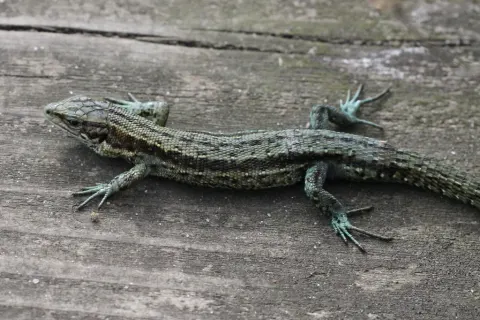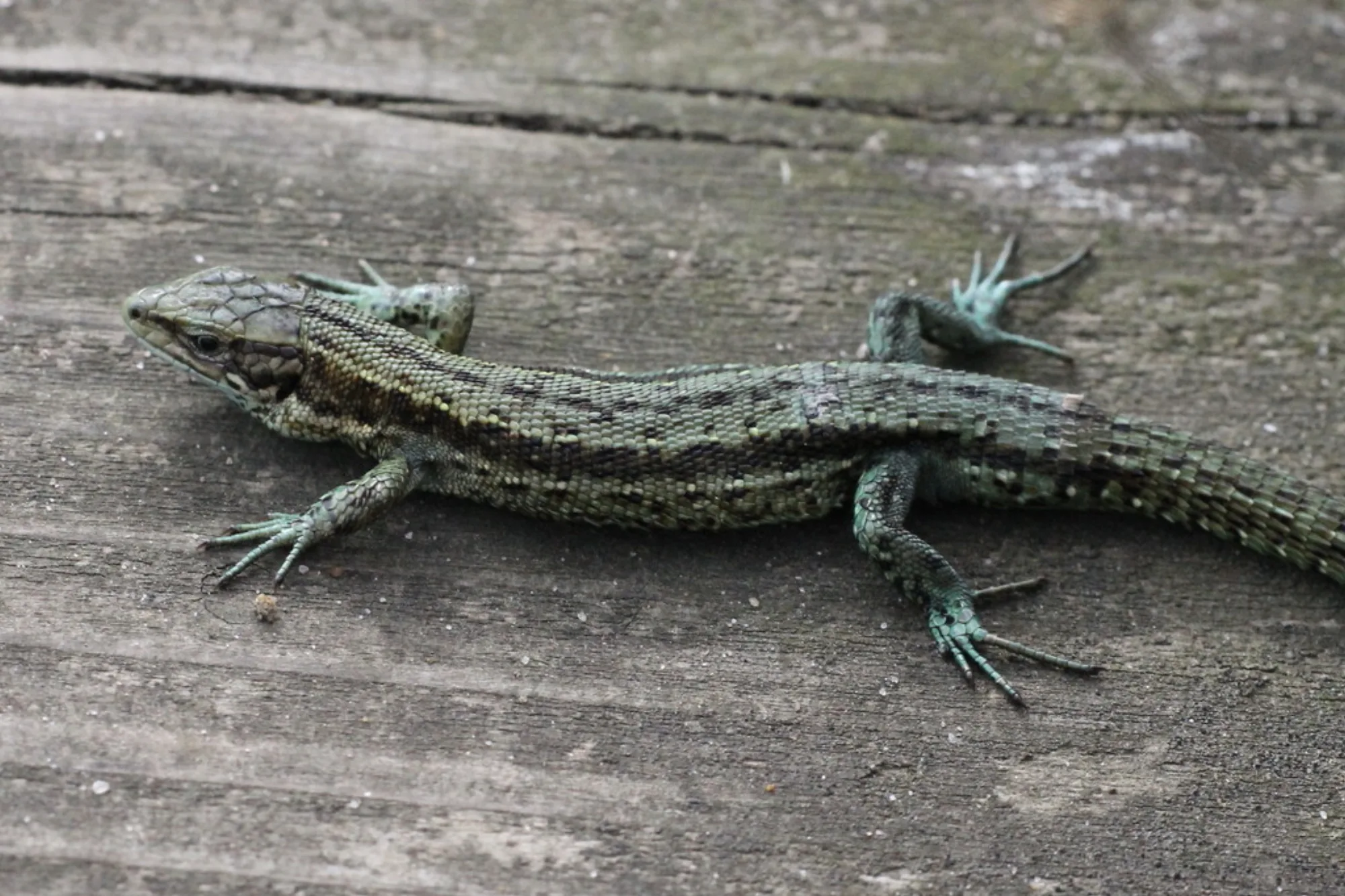
Viviparous Lizard
Zootoca vivipara
Small and often found close to the ground, the Viviparous Lizard (Zootoca vivipara) has an average length of 50 to 77 mm, with colouring that ranges from grey or brown to red, green or black. Males typically have spots along the back and brighter undersides, while females usually have dark stripes down their backs and sides. The species ranges across much of northern Eurasia, reaching into subarctic regions. In Europe, look for it mainly north of the Alps and Carpathians, including the British Isles; it also occurs in the Balkans and parts of northern Iberia. Its Asian range includes much of Russia and parts of northern Kazakhstan, Mongolia, China and Japan. Heathland, moorland, woodland and grassland are among its typical habitats.
Although it occasionally visits higher places, this lizard spends most of its time on the ground and much of it basking in the sun. It hibernates between October and March, and can survive extreme cold: some individuals freeze and thaw when warmer weather returns. Groundwater can warm the soil in its subarctic habitat, and the lizards find small refuges that remain above the freezing point of their body fluids. They actively hunt flies, spiders, moth larvae, mealworms and other small prey, with feeding rates increasing when there is more sunshine. The species can give birth to live young, though some populations lay eggs. Young lizards reach sexual maturity in their second year and typically live for 5 to 6 years. Predators include birds of prey, crows, snakes, hedgehogs, foxes and domestic cats, while parasitic worms and blood parasites also affect the species. Competition between lizards can reduce their survival, particularly where population density is high.
Written from the English Wikipedia article Viviparous lizard (CC BY-SA 4.0).
- Records
- 24,663
- Countries
- 17
No atlas park has a record of the Viviparous Lizard in or around it yet.
These are open occurrence records, so they show where people looked for and recorded the Viviparous Lizard as much as where it lives. Cells are up to 25 km across, and every location is generalised to its cell.
Generalised encounter areas, not exact locations. Each shape is a grid cell coloured by how likely the species is there.
- Very likelyUnited Kingdom25 km zone · high confidence · 12750 records · updated 80 days ago
- Very likelyFrance25 km zone · high confidence · 6413 records · updated 80 days ago
- Very likelyDenmark25 km zone · high confidence · 1389 records · updated 80 days ago
- Very likelyFinland25 km zone · high confidence · 916 records · updated 80 days ago
- Very likelyNetherlands25 km zone · high confidence · 825 records · updated 80 days ago
- Very likelyNorway25 km zone · high confidence · 693 records · updated 80 days ago
- Very likelyLuxembourg25 km zone · high confidence · 465 records · updated 80 days ago
- Very likelyBelgium25 km zone · high confidence · 277 records · updated 80 days ago
- Very likelyPoland25 km zone · high confidence · 202 records · updated 80 days ago
- Very likelyIreland25 km zone · high confidence · 142 records · updated 80 days ago
Conservation status not assessed here yet, so every location is generalised to its grid cell.