White-throated Sparrow
Zonotrichia albicollis
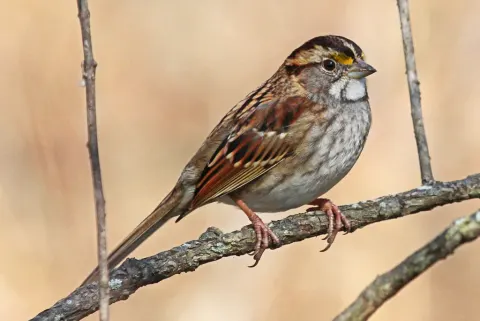
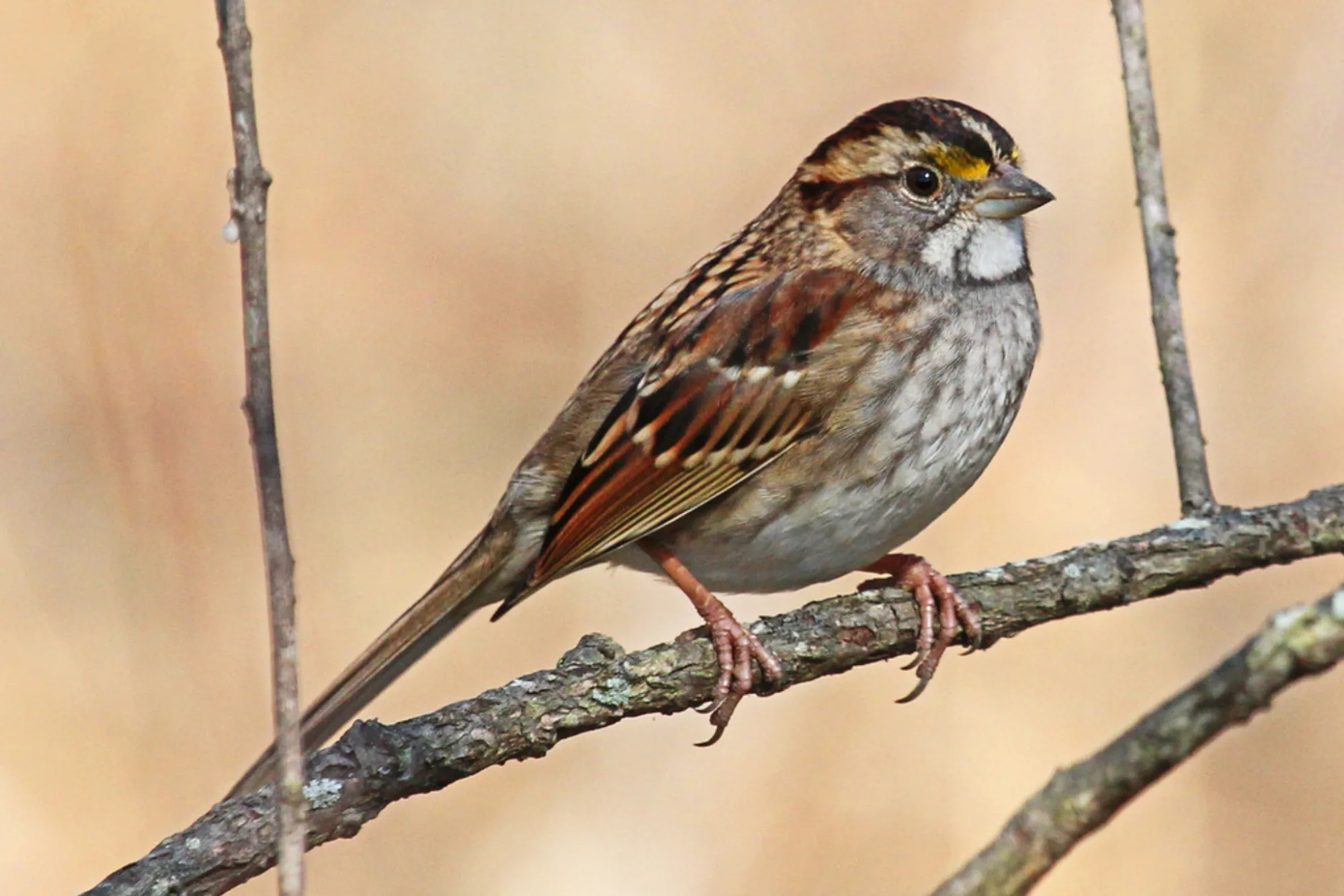
A bright white throat and yellow patches between the eyes and bill help distinguish the White-throated Sparrow from the similar white-crowned sparrow. This North American sparrow measures 15 to 19 cm long and has rufous wings crossed by two white bars. Adults come in two forms: one has a black crown with a white central stripe, while the other has a dark brown crown with a tan stripe. Both have dark eyes, a pale grey belly and a grey bill, and males and females look alike.
Look for it breeding in central Canada and New England, in deciduous or mixed forest, where it nests beneath shrubs or low in trees. It lays three to five blue or green-white eggs marked with brown. In winter it moves to the southern and eastern United States, though it remains year-round in Canada's Atlantic provinces. It is a rare visitor to western Europe and is among the most abundant native winter birds in eastern North America. Listen for a regular, somewhat pinched song, sometimes rendered as “O-oh sweet Canada, Canada, Canada”.
White-throated Sparrows search for food on the ground near thickets or among low plants, kicking backwards with both feet together. They eat mainly seeds, insects and berries, visit bird feeders, and take more insects and other small invertebrates in summer. Hawks, owls and mammalian carnivores prey on them, while competition can force them to feed in places where they face greater danger from predators. Building collisions are another threat: a study found the species particularly susceptible, possibly because artificial light and the birds' flight calls draw them towards buildings.
Written from the English Wikipedia article White-throated sparrow (CC BY-SA 4.0).
- Records
- 3,926,329
- Countries
- 16
- Atlas places
- 1
These are open occurrence records, so they show where people looked for and recorded the White-throated Sparrow as much as where it lives. Cells are up to 25 km across, and every location is generalised to its cell.
Generalised encounter areas, not exact locations. Each shape is a grid cell coloured by how likely the species is there.
- Very likelyUnited States25 km zone · high confidence · 3417781 records · updated 86 days ago
- Very likelyCanada25 km zone · high confidence · 506594 records · updated 86 days ago
- Very likelySt. Pierre & Miquelon25 km zone · high confidence · 1155 records · updated today
- PossibleUnited Kingdom25 km zone · high confidence · 243 records · updated today
- PossibleMexico25 km zone · high confidence · 153 records · updated today
- PossibleBermuda25 km zone · high confidence · 137 records · updated today
- PossibleSpain25 km zone · high confidence · 94 records · updated today
- PossibleFrance25 km zone · medium confidence · 63 records · updated today
- PossibleNorway25 km zone · medium confidence · 42 records · updated today
- UncommonDenmark25 km zone · medium confidence · 19 records · updated today
Conservation status not assessed here yet, so every location is generalised to its grid cell.