Cuvier's Beaked Whale
Ziphius cavirostris
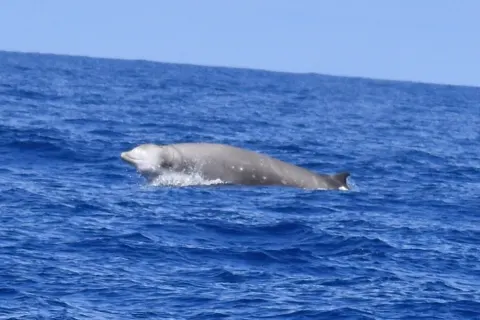
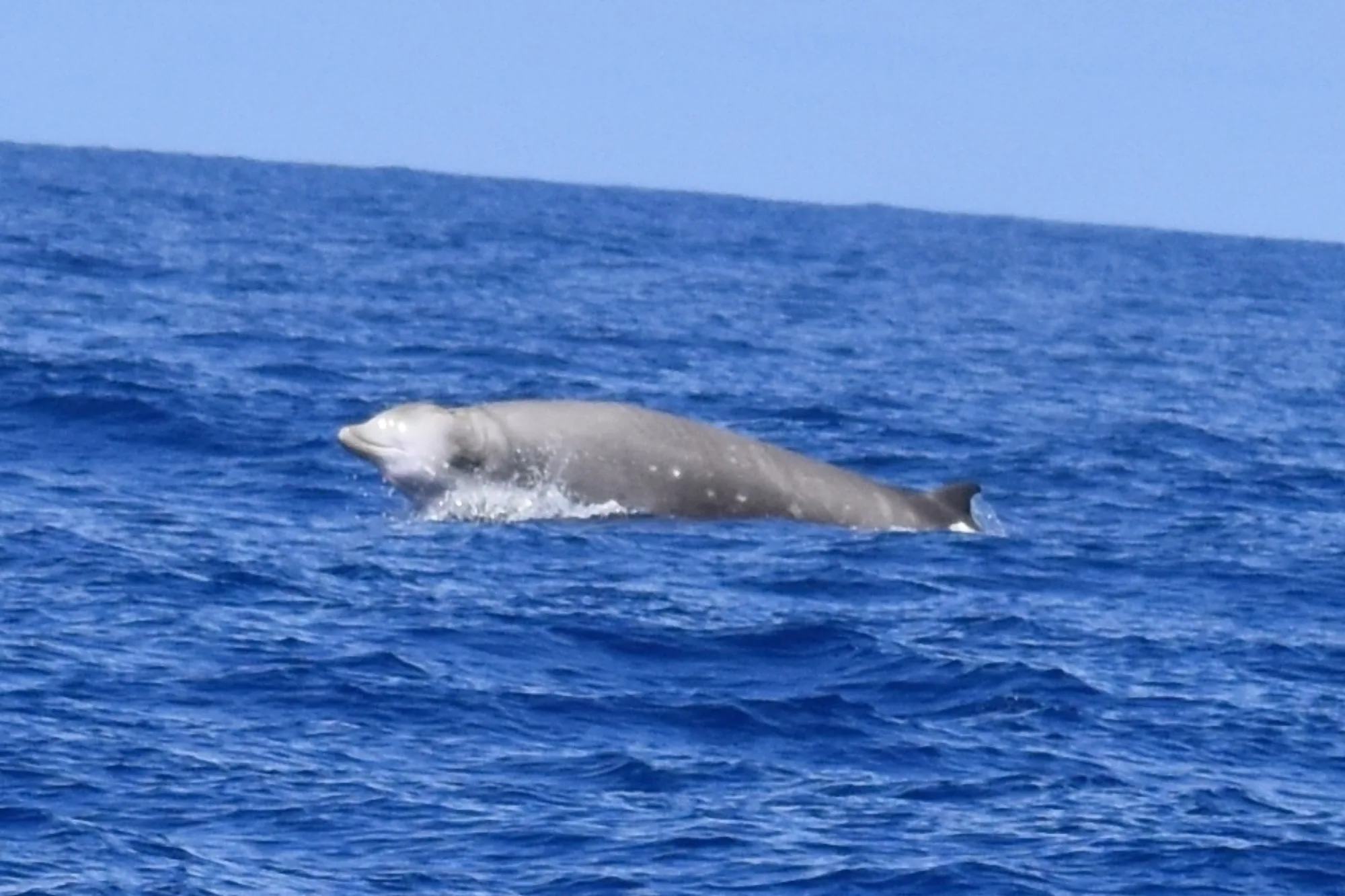
Far offshore, Cuvier's Beaked Whale moves through deep water with a robust, cigar-shaped body and a short, blunt head. Its small beak gives its profile a goose-like appearance. Adults measure about 4.5 to 8 metres and range in colour from dark grey to reddish-brown. Males often have a lighter grey or white head and numerous scars, which can help identify individual whales.
The species lives mainly in tropical, subtropical and temperate waters across three oceans: the Indian, Pacific and Atlantic. It also occurs in the Gulf of Mexico and the Mediterranean. It favours water deeper than 1,000 metres and is often found near underwater slopes, canyons and seamounts where prey is plentiful. Whales are typically seen in groups of two to seven, although groups can reach 30 to 40 individuals. They spend much of their time underwater, making deep feeding dives followed by several shorter, shallower dives, with only brief intervals at the surface. Their diet is mainly squid, supplemented by deep-sea fish and some crustaceans, and they use echolocation to find prey in dark water. Breeding and calving take place throughout the year, often in spring, and females give birth to one calf about every two to three years.
Fishing gear can accidentally trap these whales, and they have also been hunted, mainly in Japan. Loud underwater noise, especially naval sonar, can disrupt their behaviour and has been linked to mass strandings. In Hawaii, whales have been observed avoiding feeding dives or leaving an area where sonar is being used.
Written from the English Wikipedia article Cuvier's beaked whale (CC BY-SA 4.0).
- Records
- 358
- Countries
- 21
- Atlas places
- 4
These are open occurrence records, so they show where people looked for and recorded the Cuvier's Beaked Whale as much as where it lives. Cells are up to 25 km across, and every location is generalised to its cell.
Generalised encounter areas, not exact locations. Each shape is a grid cell coloured by how likely the species is there.
- Very likelyUnited States25 km zone · medium confidence · 138 records · updated 80 days ago
- Very likelyFrance25 km zone · medium confidence · 61 records · updated 80 days ago
- Very likelyItaly25 km zone · medium confidence · 28 records · updated 80 days ago
- Very likelyAustralia25 km zone · medium confidence · 25 records · updated 80 days ago
- Very likelyGuadeloupe25 km zone · medium confidence · 22 records · updated 80 days ago
- Very likelyTaiwan25 km zone · medium confidence · 16 records · updated 80 days ago
- Very likelyPortugal25 km zone · medium confidence · 13 records · updated 80 days ago
- Very likelyUnited Kingdom25 km zone · medium confidence · 13 records · updated 80 days ago
- LikelyMartinique25 km zone · medium confidence · 9 records · updated 80 days ago
- LikelyBahamas25 km zone · medium confidence · 7 records · updated 80 days ago
Conservation status not assessed here yet, so every location is generalised to its grid cell.