John Dory
Zeus faber
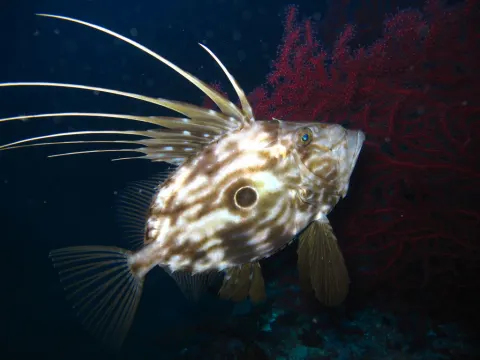
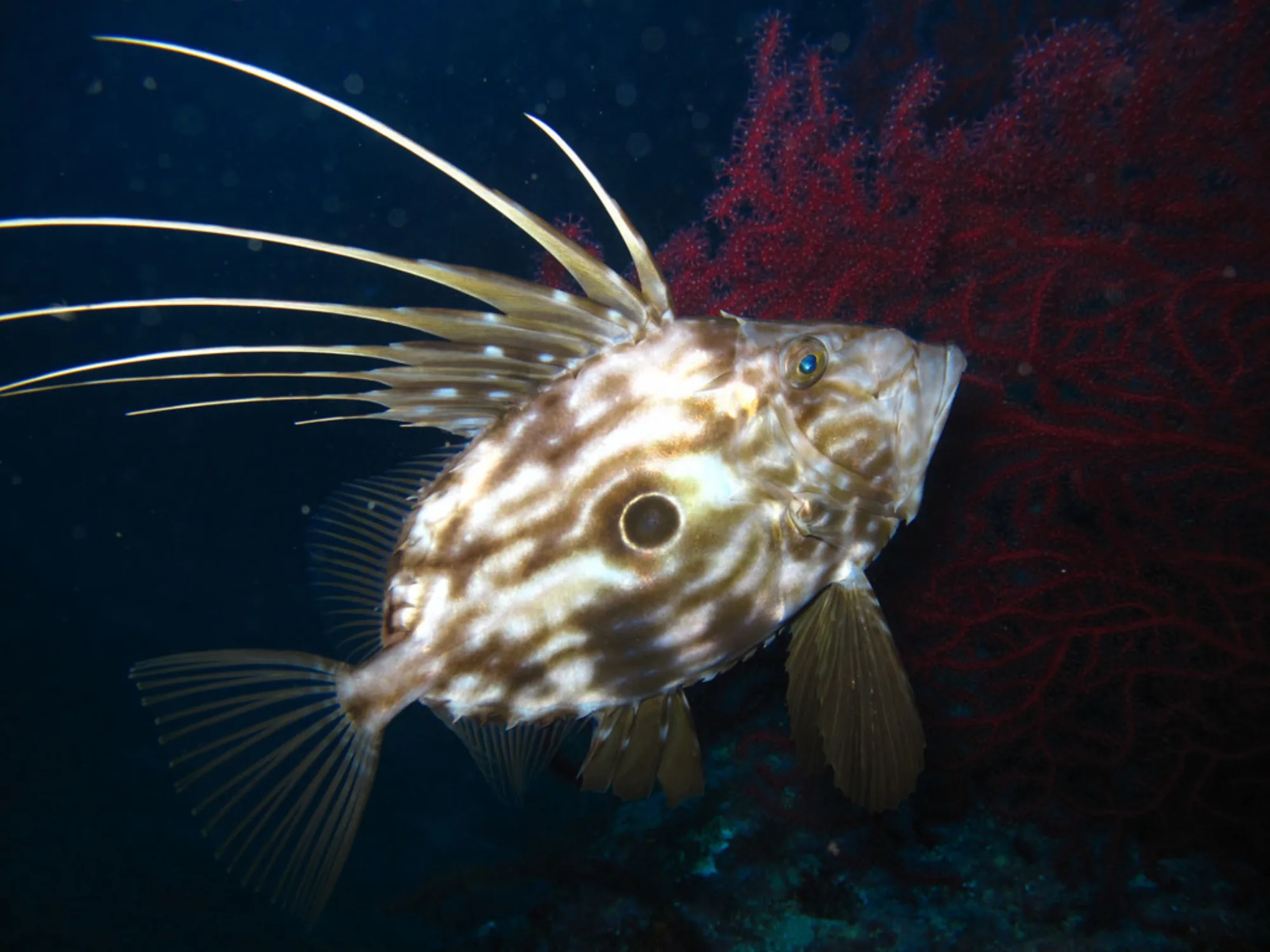
Seen from the side, the John Dory has a flat, rounded body, ranging in colour from yellowish-brown to olive green above a lighter greyish belly. A large dark spot marks its flank, while long spines rise from its dorsal fin. Its eyes sit near the top of its head, and its body is so thin that it can be hard to see from the front. It can reach 90 cm and 8 kg, although females are more typically 65 cm long and males 45 cm. Despite its striking shape, it is a poor swimmer.
This coastal marine fish lives close to the seabed, at depths of 5 to 360 metres. Its range includes the Mediterranean and the northeast Atlantic, from northern Africa and the coasts of southern and western Europe north to Norway. Few are found beyond southern England and Ireland. It also occurs off Southeast Asia, Japan, Australia and New Zealand, where it is more common around the North Island than in the colder waters around the South Island. John Dory usually live alone.
A hunter, the fish stalks its prey before extending its jaw and sucking it into its mouth. Its large eyes help it judge depth, while the dark spot on its side can confuse prey. Small schooling fish make up most of its diet, but it may also eat cephalopods and crustaceans. Sharks, including dusky sharks, and large bony fish prey on it. John Dory are ready to reproduce at three or four years old and lay eggs that become part of the plankton. In the wild, they typically live for about 12 years. They are also caught as bycatch.
Written from the English Wikipedia article John Dory (CC BY-SA 4.0).
- Records
- 2,814
- Countries
- 15
- Atlas places
- 2
These are open occurrence records, so they show where people looked for and recorded the John Dory as much as where it lives. Cells are up to 25 km across, and every location is generalised to its cell.
Generalised encounter areas, not exact locations. Each shape is a grid cell coloured by how likely the species is there.
- Very likelyNew Zealand25 km zone · medium confidence · 1926 records · updated 80 days ago
- Very likelyAustralia25 km zone · medium confidence · 293 records · updated 80 days ago
- Very likelyFrance25 km zone · medium confidence · 210 records · updated 80 days ago
- Very likelyUnited Kingdom25 km zone · medium confidence · 122 records · updated 80 days ago
- Very likelyNorway25 km zone · medium confidence · 51 records · updated 80 days ago
- Very likelyIreland25 km zone · medium confidence · 41 records · updated 80 days ago
- Very likelyIsle of Man25 km zone · medium confidence · 28 records · updated 80 days ago
- Very likelyTaiwan25 km zone · medium confidence · 27 records · updated 80 days ago
- Very likelyItaly25 km zone · medium confidence · 19 records · updated 80 days ago
- LikelyJapan25 km zone · medium confidence · 28 records · updated 80 days ago
Conservation status not assessed here yet, so every location is generalised to its grid cell.