Mourning Dove
Zenaida macroura
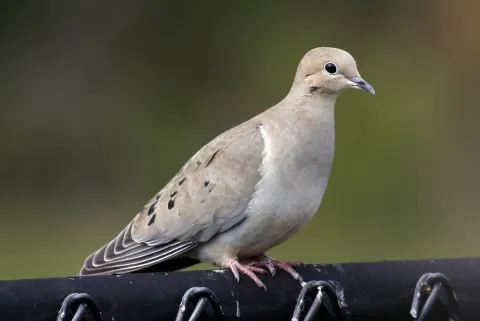
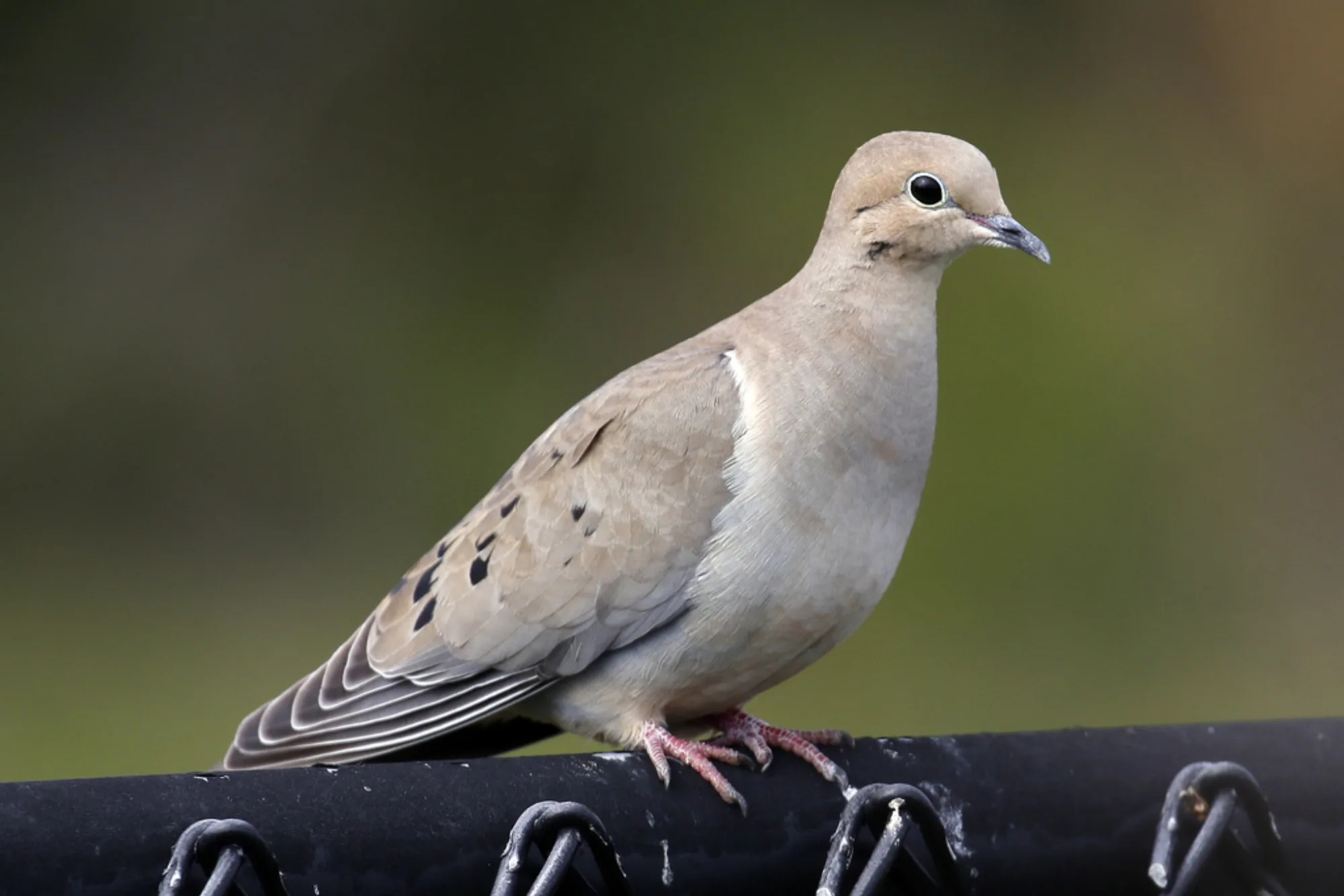
Listen for a plaintive coo that could initially be mistaken for an owl: it belongs to the Mourning Dove, a slender member of the dove family. About 31 cm long, it has a rounded head, a long tapered tail and muted grey-brown plumage, lighter and pinkish underneath. Black spots mark the wings, white outer tail feathers contrast with darker inner ones, and a dark crescent sits below each eye. Its wings whistle most noticeably as it takes off or lands.
The species lives year-round across the continental United States, most of Mexico, southern Canada, Bermuda and the Greater Antilles. It also visits much of the Canadian prairie in summer and southern Central America in winter. Look for it in open or partly open places, including farms, grassland, towns and lightly wooded areas; it avoids thick forest and swamps. Migrating birds usually travel in flocks by day, flying low over land. On the ground, they walk in search of visible seeds, sometimes pushing aside leaf litter, and may also feed while perched on plants. More than 99% of what they eat is seed, with insects and snails taken rarely.
Outside the breeding season, mourning doves roost together in dense trees. Their flimsy nests are usually in trees, but can also be found on buildings, in shrubs or on the ground. Both parents incubate the eggs and feed the young; in warm areas, a pair can rear as many as six broods in one year. Hawks and falcons prey on the birds, while eggs are taken by animals including corvids, housecats and rat snakes. Hunting also takes millions each year, and reports indicate a decline in the western United States.
Written from the English Wikipedia article Mourning dove (CC BY-SA 4.0).
- Records
- 8,150,361
- Countries
- 28
- Atlas places
- 1
These are open occurrence records, so they show where people looked for and recorded the Mourning Dove as much as where it lives. Cells are up to 25 km across, and every location is generalised to its cell.
Generalised encounter areas, not exact locations. Each shape is a grid cell coloured by how likely the species is there.
- Very likelyUnited States25 km zone · high confidence · 7282757 records · updated 86 days ago
- Very likelyCanada25 km zone · high confidence · 720410 records · updated 86 days ago
- Very likelyMexico25 km zone · high confidence · 88808 records · updated 86 days ago
- Very likelyBermuda25 km zone · high confidence · 15624 records · updated today
- Very likelyPuerto Rico25 km zone · high confidence · 10708 records · updated today
- Very likelyCuba25 km zone · high confidence · 7343 records · updated today
- Very likelyBahamas25 km zone · high confidence · 3886 records · updated today
- LikelyDominican Republic25 km zone · high confidence · 6523 records · updated today
- LikelyHaiti25 km zone · high confidence · 3827 records · updated today
- LikelyCosta Rica25 km zone · high confidence · 3032 records · updated today
Conservation status not assessed here yet, so every location is generalised to its grid cell.