Yellow Tang
Zebrasoma flavescens
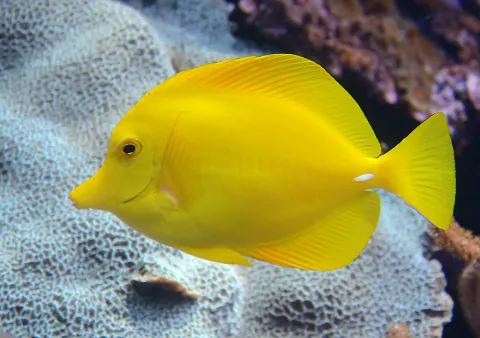
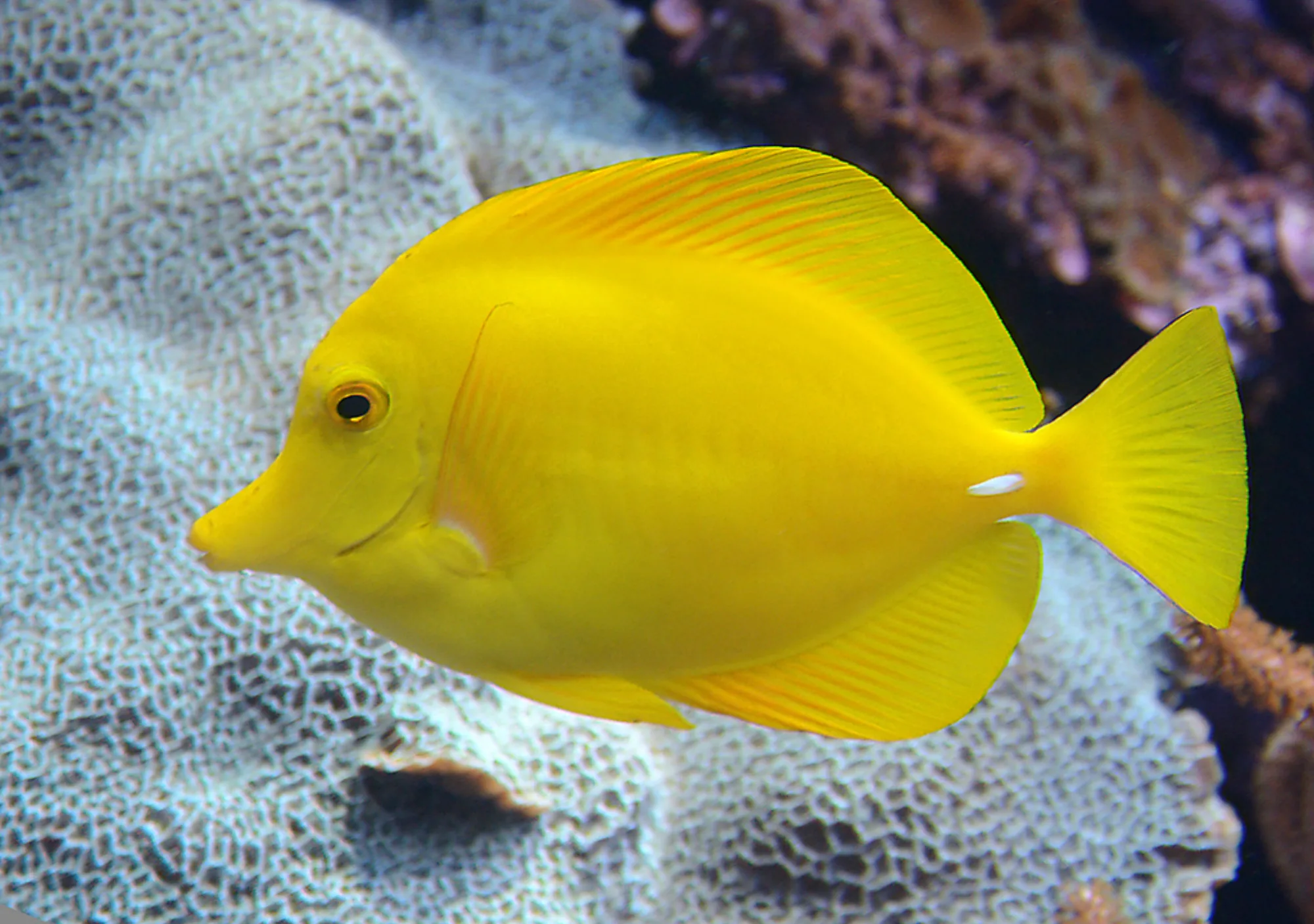
Bright yellow against a Pacific reef, the Yellow Tang is a marine fish with a small mouth and a moderately protruding snout. Adults can reach 20 centimetres in length, and males tend to be larger than females. After dark, its colour fades slightly and a brownish patch with a horizontal white band appears in the middle of its body. By daylight, the fish quickly returns to bright yellow. A white barb just before the tail helps it defend itself.
Yellow tangs are commonly found on shallow Pacific reefs at depths of 2 to 46 metres, from waters west of Hawaii to those east of Japan. They occur around islands including Hawaii, Wake and the Ryukyu Islands. They live in tropical water and are usually seen alone or in small groups. Mainly plant eaters, they graze on turf algae and other sea plants, but also take some zooplankton. They also remove algae from the shells of marine turtles. Larger fish, sharks, crabs and octopuses are among their natural predators.
Spawning takes place throughout the year, usually peaking around a full moon. Eggs are left in open water without a guard, and the young receive no parental care after hatching. In the wild, yellow tangs can live for over 40 years. The aquarium trade has placed heavy pressure on them: in Hawaii alone, 300,000 to 500,000 were collected from the wild each year. Stocks were collapsing by the late 1990s, prompting the establishment of nine marine protected areas off Hawaii. Larval drift can replenish distant fished areas, and the fishery is recovering.
Written from the English Wikipedia article Yellow tang (CC BY-SA 4.0).
- Records
- 7,158
- Countries
- 7
- Atlas places
- 1
These are open occurrence records, so they show where people looked for and recorded the Yellow Tang as much as where it lives. Cells are up to 25 km across, and every location is generalised to its cell.
Generalised encounter areas, not exact locations. Each shape is a grid cell coloured by how likely the species is there.
- Very likelyUnited States25 km zone · high confidence · 4736 records · updated 80 days ago
- Very likelyNorthern Mariana Islands25 km zone · high confidence · 1436 records · updated 80 days ago
- Very likelyU.S. Outlying Islands25 km zone · high confidence · 849 records · updated 80 days ago
- PossibleGuam25 km zone · medium confidence · 112 records · updated 80 days ago
- UncommonMarshall Islands25 km zone · medium confidence · 12 records · updated 80 days ago
- UncommonAmerican Samoa25 km zone · medium confidence · 11 records · updated 80 days ago
- RareJapan25 km zone · medium confidence · 2 records · updated 80 days ago
Conservation status not assessed here yet, so every location is generalised to its grid cell.