Short-billed Black-Cockatoo
Zanda latirostris
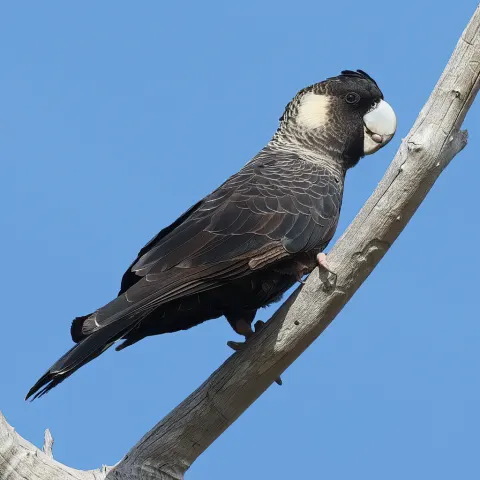
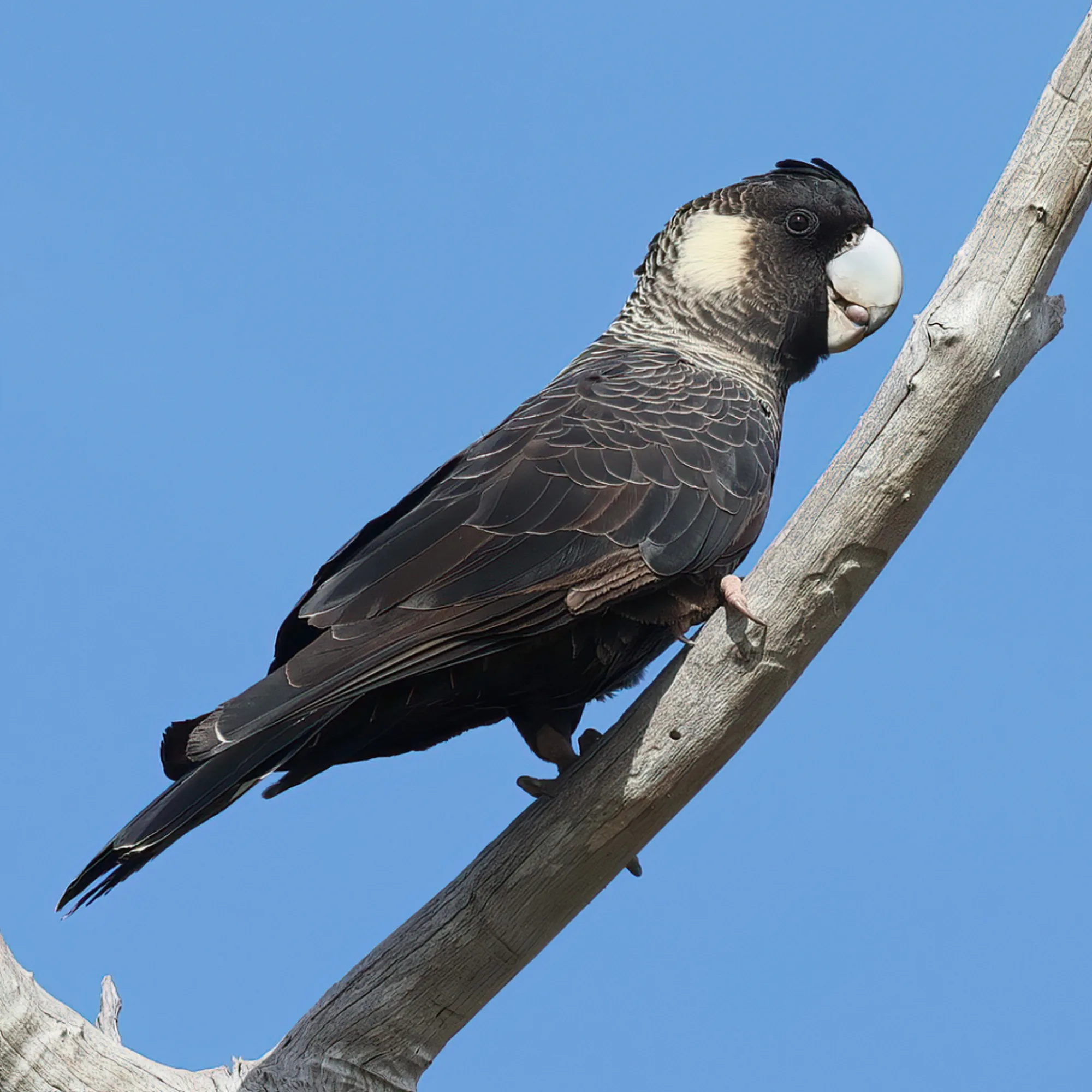
A loud, wailing wy-lah may announce the Short-billed Black-Cockatoo before it comes into view. This large cockatoo is 53 to 58 cm long, with mostly greyish-black plumage, pale cheek patches, a white tail band and a short crest. Light edges on its feathers give it a scalloped look, particularly around the neck. Adult males have dark grey beaks and pink eye-rings, while females have bone-coloured beaks, grey eye-rings and paler cheek patches.
Found only in southwest Australia, the bird ranges across much of the Wheatbelt and lives in eucalypt woodland, especially wandoo and salmon gum. It also occurs in pine plantations and on sandplains and kwongan heath, where Hakea, Banksia and Grevillea shrubs grow in abundance. Outside the breeding season, pairs gather in flocks and move away from nesting areas; birds in drier regions migrate towards the coast in summer. Look for flocks flying high with deep, slow wingbeats, or descending to treetops to feed or roost. They eat mainly seeds, often sitting in tree crowns to break open pods and cones, and also feed on flowers and insect larvae.
Breeding runs from late winter to summer, with pairs using large hollows in tall trees. The female lays one or two eggs and incubates them for 28 to 29 days; both parents usually feed the chicks, which fledge ten to eleven weeks after hatching. Young birds remain with their parents until at least the next breeding season. Clearing of feeding and nesting habitat, loss of nesting hollows, competition for nest sites and poaching all threaten the cockatoo. Removing plantations of pine trees north of Perth could further reduce the food available to these birds.
Written from the English Wikipedia article Carnaby's black cockatoo (CC BY-SA 4.0).
- Records
- 14,489
- Countries
- 1
No atlas park has a record of the Short-billed Black-Cockatoo in or around it yet.
These are open occurrence records, so they show where people looked for and recorded the Short-billed Black-Cockatoo as much as where it lives. Cells are up to 25 km across, and every location is generalised to its cell.
Generalised encounter areas, not exact locations. Each shape is a grid cell coloured by how likely the species is there.
- Very likelyAustralia25 km zone · high confidence · 14489 records · updated 80 days ago
Conservation status not assessed here yet, so every location is generalised to its grid cell.