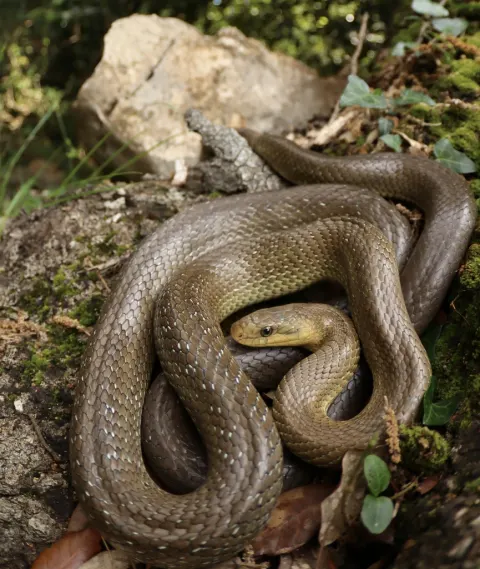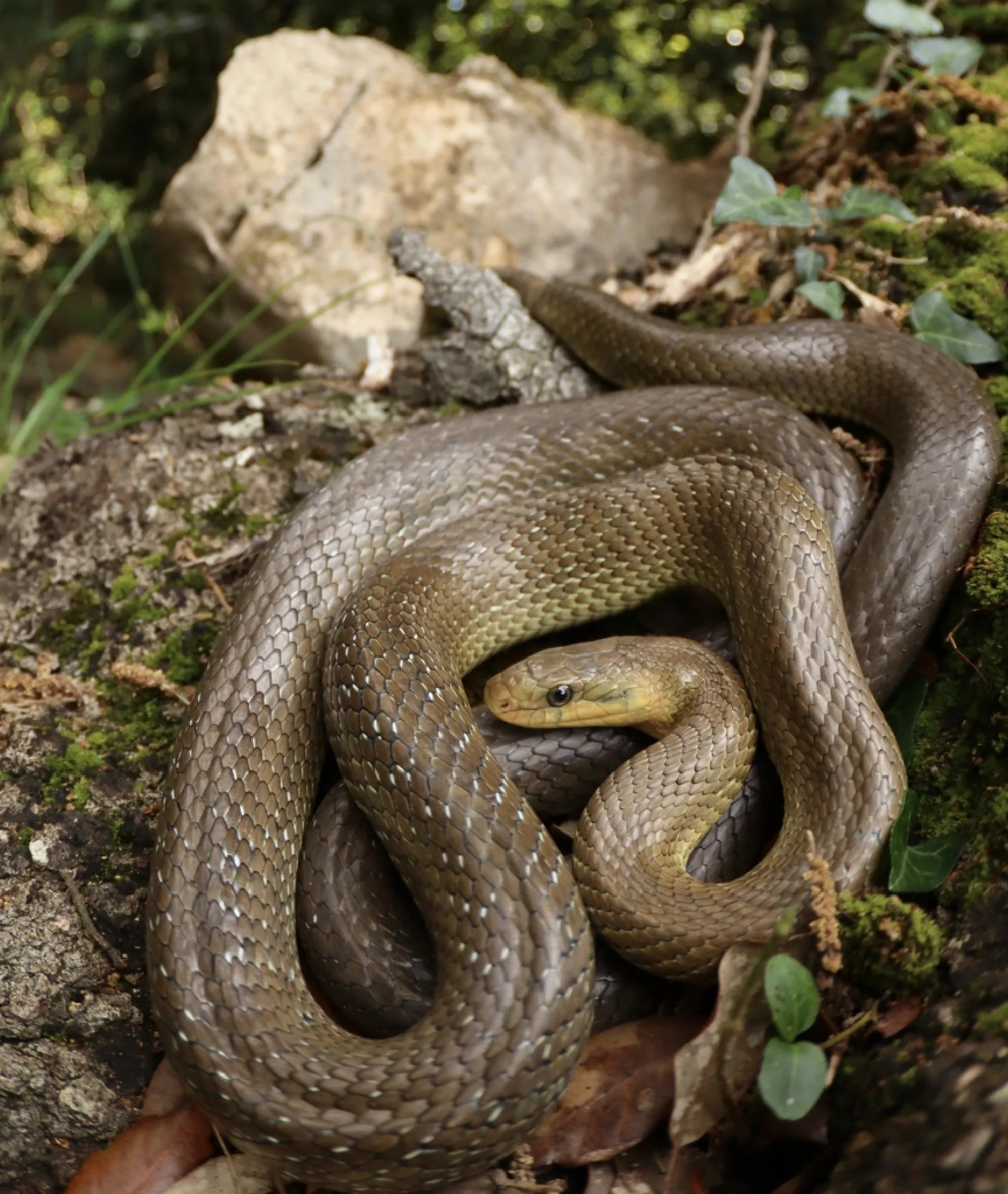
Aesculapean Snake
Zamenis longissimus
Long, slender and often bronze with a metallic sheen, the Aesculapean Snake is a non-venomous constrictor and one of Europe's largest snakes. Adults usually measure 110 to 160 cm, though some grow longer, and their colouring can range from olive-yellow or brownish-green to almost black. Young snakes are lighter green or brownish-green, with dark markings and a yellow neck collar that can make them easy to confuse with young grass snakes.
Its range includes much of France, the Spanish Pyrenees, parts of Italy, the Balkans and areas of Central and Eastern Europe, with separate populations farther east around the Black Sea and Lake Urmia. It favours warm, moderately humid woodland in hilly or rocky country, including river valleys, clearings and scrub at forest edges. Gardens, sheds, old walls and ruins can also provide places to hide and bask. Secretive and not always easy to find, it is active by day and may emerge in the early morning or late afternoon during warmer months. A skilled climber, it can ascend even bare, vertical tree trunks and has been seen foraging in building roofs.
Small mammals are its main food, but it also takes birds, eggs and nestlings; young snakes mainly eat lizards and arthropods. Breeding follows hibernation in spring, and females lay eggs in warm, moist places such as rotting wood, leaf mould or old stumps. The species is thought to be declining, largely because of human disturbance and habitat destruction. Roads and increasing traffic threaten to fragment populations further, while isolated populations at the edges of its range lack reinforcement through migration.
Written from the English Wikipedia article Aesculapian snake (CC BY-SA 4.0).
- Records
- 9,484
- Countries
- 7
No atlas park has a record of the Aesculapean Snake in or around it yet.
These are open occurrence records, so they show where people looked for and recorded the Aesculapean Snake as much as where it lives. Cells are up to 25 km across, and every location is generalised to its cell.
Generalised encounter areas, not exact locations. Each shape is a grid cell coloured by how likely the species is there.
- Very likelyFrance25 km zone · medium confidence · 8326 records · updated 80 days ago
- Very likelyAustria25 km zone · high confidence · 642 records · updated 80 days ago
- Very likelyUkraine25 km zone · high confidence · 360 records · updated 80 days ago
- Very likelySpain25 km zone · medium confidence · 90 records · updated 80 days ago
- Very likelySwitzerland25 km zone · medium confidence · 50 records · updated 80 days ago
- LikelyCzechia25 km zone · medium confidence · 16 records · updated 80 days ago
Conservation status not assessed here yet, so every location is generalised to its grid cell.