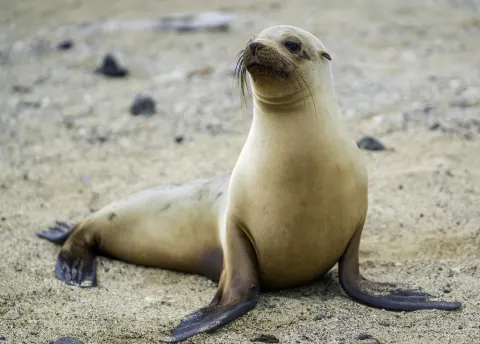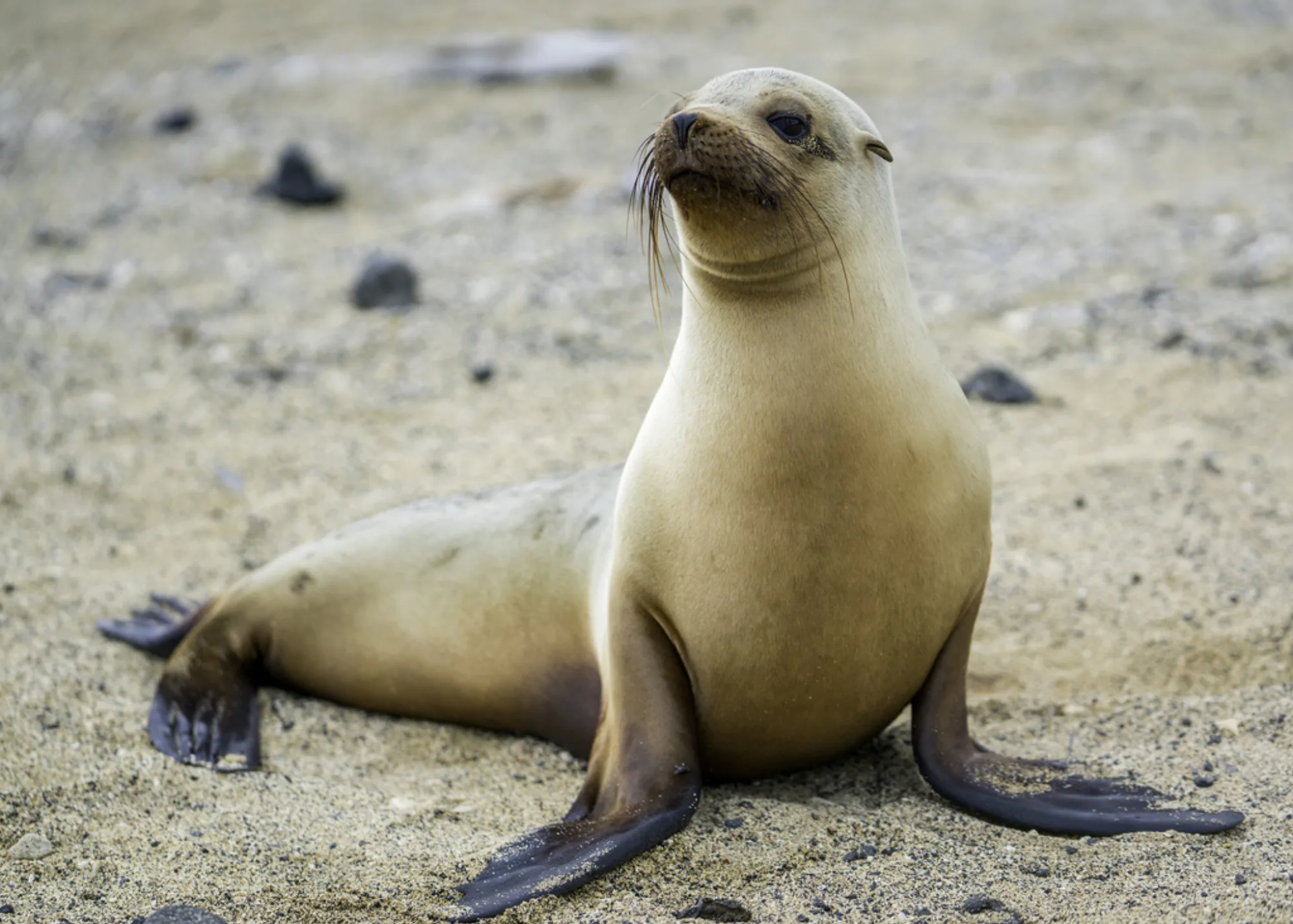
Galapagos Sea Lion
Zalophus wollebaeki
On the shores of the Galápagos, the Galapagos Sea Lion gathers in colonies, barks across the water and rests in the shade. It is the smallest sea lion species, measuring 1.5 to 2.5 m long and weighing 50 to 400 kg, with males larger on average than females. Look for a pointed, whiskered nose, a long, narrow muzzle and visible external ears. Wet animals are dark brown, while dry coats vary in colour; females tend to be lighter than males, and pups are chestnut brown. Mature males have a small bump on the forehead, while females and juveniles have almost flat heads.
These sea lions live and breed throughout the main Galápagos islands and on some smaller islands, with a smaller population on Isla de la Plata off Ecuador. Their shores range from sandy beaches to steep rocky cliffs, and they shelter beneath vegetation, rocks or cliffs to avoid the daytime heat. Clumsy on land, they move with ease through surf and around coastal rocks. They feed mainly on sardines, but also eat squid, octopus, crustaceans and other fish. Some scavenge from fishing boats or use the boats' bright lights when hunting. Breeding runs from May through January, and dependent pups can be found in colonies year round. Pups nap, play and feed together, sometimes watched by one female while others forage.
Sharks and killer whales prey on sea lions, with pups especially at risk. During El Niño, declining food supplies can cause population losses and interrupt breeding. Fishing nets, hooks and boats pose dangers, while stray dogs attack sea lions and human contact brings risks of accidents and disease.
Written from the English Wikipedia article Galápagos sea lion (CC BY-SA 4.0).
- Records
- 1,138
- Countries
- 2
- Atlas places
- 1
These are open occurrence records, so they show where people looked for and recorded the Galapagos Sea Lion as much as where it lives. Cells are up to 25 km across, and every location is generalised to its cell.
Generalised encounter areas, not exact locations. Each shape is a grid cell coloured by how likely the species is there.
- Very likelyEcuador25 km zone · high confidence · 1138 records · updated 80 days ago
- RareColombia25 km zone · low confidence · 0 records · updated 80 days ago
Conservation status not assessed here yet, so every location is generalised to its grid cell.