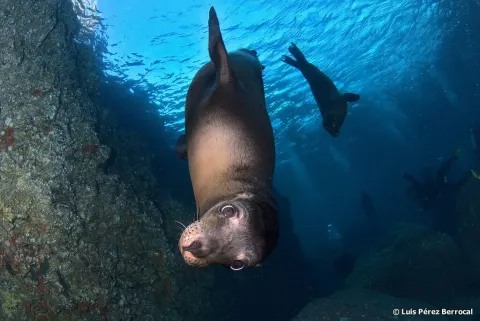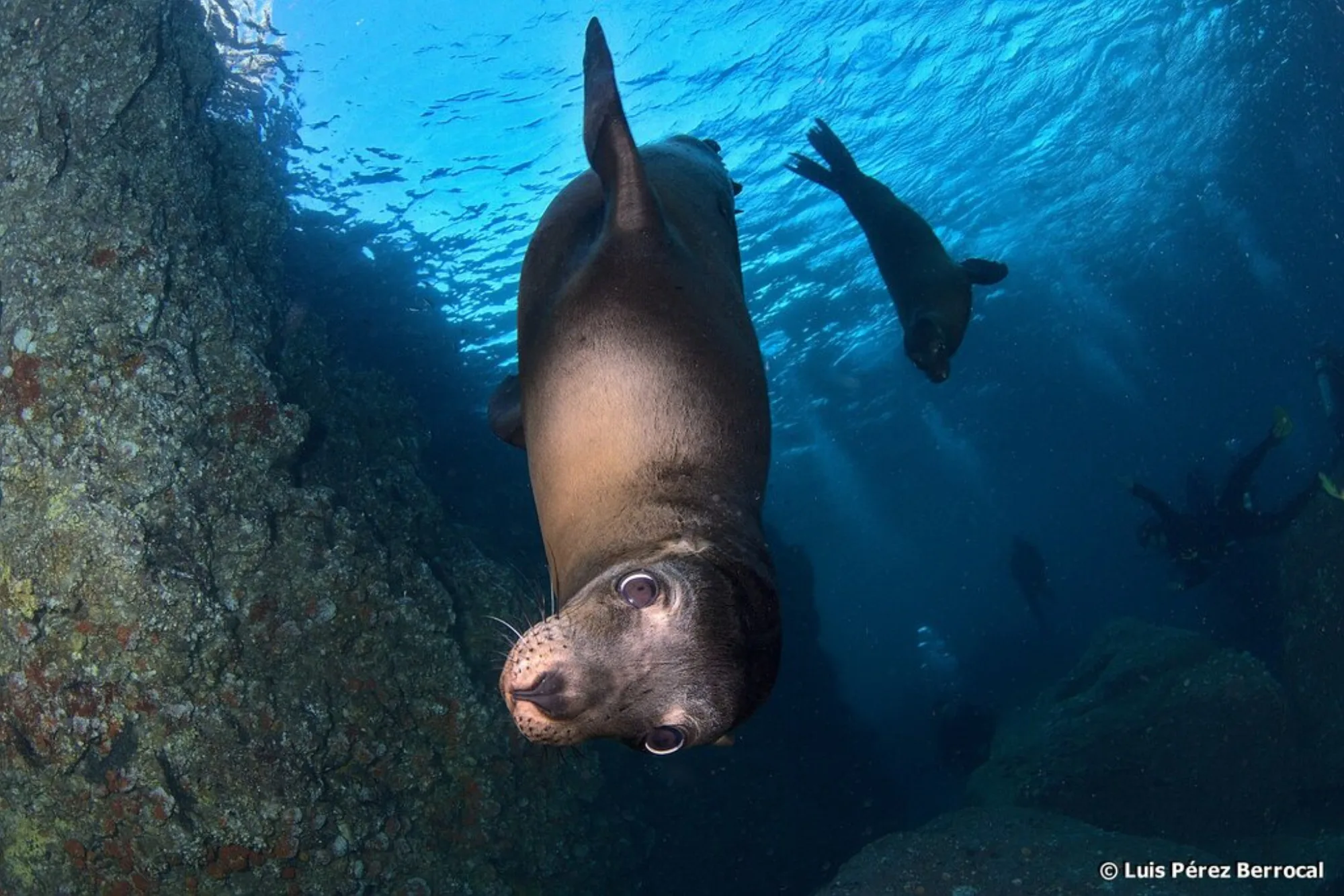
California Sea Lion
Zalophus californianus
Along the western coast of North America, the California Sea Lion is an eared seal at home on sandy and rocky shores. Its range extends along North America's western coast and islands, reaching southeast Alaska in the north and central Mexico in the south, as well as the Gulf of California. It also hauls out in marinas and on wharves, and non-breeding animals sometimes gather on navigational buoys. Males are larger than females, with thick necks and a raised crest that gives the forehead a domed shape. Adult males are typically dark brown, while females and young are tawny brown.
California sea lions are social animals whose characteristic barks can be heard especially often during the breeding season. They eat mainly fish, squid and octopus, foraging alone or in groups and sometimes hunting alongside dolphins, porpoises or seabirds. Outside the breeding season, they spend much of their time at sea, coming ashore between trips and to moult. From May to August, they gather to breed, with males defending territories on the shore. Females give birth in June or July, then alternate nursing their pups with trips to find food. Pups left ashore gather in groups to play, and mothers and pups recognise each other's calls when they reunite.
Orcas and great white sharks prey on California sea lions. People also kill them in conflicts with fishing, while discarded human-made rubbish can entangle them. Pollutants including DDT and PCB build up in the marine food chain and pose another threat. Warm coastal waters have reduced the supply of fish eaten by pups, leaving some to starve or venture into open water too early. Oregon and Washington have also killed sea lions to protect fish populations.
Written from the English Wikipedia article California sea lion (CC BY-SA 4.0).
- Records
- 5,546
- Countries
- 3
- Atlas places
- 4
These are open occurrence records, so they show where people looked for and recorded the California Sea Lion as much as where it lives. Cells are up to 25 km across, and every location is generalised to its cell.
Generalised encounter areas, not exact locations. Each shape is a grid cell coloured by how likely the species is there.
- Very likelyUnited States25 km zone · medium confidence · 4111 records · updated 80 days ago
- Very likelyMexico25 km zone · medium confidence · 1085 records · updated 80 days ago
- Very likelyCanada25 km zone · medium confidence · 350 records · updated 80 days ago
Conservation status not assessed here yet, so every location is generalised to its grid cell.