Swordfish
Xiphias gladius
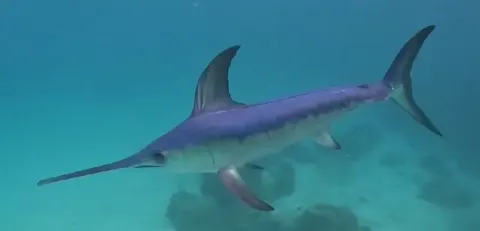
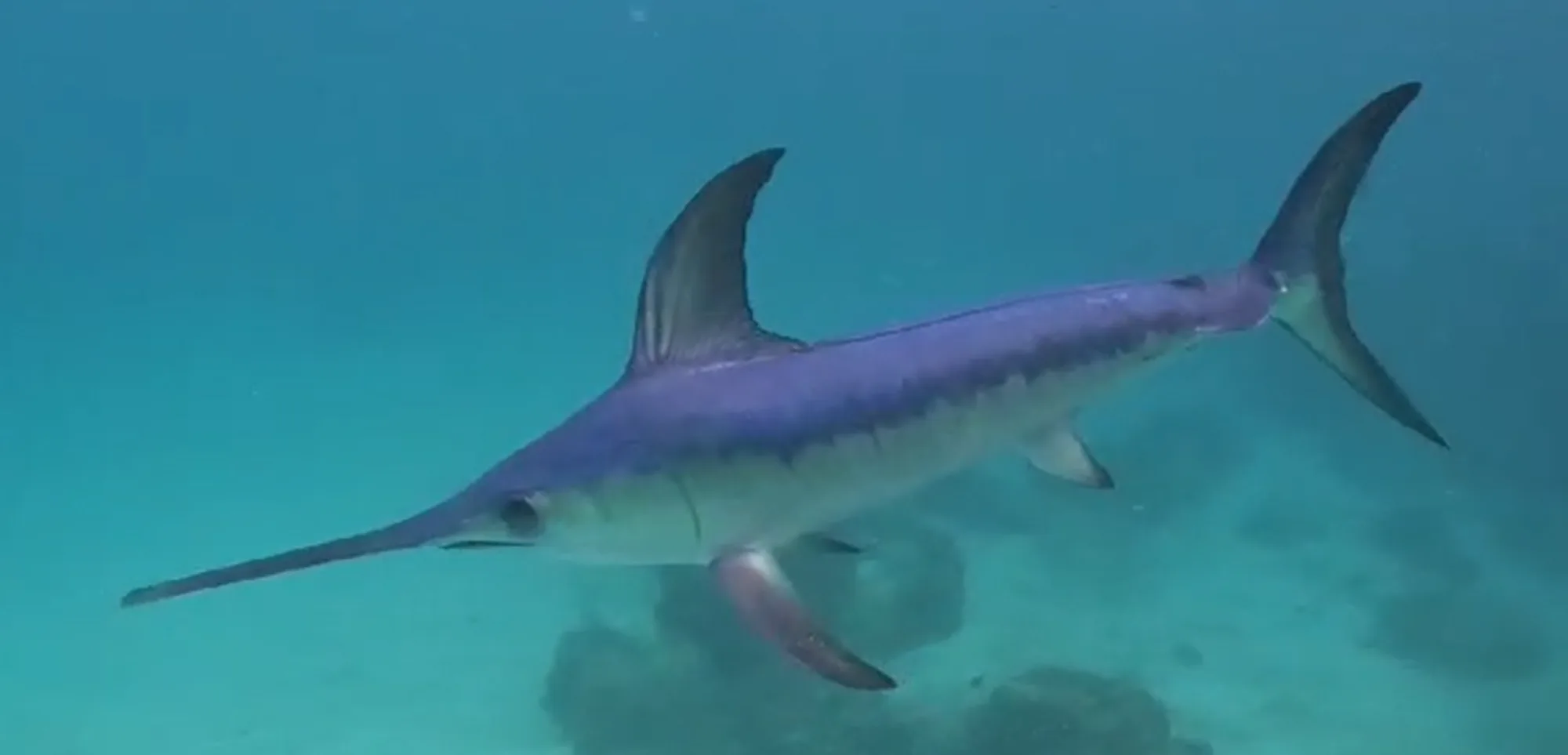
A long, flat, pointed bill gives the Swordfish its name and makes its outline unmistakable. This large predatory fish has an elongated, rounded body and commonly reaches 3 m in length. Adults have neither teeth nor scales, and females grow larger than males.
Swordfish range widely through tropical and temperate waters of the Atlantic, Pacific and Indian Oceans. They usually occur from near the surface down to 550 m, though they have been recorded much deeper. Most swim alone, or gather so loosely that neighbours may be 10 m apart. At the surface, they often bask with a dorsal fin exposed, and they are also known for powerful leaps. Highly migratory, they generally head towards colder waters to feed in summer. They feed daily, most often at night, rising towards the surface in search of smaller fish. Their varied diet includes mackerel, herring, squid and crustaceans; they typically slash large prey with the bill and swallow small prey whole.
Breeding takes place in warm waters, with spawning occurring throughout the year in the equatorial Pacific, the Caribbean Sea and other warm parts of the western Atlantic. Elsewhere, the timing varies: off southern Brazil, spawning occurs from November to February. Fishing is a major threat, and long-line fishing has caused overfishing along the coast, although some populations have shown signs of recovery following bans on the method in many coastal areas. In the Indian Ocean, swordfish are probably being caught faster than stocks can sustain, while Mediterranean fishing mortality is above the recommended maximum. Adult swordfish have few natural predators, but killer whales and shortfin mako sharks sometimes take them, and young swordfish are more vulnerable to predatory fish.
Written from the English Wikipedia article Swordfish (CC BY-SA 4.0).
- Records
- 44,000
- Countries
- 5
No atlas park has a record of the Swordfish in or around it yet.
These are open occurrence records, so they show where people looked for and recorded the Swordfish as much as where it lives. Cells are up to 25 km across, and every location is generalised to its cell.
Generalised encounter areas, not exact locations. Each shape is a grid cell coloured by how likely the species is there.
- Very likelyUnited States25 km zone · high confidence · 38820 records · updated 80 days ago
- Very likelyBahamas25 km zone · high confidence · 2774 records · updated 80 days ago
- Very likelyCuba25 km zone · high confidence · 2108 records · updated 80 days ago
- Very likelyU.S. Virgin Islands25 km zone · high confidence · 298 records · updated 80 days ago
Conservation status not assessed here yet, so every location is generalised to its grid cell.