African Clawed Frog
Xenopus laevis
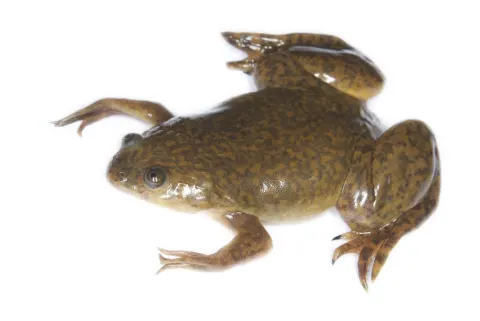
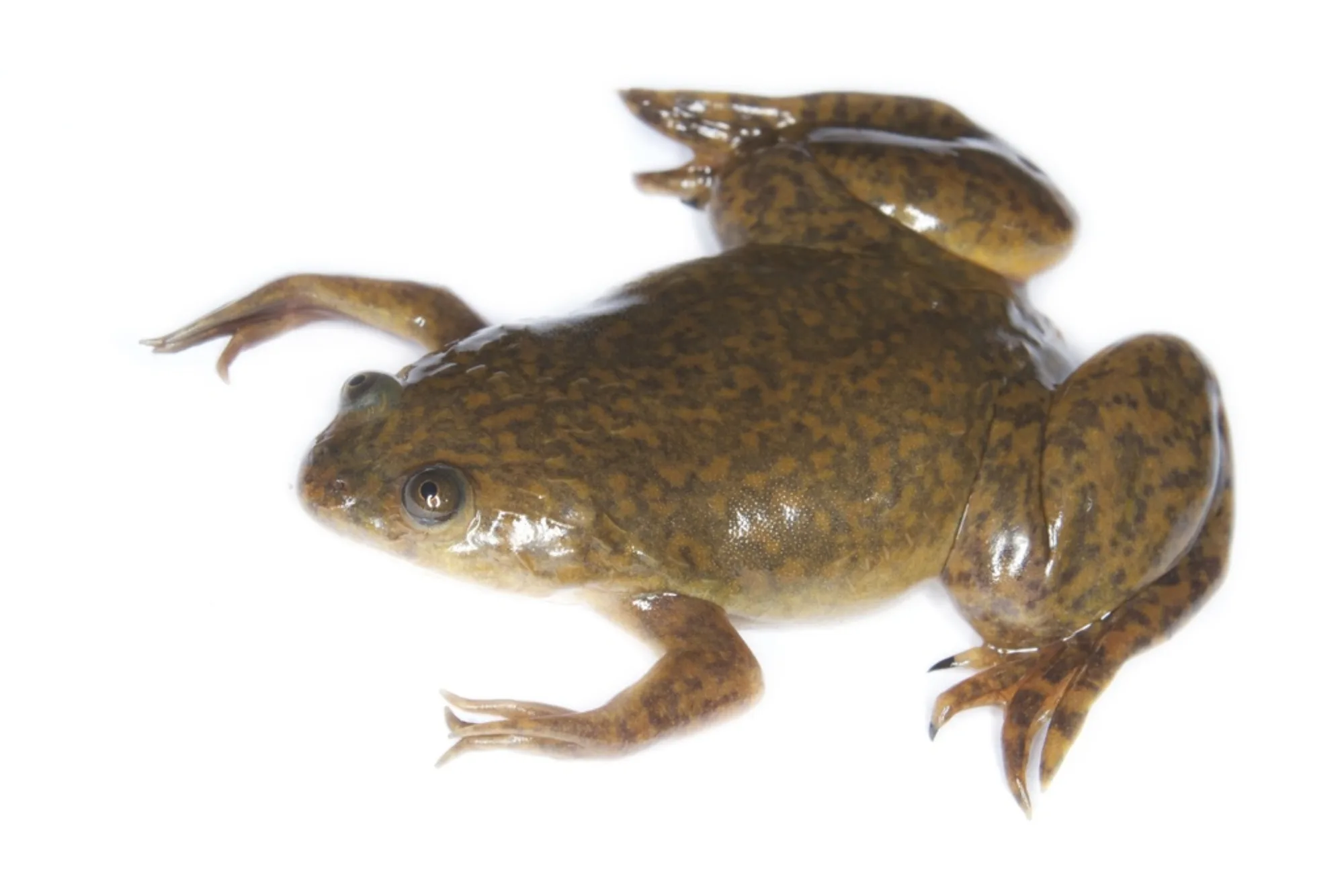
Smooth, slippery skin and short black claws help identify the African Clawed Frog, an aquatic frog native to sub-Saharan Africa. Its back is mottled with olive-grey or brown blotches, while its pale underside has a yellow tinge. Females are larger and rounder than the smaller, slimmer males, and both have powerful legs that propel them through water.
In the wild, it inhabits wetlands, ponds and lakes across arid and semiarid parts of sub-Saharan Africa. It can also be found in artificial waters, including ponds, dams and irrigation canals, where it occurs at higher densities than in natural lagoons, streams or rivers. Introduced populations live in parts of North and South America, Europe and Asia. Fully aquatic, it rarely leaves the water except to move to another body of water during drought or other disturbances. During rainy seasons, it may travel to ponds or puddles in search of food and new habitat; in drought, it can burrow into mud and remain dormant for up to a year.
Most feeding and reproductive activity takes place after dark. When resting, the frog may float motionless at the surface, with its legs spread and its eyes and nostrils above water. It eats living and dead prey, including fish, tadpoles and crustaceans, using its hands to push food into its mouth. It also digs through the material on the bottom for worms and other food, and may eat its own larvae. Breeding can take place whenever conditions allow, with males calling in alternating long and short trills. Native birds prey on these frogs, and wild individuals commonly carry parasites. People have also sought to remove introduced frogs to protect other native species.
Written from the English Wikipedia article African clawed frog (CC BY-SA 4.0).
- Records
- 1,530
- Countries
- 17
- Atlas places
- 12
- Garden Route National Park· South Africa
- uKhahlamba-Drakensberg Park· South Africa
- Addo Elephant National Park· South Africa
- iSimangaliso Wetland Park· South Africa
- Table Mountain National Park· South Africa
- Kruger National Park· South Africa
- Matobo National Park· Zimbabwe
- Namib-Naukluft· Namibia
- Karoo National Park· South Africa
- Kibale National Park· Uganda
- Kunene / Kaokoveld· Namibia
- Skeleton Coast· Namibia
These are open occurrence records, so they show where people looked for and recorded the African Clawed Frog as much as where it lives. Cells are up to 25 km across, and every location is generalised to its cell.
Generalised encounter areas, not exact locations. Each shape is a grid cell coloured by how likely the species is there.
- Very likelyUnited States25 km zone · high confidence · 1013 records · updated 80 days ago
- Very likelyFrance25 km zone · high confidence · 274 records · updated 80 days ago
- Very likelySouth Africa25 km zone · medium confidence · 130 records · updated 80 days ago
- Very likelyNamibia25 km zone · medium confidence · 30 records · updated 80 days ago
- Very likelyChile25 km zone · medium confidence · 27 records · updated 80 days ago
- Very likelyCongo - Kinshasa25 km zone · medium confidence · 24 records · updated 80 days ago
- LikelyMalawi25 km zone · medium confidence · 7 records · updated 80 days ago
- LikelyZimbabwe25 km zone · medium confidence · 7 records · updated 80 days ago
- LikelyBenin25 km zone · medium confidence · 5 records · updated 80 days ago
- LikelyLesotho25 km zone · medium confidence · 4 records · updated 80 days ago
Conservation status not assessed here yet, so every location is generalised to its grid cell.