Fennec Fox
Vulpes zerda
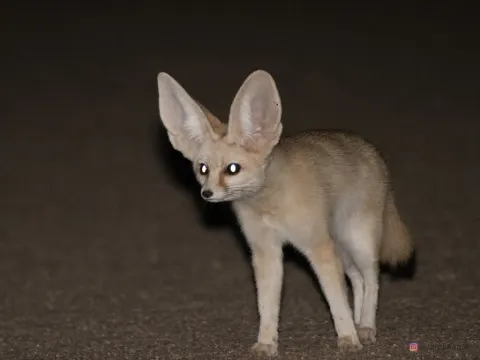
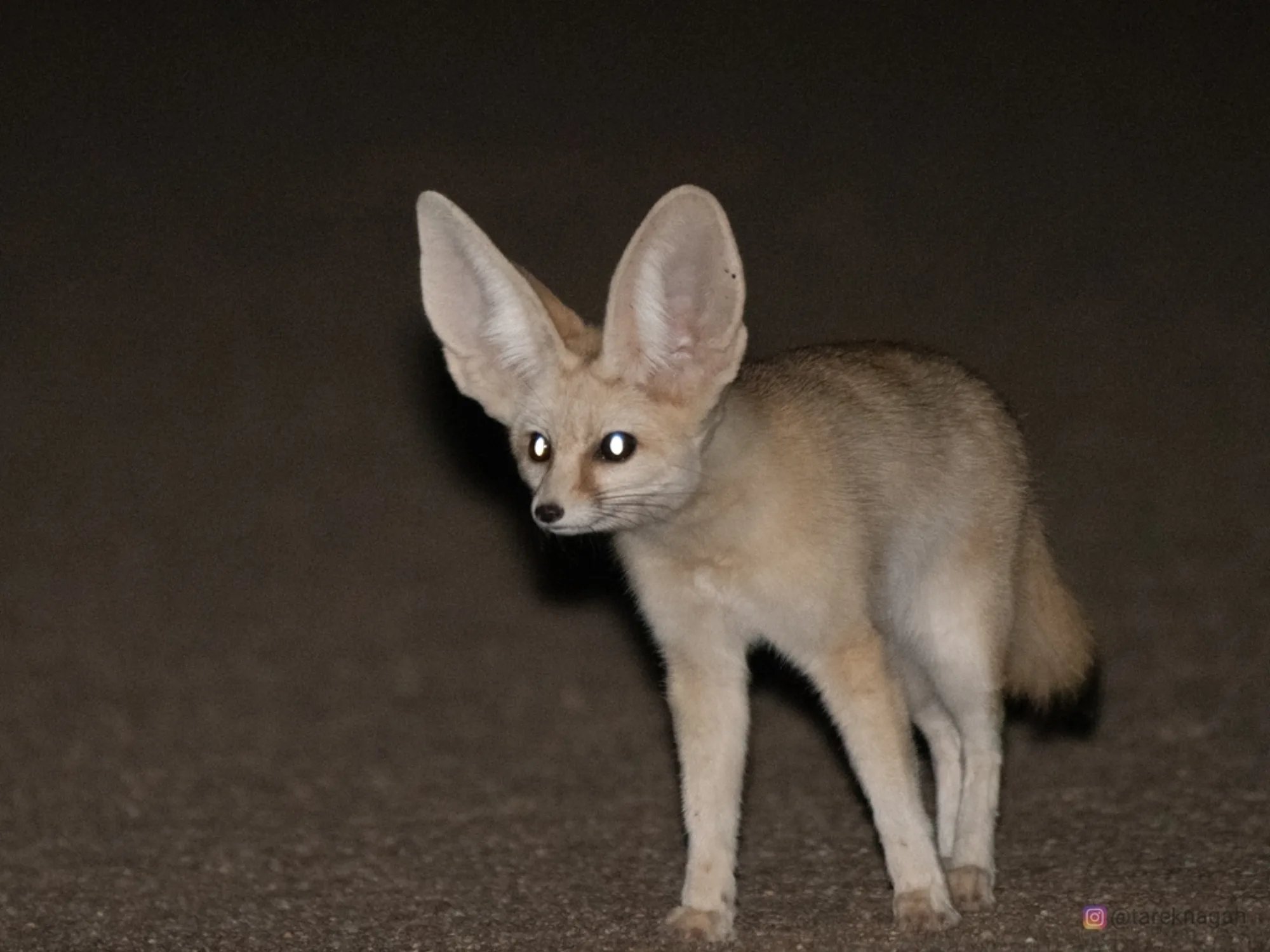
With its oversized ears and sand-coloured coat, the Fennec Fox (Vulpes zerda) is the smallest of all foxes. Its fur reflects sunlight by day and helps it stay warm after dark. Look for a black nose, dark eyes and a tapering tail with a black tip. Dark streaks run from the inner corners of its eyes towards its slender muzzle, while dense fur covers its paw pads and helps it walk on hot sand.
The fox ranges across the Sahara, reaching from Mauritania and Morocco eastwards through Egypt to the Sinai Peninsula and south to northern Sudan. It lives among small dunes and in broad, treeless stretches of sand where grasses, sedges and small shrubs grow sparsely. Primarily nocturnal, it is most active during the cooler hours of darkness. It digs dens in sand, sometimes beneath plants, and family burrows may connect or lie close together. In compacted soil, a den can cover 120 m2 and have up to 15 entrances; in loose sand, it may have a single entrance and chamber.
Fennec foxes hunt alone, digging for small animals and insects. Their varied diet also includes birds and eggs, fruit, leaves, roots and tubers. They obtain moisture from prey and drink when water is available; some have been seen burying food for later. Pairs mate for life, and both parents care for litters of one to four pups. Pharaoh eagle-owls prey on pups, while jackals and striped hyenas may take foxes of any age. People commonly trap fennec foxes in North Africa for exhibition or sale to tourists. Expanding settlements have displaced them in parts of southern Morocco, while roadwork, mining and oil fields are among the potential threats.
Written from the English Wikipedia article Fennec fox (CC BY-SA 4.0).
- Records
- 21
- Countries
- 4
No atlas park has a record of the Fennec Fox in or around it yet.
These are open occurrence records, so they show where people looked for and recorded the Fennec Fox as much as where it lives. Cells are up to 25 km across, and every location is generalised to its cell.
Generalised encounter areas, not exact locations. Each shape is a grid cell coloured by how likely the species is there.
- Very likelyTunisia25 km zone · medium confidence · 5 records · updated 80 days ago
- Very likelyMauritania25 km zone · medium confidence · 4 records · updated 80 days ago
- LikelyMorocco25 km zone · medium confidence · 6 records · updated 80 days ago
- PossibleWestern Sahara25 km zone · medium confidence · 6 records · updated 80 days ago
Conservation status not assessed here yet, so every location is generalised to its grid cell.