Red Fox
Vulpes vulpes
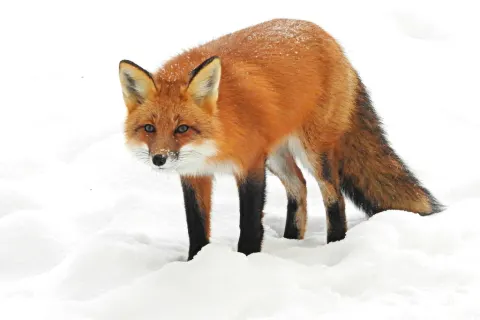
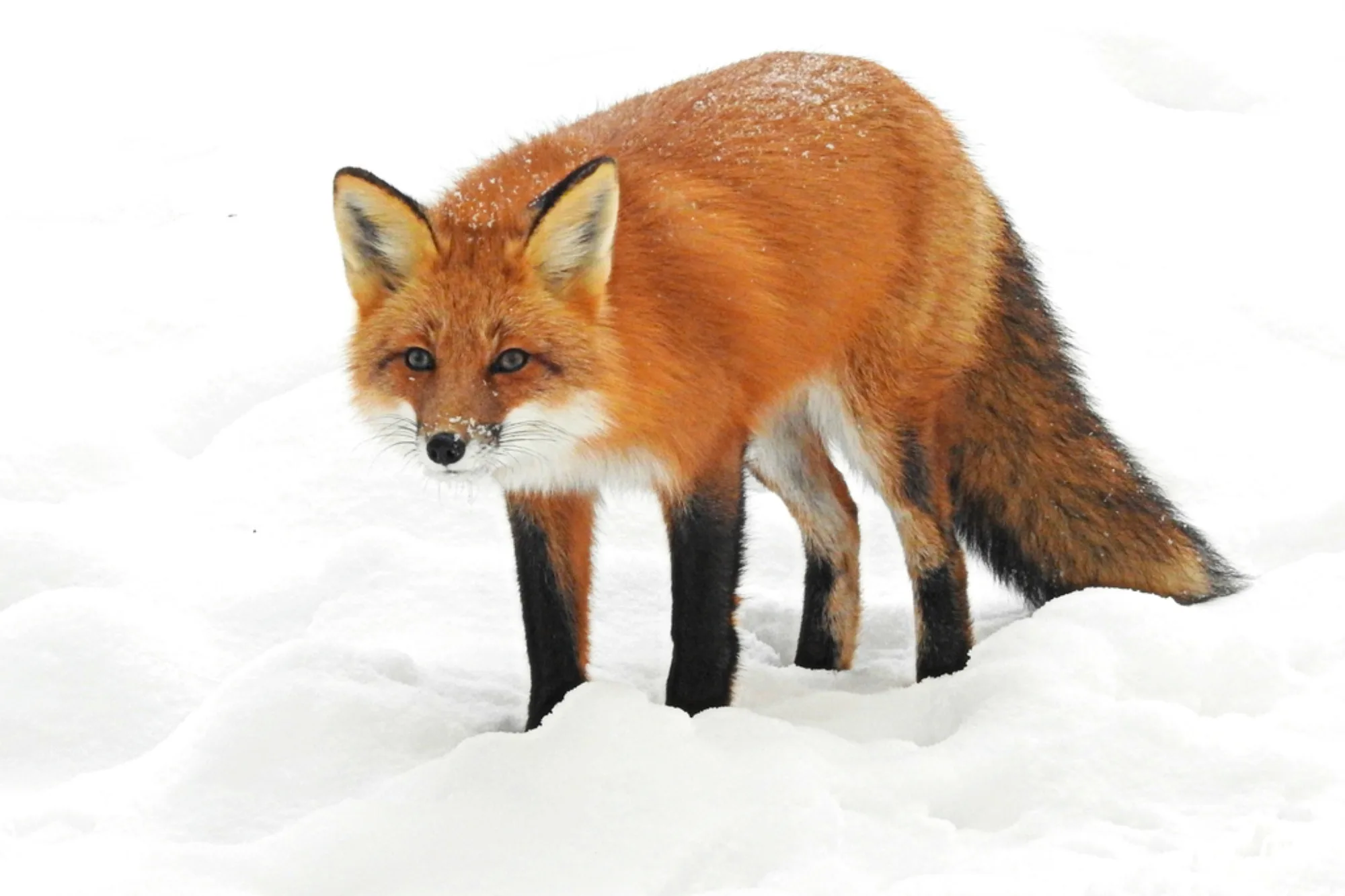
A long body, short legs and a fluffy tail that reaches the ground when the animal stands give the Red Fox (Vulpes vulpes) a distinctive outline. It is the largest of the true foxes, but its coat is not always red: wild animals also occur in silver or black, and in a cross pattern. Adults average 35 to 50 cm at the shoulder, though their size varies considerably.
Red foxes range across Europe, much of Asia and North America, and parts of North Africa; they have also been introduced to Australia. Adaptable to new surroundings, they have colonised many suburban and urban areas. They also live in places as different as grasslands, alpine meadows and desert regions. Outside the breeding season, most prefer to live in the open among dense vegetation, although they may shelter in burrows during bad weather. Foxes often live as pairs or in small family groups, and some young stay with their parents and help raise the next litter.
Small rodents are their main food, but the menu also includes rabbits, birds, reptiles, invertebrates, fruit and vegetables. A fox usually forages alone and favours the hours before sunrise and late in the evening for hunting. When pursuing mouse-like prey, it locates the animal by sound before leaping towards it. Breeding takes place in spring, with an average litter of four to six kits, born blind and deaf. The kits begin to venture from the den at three to four weeks, when they also start trying solid food brought by their parents. Foxes face attacks from predators, including eagles and owls, and have long been hunted both as pests and for their fur.
Written from the English Wikipedia article Red fox (CC BY-SA 4.0).
- Records
- 680,174
- Countries
- 64
- Atlas places
- 3
These are open occurrence records, so they show where people looked for and recorded the Red Fox as much as where it lives. Cells are up to 25 km across, and every location is generalised to its cell.
Generalised encounter areas, not exact locations. Each shape is a grid cell coloured by how likely the species is there.
- Very likelySwitzerland25 km zone · high confidence · 458158 records · updated 86 days ago
- Very likelyFrance25 km zone · high confidence · 75935 records · updated 86 days ago
- Very likelyAustralia25 km zone · high confidence · 34922 records · updated 86 days ago
- Very likelySpain25 km zone · high confidence · 27741 records · updated 86 days ago
- Very likelyGermany25 km zone · high confidence · 27440 records · updated 86 days ago
- Very likelyUnited Kingdom25 km zone · high confidence · 19537 records · updated 86 days ago
- Very likelyBelgium25 km zone · high confidence · 7975 records · updated 86 days ago
- Very likelyAustria25 km zone · high confidence · 6677 records · updated 86 days ago
- Very likelyLuxembourg25 km zone · high confidence · 4139 records · updated 86 days ago
- Very likelyLiechtenstein25 km zone · high confidence · 2962 records · updated 86 days ago
Conservation status not assessed here yet, so every location is generalised to its grid cell.