Swift Fox
Vulpes velox
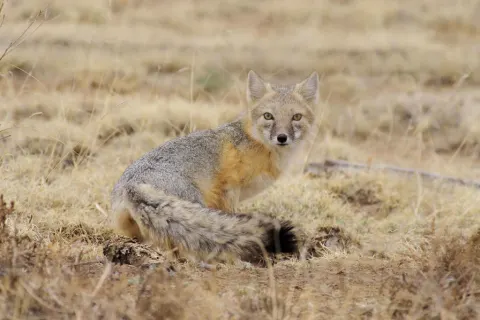
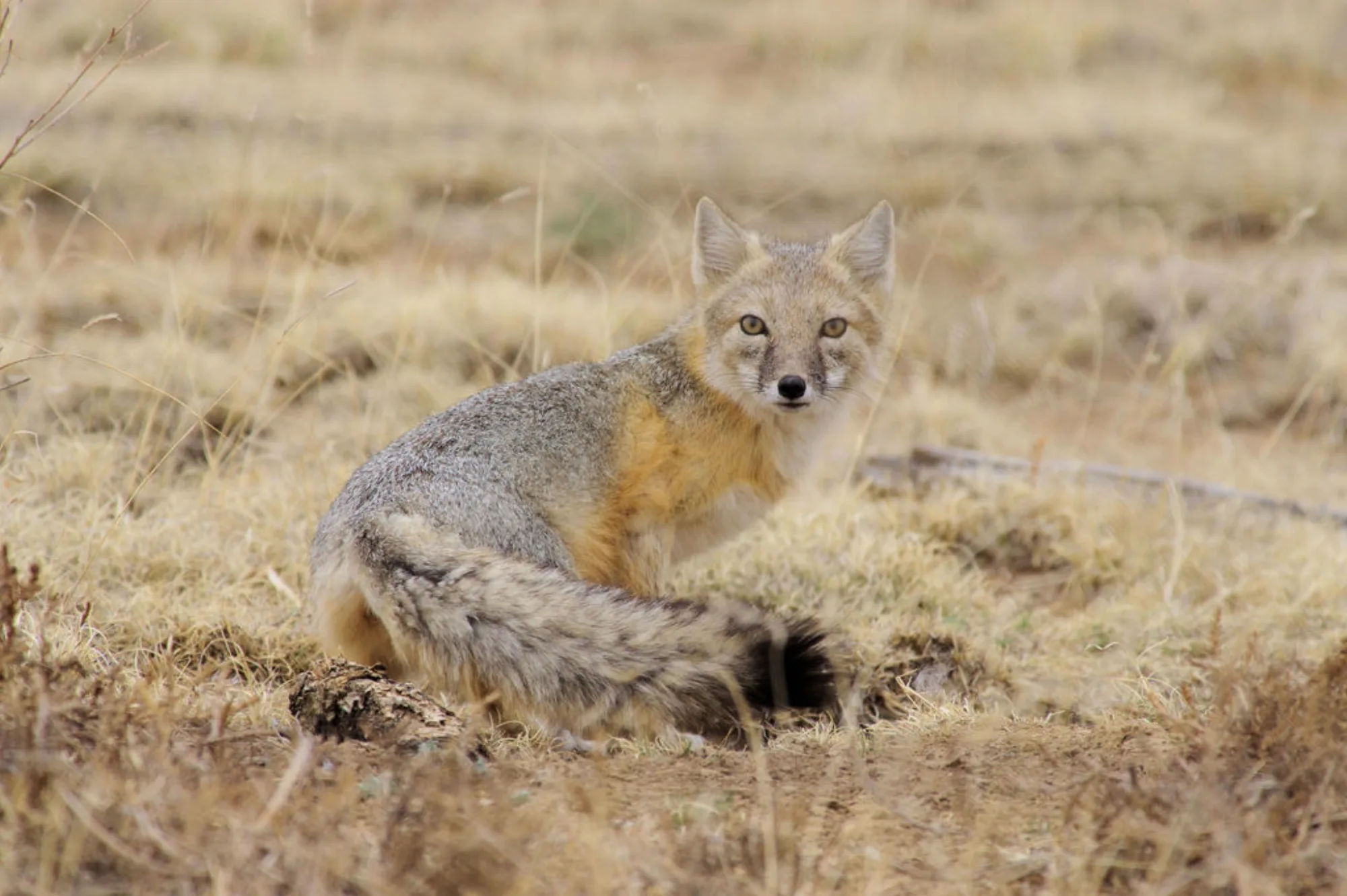
About the size of a domestic cat, the Swift Fox has large ears, a black-tipped tail and black patches on its muzzle. Its greyish tan coat becomes yellowish tan along the sides and legs, while the throat, chest and belly are pale yellow to white. Males and females look similar, though males are slightly larger. Its range lies in the Great Plains of North America, from southern Alberta and Saskatchewan to Texas. It lives mainly in short-grass prairie and desert, making dens in sandy soil on open prairie, in ploughed fields or along fences.
For a traveller hoping to spot one, evenings and nights are the likeliest times in summer, when the fox spends its days in the den. In winter, it sometimes comes above ground during the warmer middle of the day. Dens offer shelter from predators, and a fox may use up to thirteen in a year, moving when prey is scarce or skin parasites accumulate. Its varied diet includes rabbits, mice, ground squirrels, birds, insects, lizards and eggs, as well as grasses, fruit and carrion. Adults eat many insects in summer and bring larger prey to their young. Adults live in pairs, and some stay with the same partner for life. One litter is born each year, with pups arriving between March and mid-May, depending on the region. The pups are usually weaned at six or seven weeks and stay with their parents until autumn.
Coyotes are the fox's main predator, and American badgers, golden eagles and bobcats also prey on it. Trapping, poisoning, highway deaths and harsh winters add to the pressures it faces. Predator control programmes nearly wiped it out in the 1930s, and it now occupies only 40% of its historic range.
Written from the English Wikipedia article Swift fox (CC BY-SA 4.0).
- Records
- 31
- Countries
- 2
No atlas park has a record of the Swift Fox in or around it yet.
These are open occurrence records, so they show where people looked for and recorded the Swift Fox as much as where it lives. Cells are up to 25 km across, and every location is generalised to its cell.
Generalised encounter areas, not exact locations. Each shape is a grid cell coloured by how likely the species is there.
- Very likelyUnited States25 km zone · medium confidence · 30 records · updated 80 days ago
- LikelyCanada25 km zone · medium confidence · 1 record · updated 80 days ago
Conservation status not assessed here yet, so every location is generalised to its grid cell.