Rüppell's Fox
Vulpes rueppellii
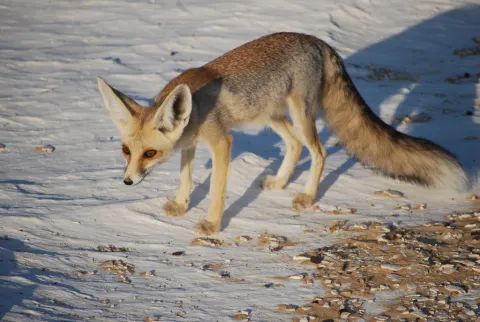
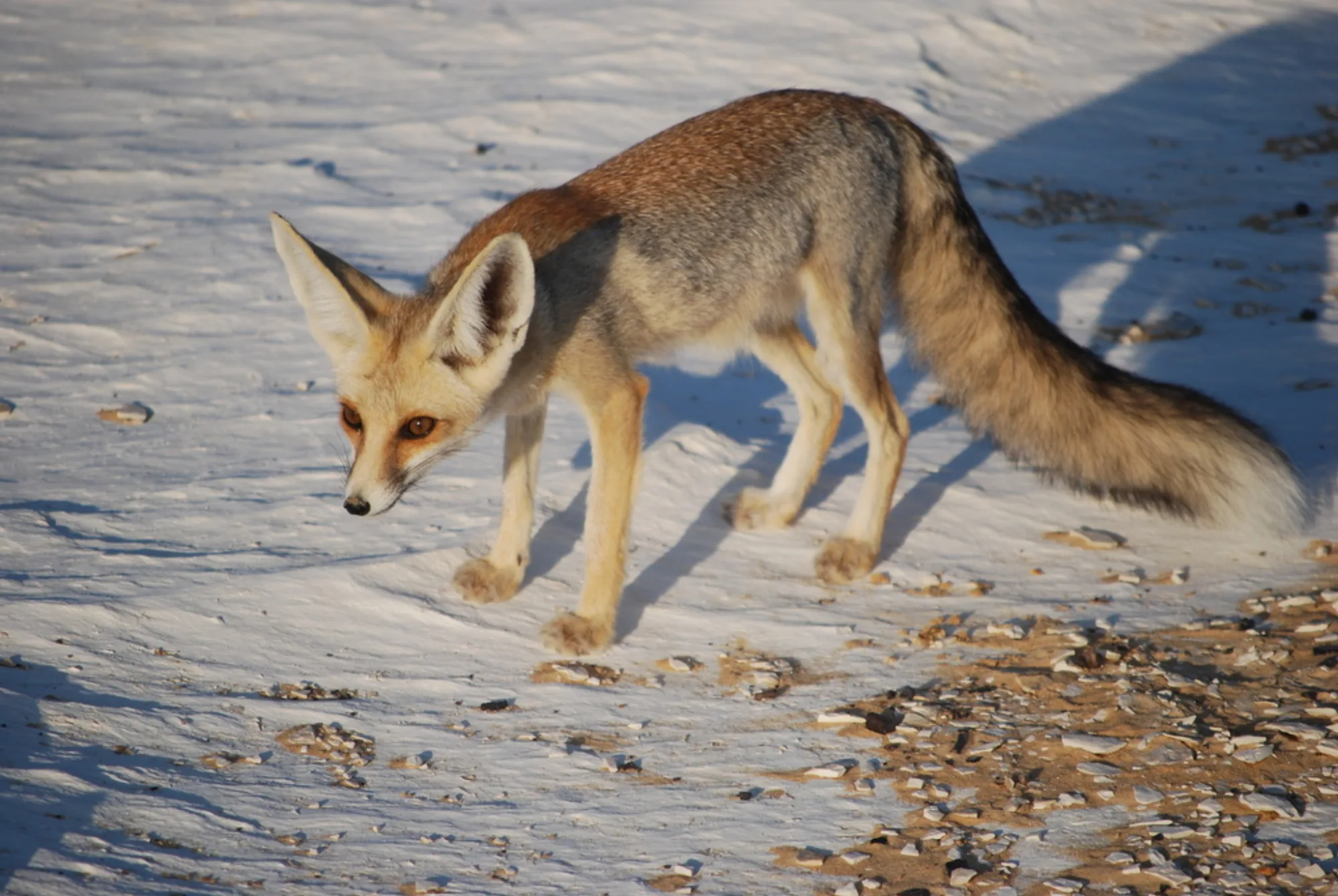
Large ears and a bushy white-tipped tail help distinguish the Rüppell's Fox from other foxes sharing parts of its range. Its soft coat is sandy and brown, flecked with white hairs, with paler flanks and white underparts. Rusty tones colour the forehead and muzzle, while dark brown patches extend towards the eyes. The fox measures 66 to 74 cm in total length, including a tail of 27 to 30 cm.
Its range stretches from North Africa through the Middle East to southwestern Asia, covering deserts and semi-desert regions. It favours sandy or rocky deserts, but also lives in semiarid steppes and sparse scrub. In the Sahara it appears to avoid the driest central areas, occurring more often around the edges, in mountain massifs and near oases. It is usually active at dusk or at night, spending the day in an underground den, although it sometimes ventures out during winter days. At night, a foraging fox can travel over 9 km.
Food depends on what is available locally, from beetles and other insects to small mammals, lizards and birds. The fox also eats grasses, desert succulents and fruit, and may scavenge from human rubbish. Pairs share a breeding den with their young, but occupy separate dens outside the mating season. Litters usually contain two or three kits, which are born blind and become independent at about four months. Competition with red foxes and human settlements are thought to limit its range. Steppe eagles and eagle-owls are its reported natural predators.
Written from the English Wikipedia article Rüppell's fox (CC BY-SA 4.0).
- Records
- 35
- Countries
- 2
No atlas park has a record of the Rüppell's Fox in or around it yet.
These are open occurrence records, so they show where people looked for and recorded the Rüppell's Fox as much as where it lives. Cells are up to 25 km across, and every location is generalised to its cell.
Generalised encounter areas, not exact locations. Each shape is a grid cell coloured by how likely the species is there.
- Very likelyDjibouti25 km zone · medium confidence · 26 records · updated 80 days ago
- PossibleWestern Sahara25 km zone · medium confidence · 9 records · updated 80 days ago
Conservation status not assessed here yet, so every location is generalised to its grid cell.