Arctic Fox
Vulpes lagopus
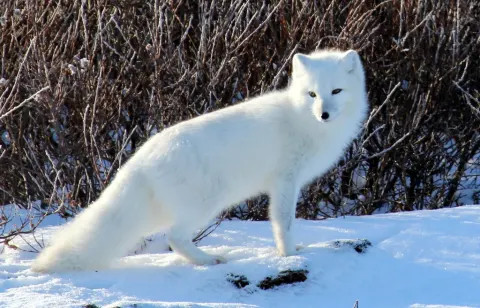
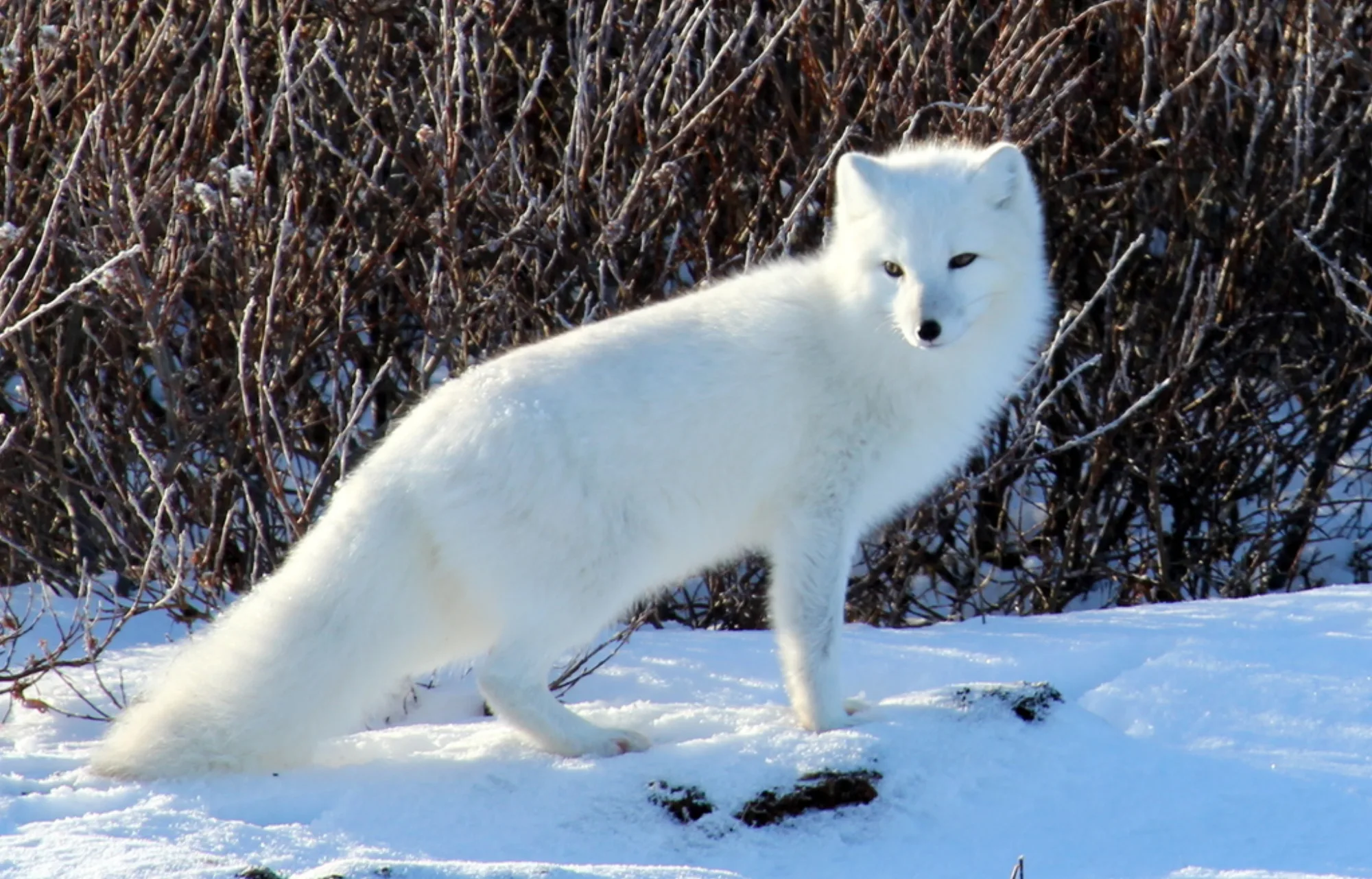
At home on Arctic tundra and pack ice, the Arctic Fox (Vulpes lagopus) is a small fox with a rounded body, short legs and a large, fluffy tail. Its coat changes with the seasons: the white form is generally brown and cream in summer, turning white in winter, while the darker blue form becomes only slightly lighter. Its long, thick winter fur helps it retain heat and can camouflage it against snow.
The fox ranges around the Arctic, from northern parts of Europe and Asia to North America, including Iceland, Greenland, Alaska and Canada. It also occurs in Canadian boreal forests and has been seen on sea ice near the North Pole. Active throughout the year, it shelters from wind in dens and reduces its movement in winter. It hunts lemmings, voles, birds, fish and other small animals, and also eats carrion, eggs, berries and seaweed. After hearing prey beneath the snow, it can pounce and break through to catch it. Foxes also store food for leaner months, and build fat reserves in autumn.
Breeding pairs raise their pups together in complex underground dens, sometimes with help from other family members. The pups emerge at 3 to 4 weeks old. Food supplies can shape breeding: inland white foxes may have 6 to 18 pups when lemmings are abundant, but often do not breed when food is scarce. Arctic fox numbers can fall when lemming and vole populations crash, while uncontrolled trapping has nearly wiped out two subpopulations. Red foxes kill Arctic foxes and their pups where their ranges overlap, and reduced snow cover makes the Arctic fox's lighter coat less effective as camouflage.
Written from the English Wikipedia article Arctic fox (CC BY-SA 4.0).
- Records
- 470
- Countries
- 8
- Atlas places
- 1
These are open occurrence records, so they show where people looked for and recorded the Arctic Fox as much as where it lives. Cells are up to 25 km across, and every location is generalised to its cell.
Generalised encounter areas, not exact locations. Each shape is a grid cell coloured by how likely the species is there.
- Very likelyRussia25 km zone · high confidence · 258 records · updated 80 days ago
- Very likelyFinland25 km zone · medium confidence · 71 records · updated 80 days ago
- Very likelyUnited States25 km zone · medium confidence · 47 records · updated 80 days ago
- Very likelySvalbard & Jan Mayen25 km zone · medium confidence · 32 records · updated 80 days ago
- Very likelyIceland25 km zone · medium confidence · 22 records · updated 80 days ago
- Very likelyNorway25 km zone · medium confidence · 13 records · updated 80 days ago
- LikelyCanada25 km zone · medium confidence · 19 records · updated 80 days ago
- LikelyGreenland25 km zone · medium confidence · 8 records · updated 80 days ago
Conservation status not assessed here yet, so every location is generalised to its grid cell.