Tibetan Fox
Vulpes ferrilata
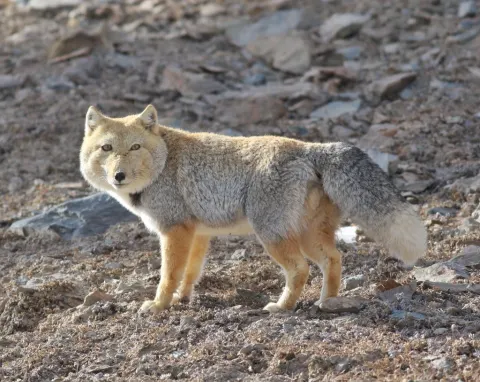
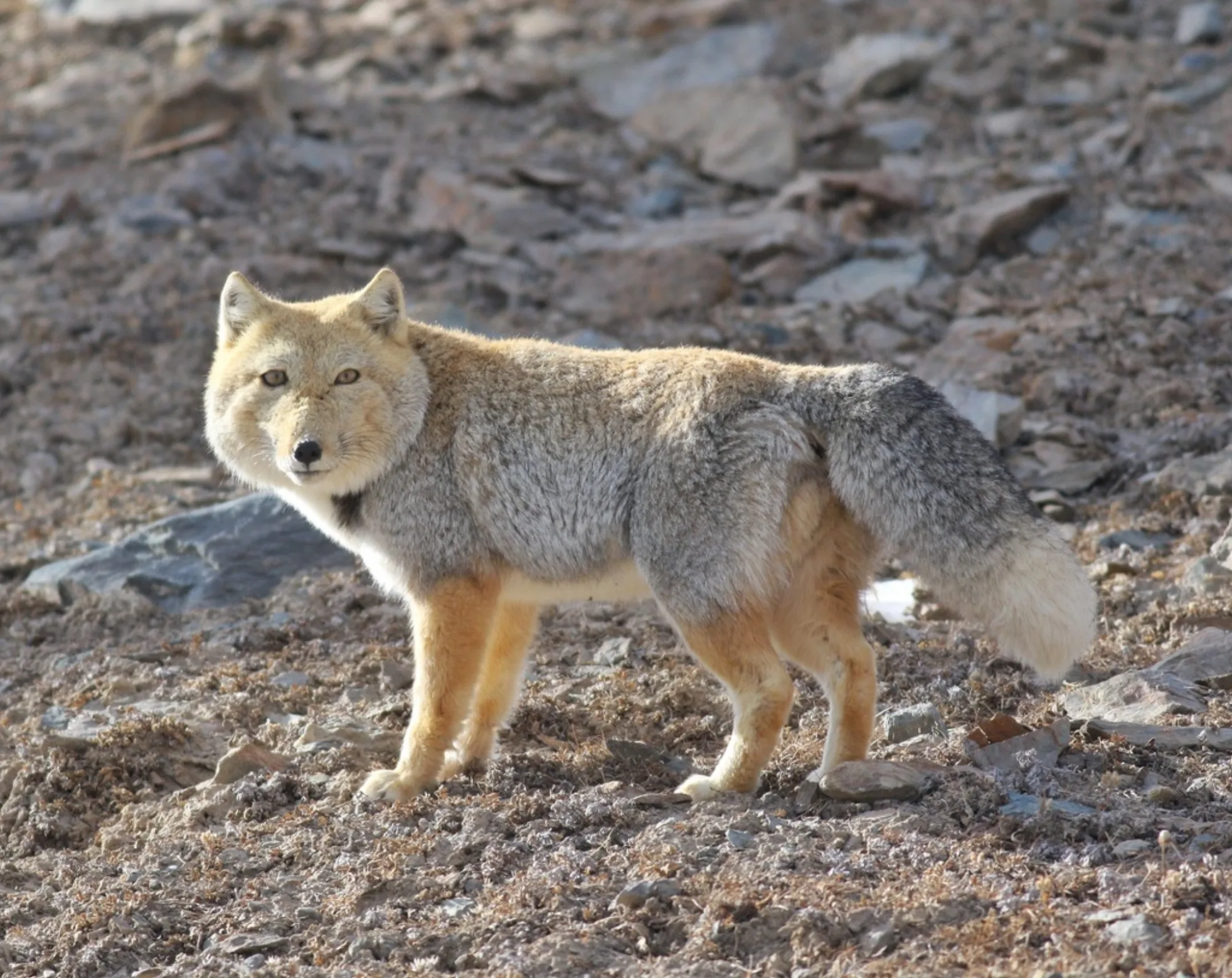
With its narrow muzzle, grey cheeks and white-tipped bushy tail, the Tibetan Fox has a distinctive appearance. Its soft, dense coat is rufous over the crown, neck and back, while the flanks and upper legs are grey. Its short ears are white inside and underneath, with tan to greyish tan colouring on their backs. Adults measure 60 to 70 cm, excluding a tail of 29 to 40 cm, and usually weigh 4 to 5.5 kg. The fox lives on the high Tibetan Plateau and occurs in Bhutan, China, India and Nepal. It favours dry grasslands away from people and dense vegetation, living on upland plains and hills at elevations of 3,500 to 5,200 m. It has occasionally been seen at around 2,500 m.
Tibetan foxes usually hunt alone during the day, when their main prey, the plateau pika, is active. Their other prey includes marmots, rodents, rabbits and woolly hares, as well as lizards and small birds that live on the ground; they also scavenge carcasses of wild animals and livestock. Sometimes a fox hunts alongside a brown bear, catching pikas as they flee from the bear's digging. Mated pairs stay together and may hunt together too. After a gestation of about 50 to 60 days, a litter of two to four is born in a den; the young stay with their parents for eight to ten months. Burrows can be found at the base of boulders, along old beach lines and on low slopes. Rising temperatures have pushed suitable habitat higher on the plateau, increasing overlap and competition with the red fox.
Written from the English Wikipedia article Tibetan fox (CC BY-SA 4.0).
- Records
- 1
- Countries
- 2
No atlas park has a record of the Tibetan Fox in or around it yet.
These are open occurrence records, so they show where people looked for and recorded the Tibetan Fox as much as where it lives. Cells are up to 25 km across, and every location is generalised to its cell.
Generalised encounter areas, not exact locations. Each shape is a grid cell coloured by how likely the species is there.
- Very likelyChina25 km zone · medium confidence · 1 record · updated 80 days ago
- Very likelyIndia25 km zone · low confidence · 0 records · updated 80 days ago
Conservation status not assessed here yet, so every location is generalised to its grid cell.