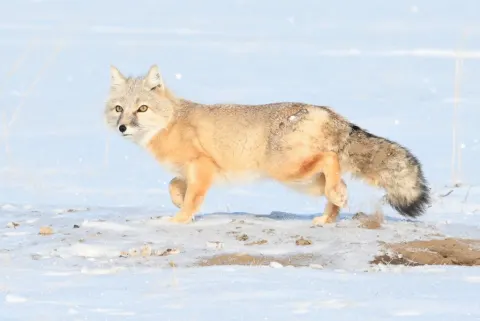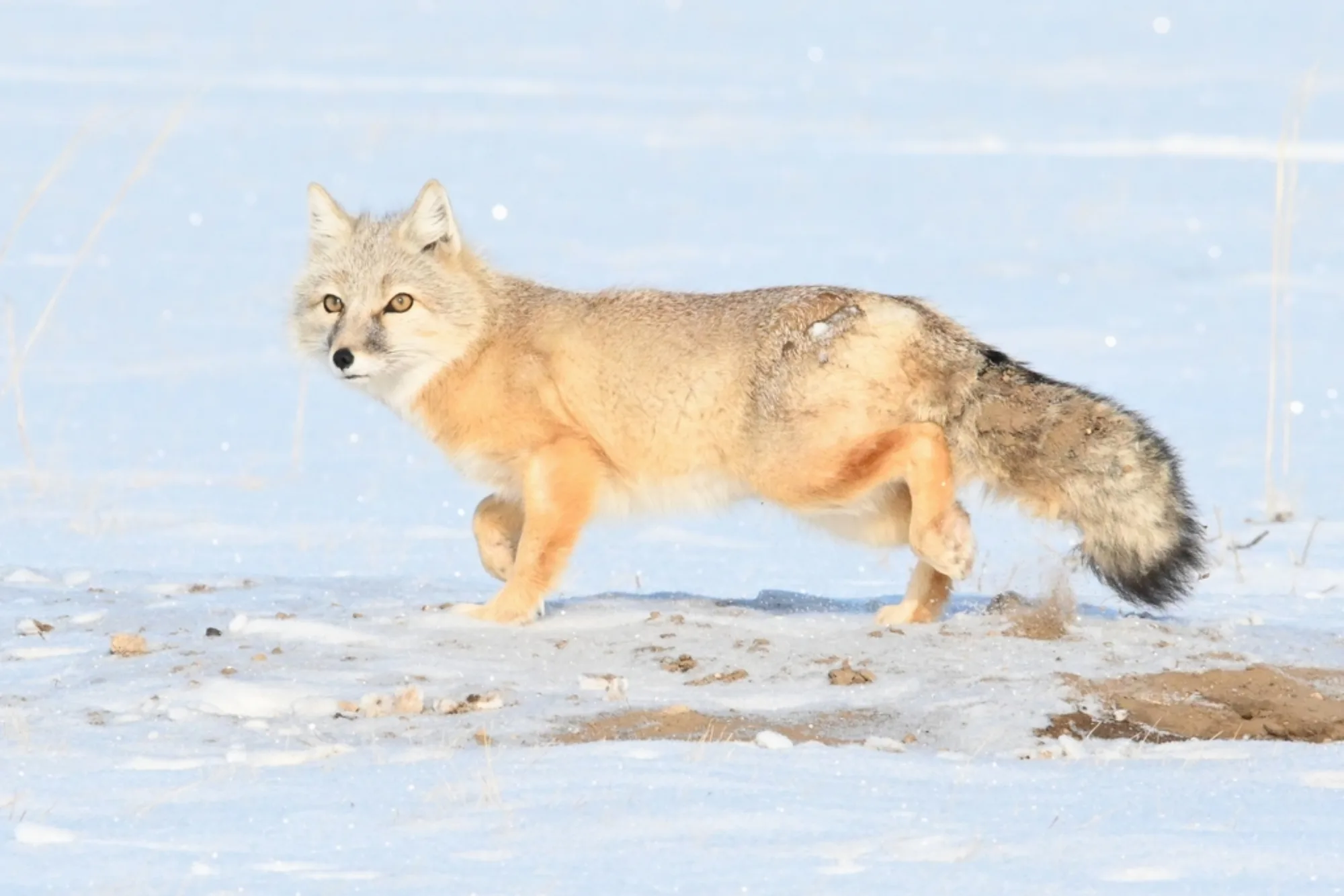
Corsac Fox
Vulpes corsac
Across the open steppes of Central Asia, the Corsac Fox moves through grassland and semi-desert, keeping away from dense vegetation and mountains. Its range stretches across Kazakhstan, Uzbekistan and Turkmenistan, through much of Mongolia and into northern China, with populations in neighbouring parts of Russia and other countries to the south. This medium-sized fox has grey to yellowish fur, paler underparts and light markings around its mouth, chin and throat. In winter, its coat grows thick and silky, turning straw-grey with a darker stripe along the back. Deep snowfields and deserts of drifting sand are places it tends to avoid, as are areas disturbed by people.
The fox hunts mainly at night and wanders rather than defending a territory, sometimes travelling in a pack. Small rodents, other small and medium-sized animals and insects make up much of its diet, although it also takes hares and pikas, scavenges and occasionally eats fruit and other vegetation. In harsh weather it shelters in a den, while some northern foxes travel south for winter. It digs shallow dens or takes over other animals' burrows, and social packs may share a network of dens and connecting holes. Breeding takes place from January to March, and both parents help raise the young. A litter typically contains two to six kits, which emerge from the den shortly after they begin eating meat at four weeks.
Poaching for fur is a major threat, and heavy hunting has reduced populations in some areas. Livestock overgrazing and landscape development also pose threats, while a decline in marmots may reduce the availability of burrows used for daytime shelter. Natural disasters can cause sharp local declines, although populations often recover quickly.
Written from the English Wikipedia article Corsac fox (CC BY-SA 4.0).
- Records
- 0
- Countries
- 1
No atlas park has a record of the Corsac Fox in or around it yet.
These are open occurrence records, so they show where people looked for and recorded the Corsac Fox as much as where it lives. Cells are up to 25 km across, and every location is generalised to its cell.
Generalised encounter areas, not exact locations. Each shape is a grid cell coloured by how likely the species is there.
- Very likelyRussia25 km zone · low confidence · 0 records · updated 80 days ago
Conservation status not assessed here yet, so every location is generalised to its grid cell.