Cape Fox
Vulpes chama
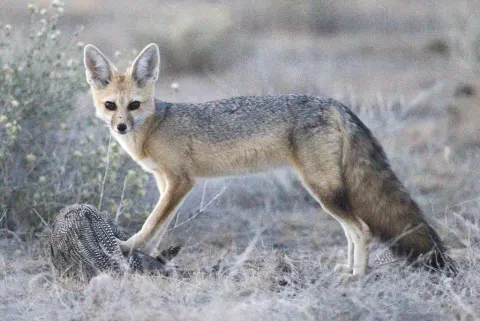
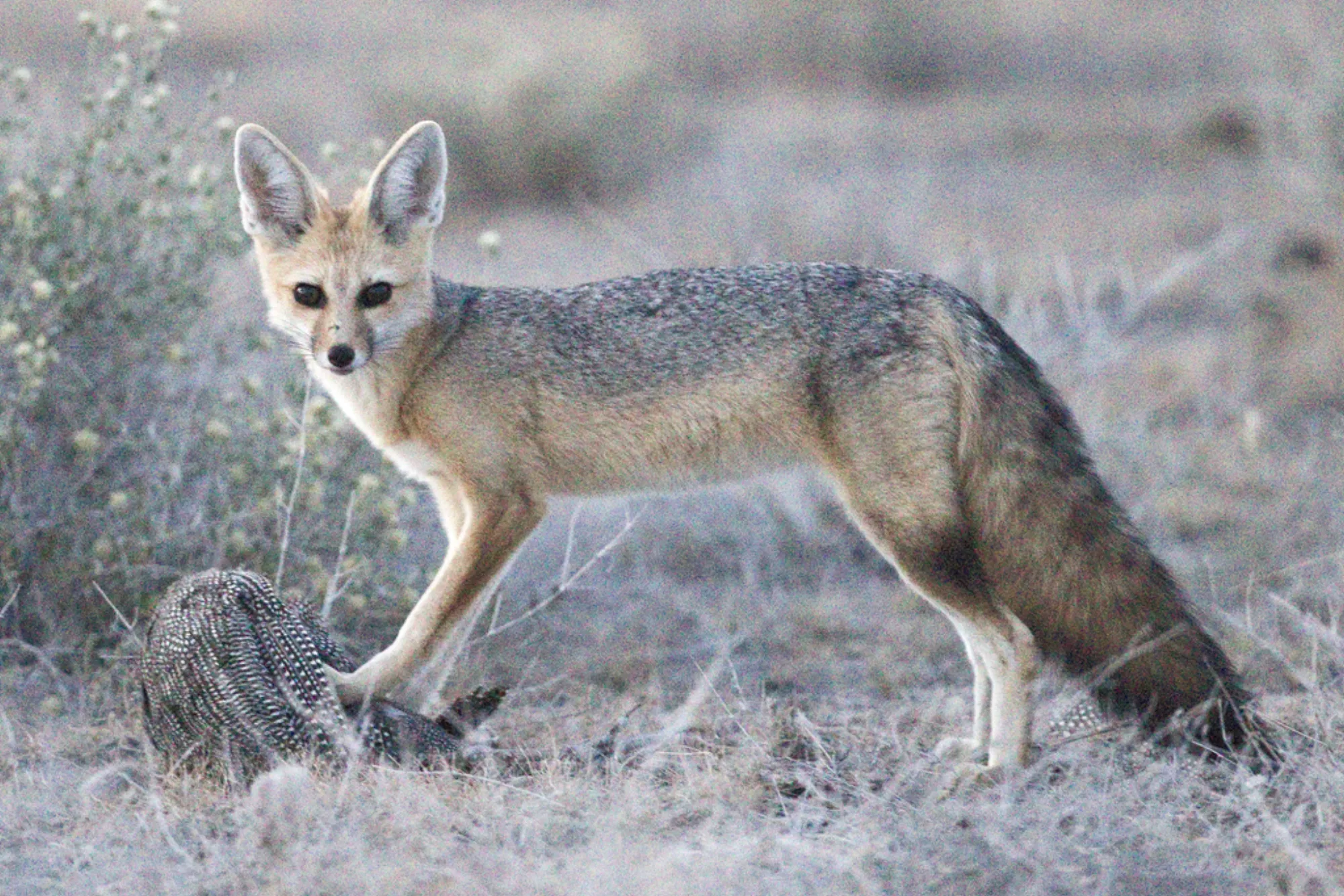
Look for the Cape Fox in the soft light before dawn or after dusk, when this small southern African fox is most active. Its silvery-grey coat, large pointed ears and bushy tail with a black tip make a distinctive combination. The head is dull red, the legs are tawny and the underparts are pale.
Cape Foxes are widespread in Botswana, Zimbabwe and South Africa, and also occur in Lesotho and south-western Angola. They favour arid and semi-arid country, although they also reach wetter areas with denser vegetation in the western Cape. By day, they shelter underground or in hollows and dense thickets, often adapting another animal's abandoned burrow. They usually forage alone, even when paired, but sometimes gather in loose groups to feed. Small mammals and insects make up much of their diet, supplemented by birds, reptiles, carrion and fruit. They also hide food in holes for later.
A female gives birth to one to six cubs after a gestation of 51 to 53 days. Both parents care for the young, which are raised underground and often play outside during daylight. The cubs stay near the den until about four months old, when they begin to forage. Farmers often target Cape Foxes because they are presumed to prey on livestock, particularly lambs. Control methods include leg-hold traps and agricultural poisons, and these measures have caused declines in some areas. Road vehicles also kill many foxes, while rabies and canine distemper are further threats.
Written from the English Wikipedia article Cape fox (CC BY-SA 4.0).
- Records
- 6
- Countries
- 3
- Atlas places
- 2
These are open occurrence records, so they show where people looked for and recorded the Cape Fox as much as where it lives. Cells are up to 25 km across, and every location is generalised to its cell.
Generalised encounter areas, not exact locations. Each shape is a grid cell coloured by how likely the species is there.
- Very likelySouth Africa25 km zone · medium confidence · 5 records · updated 80 days ago
- LikelyNamibia25 km zone · medium confidence · 1 record · updated 80 days ago
- RareBotswana25 km zone · low confidence · 0 records · updated 80 days ago
Conservation status not assessed here yet, so every location is generalised to its grid cell.