Blanford's Fox
Vulpes cana
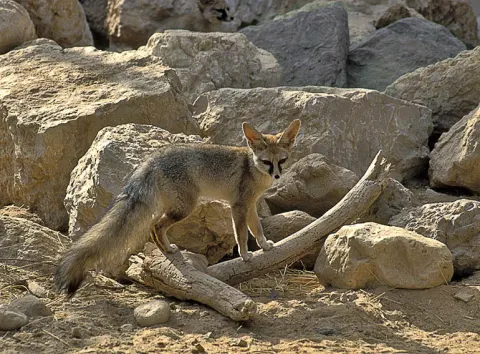
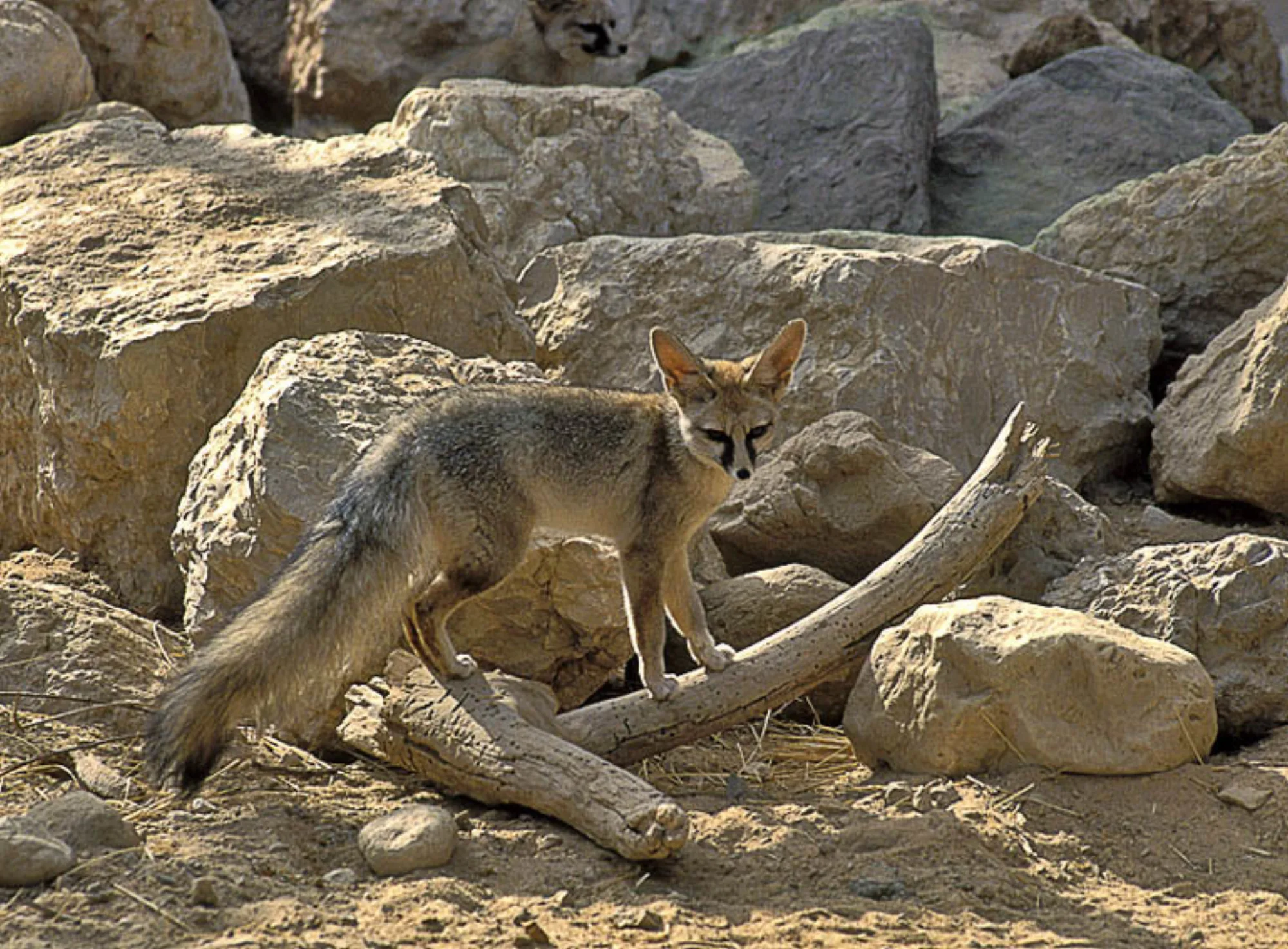
Wide ears and a long, bushy tail give the Blanford's Fox its distinctive outline. This small fox has brownish-grey fur that fades to light yellow on the belly, while its tail is usually black at the tip, though some individuals have a white tip. In winter its coat is soft and woolly, with white speckles across the back; in summer the fur is paler and less thick. It is an agile climber, able to reach ledges 3 m above it and work its way up crumbling cliffs in a series of jumps. Its tail helps it balance on narrow ledges.
The fox has a discontinuous range spanning western and central Asia and extending into southern Asia. Records place it around the Iranian Plateau, Turkmenistan and Pakistan, as well as in places including Israel, Jordan, Oman, Saudi Arabia and the United Arab Emirates. It has also been recorded in Yemen, including in Hawf Forest and Wadi Sharis. Rocky cliffs and the desert of Israel are among the settings associated with this strictly nocturnal fox, so a traveller hoping to see one would need to look after dark. It usually searches for food alone, eating mainly insects and fruit, including caperbush fruit in Israel and melons and grapes in Pakistan. Pairs are thought to stay with one mate, and females give birth to one to three young after a gestation of around 50 to 60 days. At two months the kits begin to forage with a parent, and at 3 months they start to forage alone. In Afghanistan, some foxes are hunted for fur, while others occasionally encounter poison set out for hyenas and other animals. Little is known about their vulnerability to diseases carried by domestic dogs.
Written from the English Wikipedia article Blanford's fox (CC BY-SA 4.0).
- Records
- 0
- Countries
- 3
No atlas park has a record of the Blanford's Fox in or around it yet.
These are open occurrence records, so they show where people looked for and recorded the Blanford's Fox as much as where it lives. Cells are up to 25 km across, and every location is generalised to its cell.
Generalised encounter areas, not exact locations. Each shape is a grid cell coloured by how likely the species is there.
- Very likelyIsrael25 km zone · low confidence · 0 records · updated 80 days ago
- PossibleUnited Arab Emirates25 km zone · low confidence · 0 records · updated 80 days ago
Conservation status not assessed here yet, so every location is generalised to its grid cell.