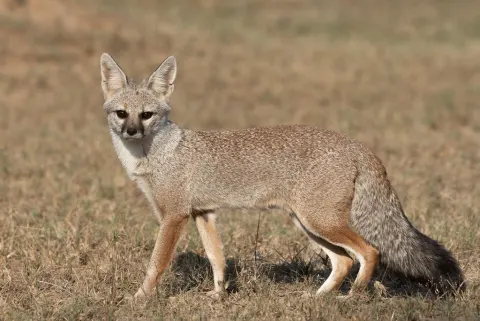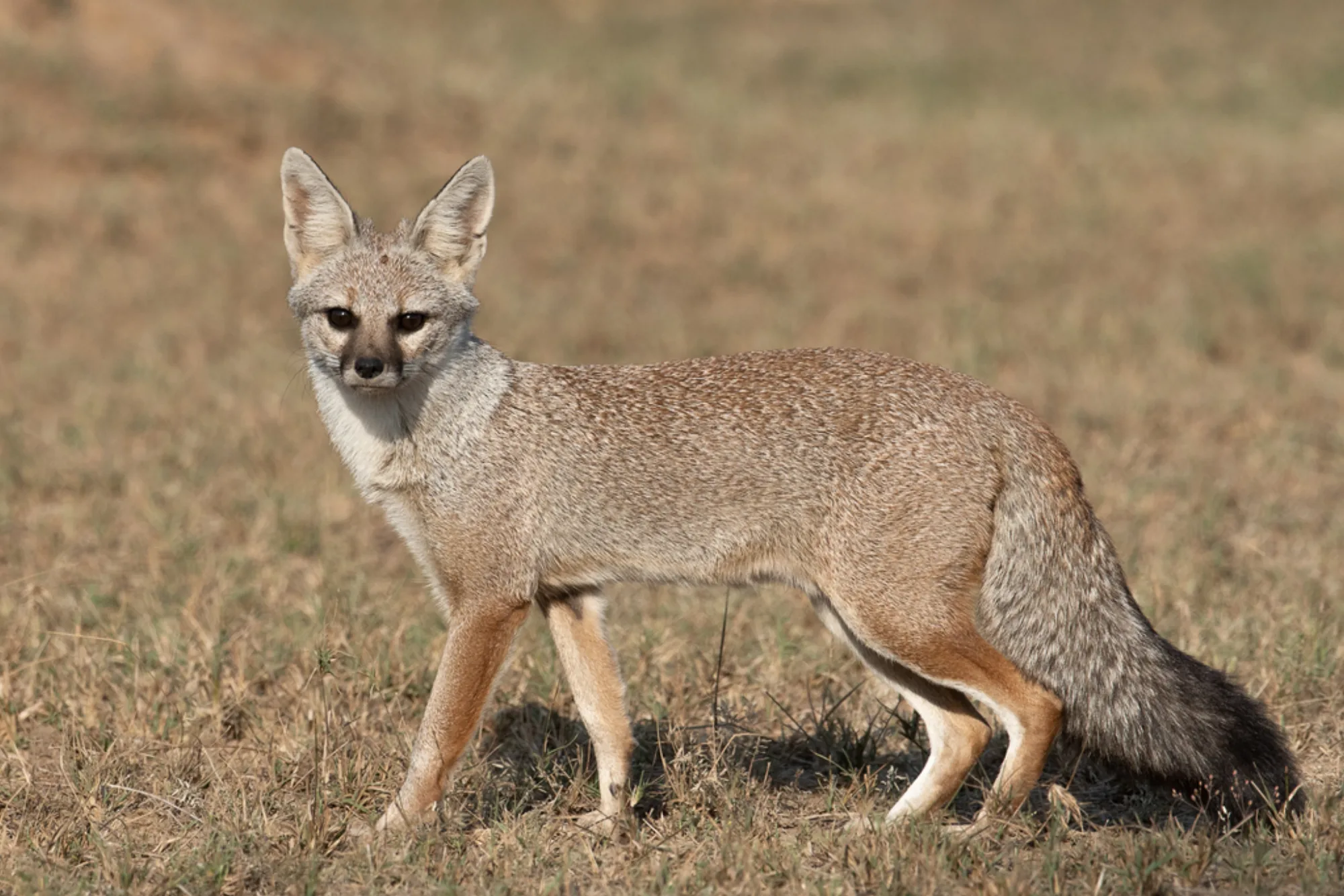
Bengal Fox
Vulpes bengalensis
With its pointed ears, slender muzzle and bushy, black-tipped tail, the Bengal Fox is a small fox of the Indian subcontinent. Its coat varies with place and season, but is generally reddish grey above, with paler sides and reddish limbs. Its range extends from the Himalayan foothills and Nepal's Terai through southern India, and from parts of Pakistan east to India and southeastern Bangladesh. Look for it in dry, open country, particularly semiarid short grassland, bush and scrub; it avoids dense forest, steep ground, tall grass and true desert.
Bengal Foxes are mostly active around twilight and at night, although they sometimes emerge during cooler parts of the day. In warmer daylight hours they shelter beneath vegetation or in underground dens, which range from simple resting places to complexes with multiple entrances. A breeding pair forms the basic social unit, and its bond can last for many years. The foxes eat whatever suitable food is available, including insects, small mammals, reptiles, small birds and fruit. Across most of the range, breeding takes place in December and January; after roughly 50 to 53 days, a litter of two to four pups arrives in a den. Both parents rear and protect the pups, which play during their first 3 months.
Grassland conversion for agriculture, industry and biofuel plantations has reduced habitat and affected population density. Hunting for skin and flesh, the use of body parts in traditional medicine, and disease also threaten the fox. In western India, outbreaks of canine distemper and rabies have reduced fox numbers locally.
Written from the English Wikipedia article Bengal fox (CC BY-SA 4.0).
- Records
- 18
- Countries
- 2
- Atlas places
- 2
These are open occurrence records, so they show where people looked for and recorded the Bengal Fox as much as where it lives. Cells are up to 25 km across, and every location is generalised to its cell.
Generalised encounter areas, not exact locations. Each shape is a grid cell coloured by how likely the species is there.
- Very likelyIndia25 km zone · medium confidence · 14 records · updated 80 days ago
- Very likelyNepal25 km zone · medium confidence · 4 records · updated 80 days ago
Conservation status not assessed here yet, so every location is generalised to its grid cell.