Marbled Polecat
Vormela peregusna
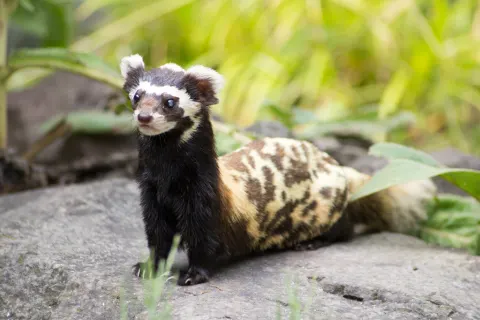
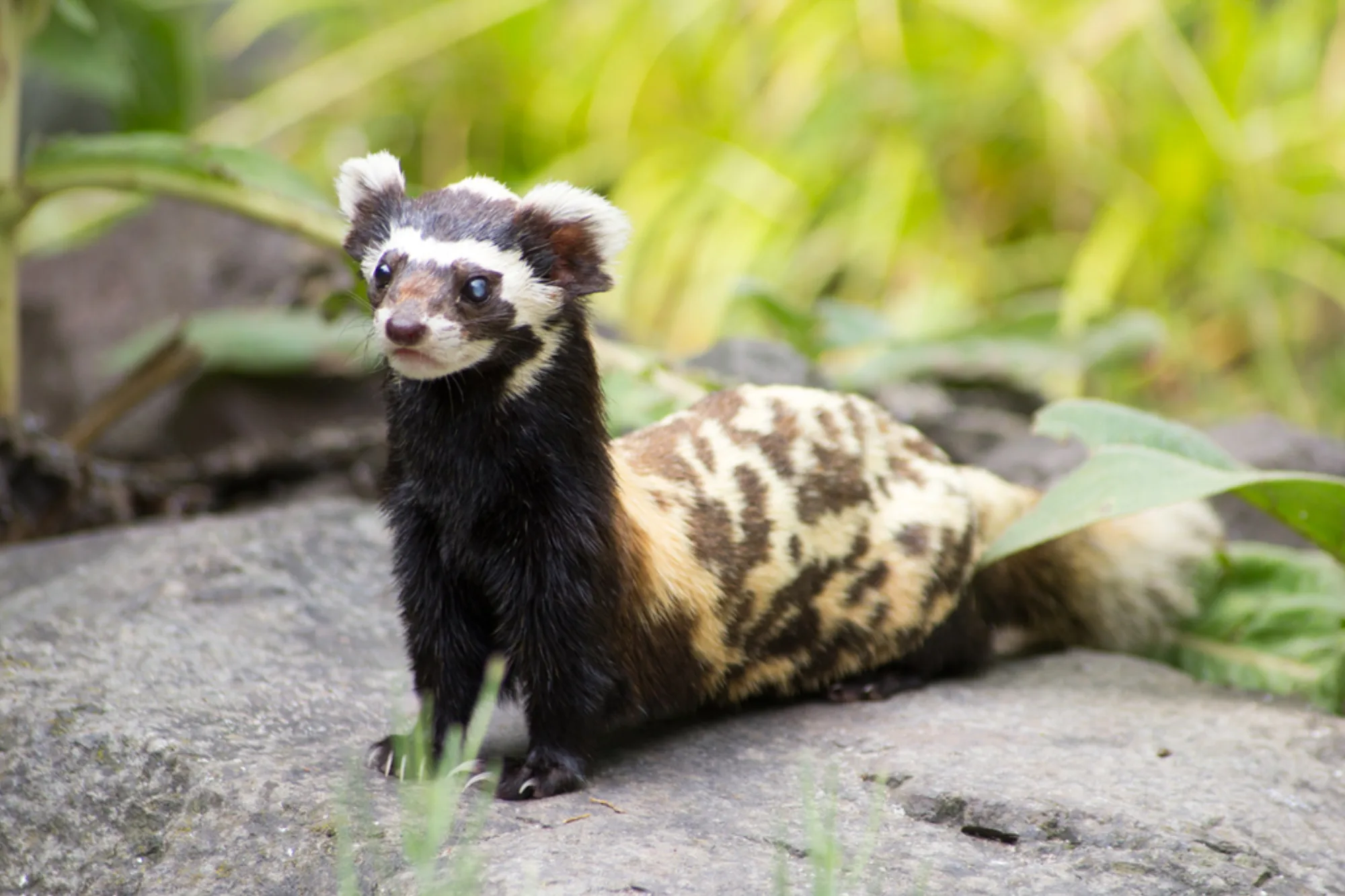
With its large ears and boldly patterned coat, the Marbled Polecat (Vormela peregusna) is a small mustelid of dry, open country. Its yellow back is heavily marked with irregular reddish or brown spots, while its face has a dark eye band and white markings around the mouth. Short legs and a long, hairy tail add to its distinctive outline. A yellowish band breaks up the dark brown tail, while the legs and underside are also dark brown. Head and body measure 29 to 35 cm.
Its range stretches from southeastern Europe and the Balkans through the Caucasus, the Levant and Central Asia, reaching north-western Pakistan, southern Mongolia and parts of northern China. It lives in desert, semidesert, steppe, rocky upland valleys and low hills, as well as dry subtropical scrub forest, but avoids mountain regions. It has also been seen in cultivated places, including melon patches and vegetable fields. Most active in the morning and evening, it lives alone and uses its keen sense of smell to make up for weak eyesight. When alarmed, it arches its back and curls its raised tail over it; if threatened, it can release a foul-smelling secretion.
For shelter and breeding, it uses rodent burrows, digs its own dens or occupies underground irrigation tunnels. Its varied diet includes rodents, small hares, birds, lizards, insects, fruit and grass. Litters contain four to eight cubs, and only the female cares for them. Habitat loss and a decline in prey associated with rodenticide use are thought to be driving population declines.
Written from the English Wikipedia article Marbled polecat (CC BY-SA 4.0).
- Records
- 28
- Countries
- 3
No atlas park has a record of the Marbled Polecat in or around it yet.
These are open occurrence records, so they show where people looked for and recorded the Marbled Polecat as much as where it lives. Cells are up to 25 km across, and every location is generalised to its cell.
Generalised encounter areas, not exact locations. Each shape is a grid cell coloured by how likely the species is there.
- Very likelyUkraine25 km zone · medium confidence · 24 records · updated 80 days ago
- PossibleMontenegro25 km zone · medium confidence · 4 records · updated 80 days ago
- UncommonGeorgia25 km zone · low confidence · 0 records · updated 80 days ago
Conservation status not assessed here yet, so every location is generalised to its grid cell.