Small Indian Civet
Viverricula indica
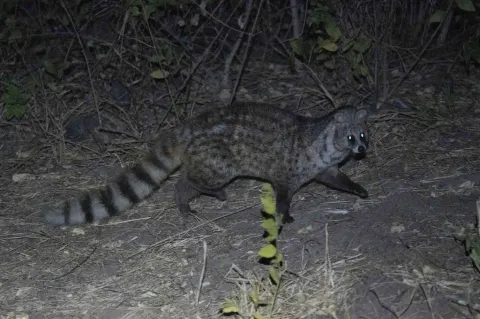
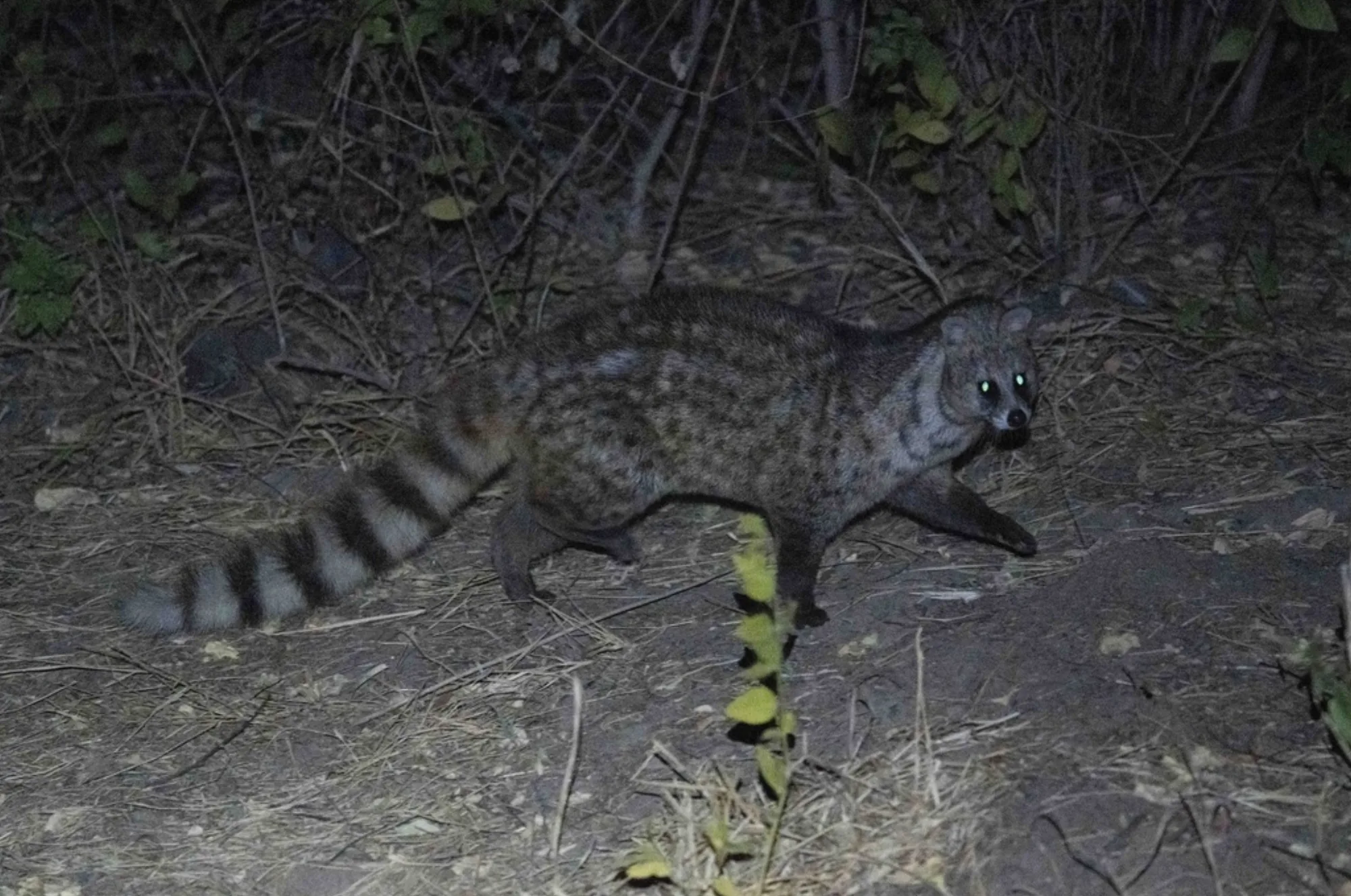
Coarse brownish-grey to pale yellowish-brown fur, dark bands along the back and rows of spots on the sides give the Small Indian Civet its patterned appearance. Its short ears are rounded, its feet are brown or black, and its tapering tail has alternating black and whitish rings. Head and body measure 53 to 58 cm, with a tail 38 to 43 cm long. The markings vary: some individuals have indistinct lines and spots, with no bands on the back.
Native to South and Southeast Asia, it occurs across most of India and in Sri Lanka, Myanmar, Thailand, Laos, Cambodia, Vietnam, southern and central China, and Taiwan. It has been introduced to Madagascar, Pemba Island and Mafia Island. Its habitats range from grasslands and scrub to bamboo, deciduous and semi-evergreen forests. It has also been recorded beside rivers, near water bodies and in marshes, as well as near a tea plantation and a village water hole.
Mostly active at night and on the ground, the civet can also climb well. In places undisturbed by people, it sometimes hunts during the day. It shelters in ground holes, beneath rocks or in thick bush, and sleeps in burrows or hollow logs. It may dig a burrow itself or take over one abandoned by another species. In suburban areas, gutters and other dark, hollow spaces can serve as makeshift dens. It eats insects and a range of other foods, from rodents and snakes to fruit, roots and dead animals; some have also been seen carrying off poultry. Pairs sometimes form to hunt, and females usually give birth to four or five young. The young open their eyes after five days.
Written from the English Wikipedia article Small Indian civet (CC BY-SA 4.0).
- Records
- 36
- Countries
- 9
- Atlas places
- 4
These are open occurrence records, so they show where people looked for and recorded the Small Indian Civet as much as where it lives. Cells are up to 25 km across, and every location is generalised to its cell.
Generalised encounter areas, not exact locations. Each shape is a grid cell coloured by how likely the species is there.
- Very likelyIndia25 km zone · medium confidence · 23 records · updated 80 days ago
- Very likelyThailand25 km zone · medium confidence · 10 records · updated 80 days ago
- LikelyHong Kong SAR China25 km zone · medium confidence · 1 record · updated 80 days ago
- LikelySri Lanka25 km zone · medium confidence · 1 record · updated 80 days ago
- LikelyVietnam25 km zone · medium confidence · 1 record · updated 80 days ago
- LikelyPakistan25 km zone · low confidence · 0 records · updated 80 days ago
- PossibleCambodia25 km zone · low confidence · 0 records · updated 80 days ago
- PossibleChina25 km zone · low confidence · 0 records · updated 80 days ago
- UncommonTaiwan25 km zone · low confidence · 0 records · updated 80 days ago
Conservation status not assessed here yet, so every location is generalised to its grid cell.