Adder
Vipera berus
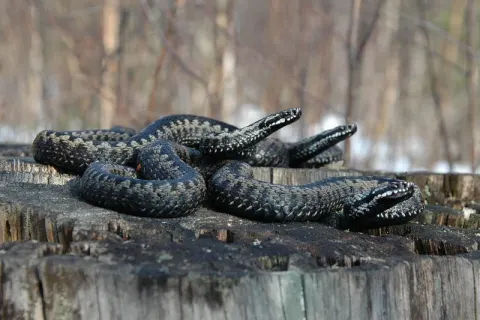
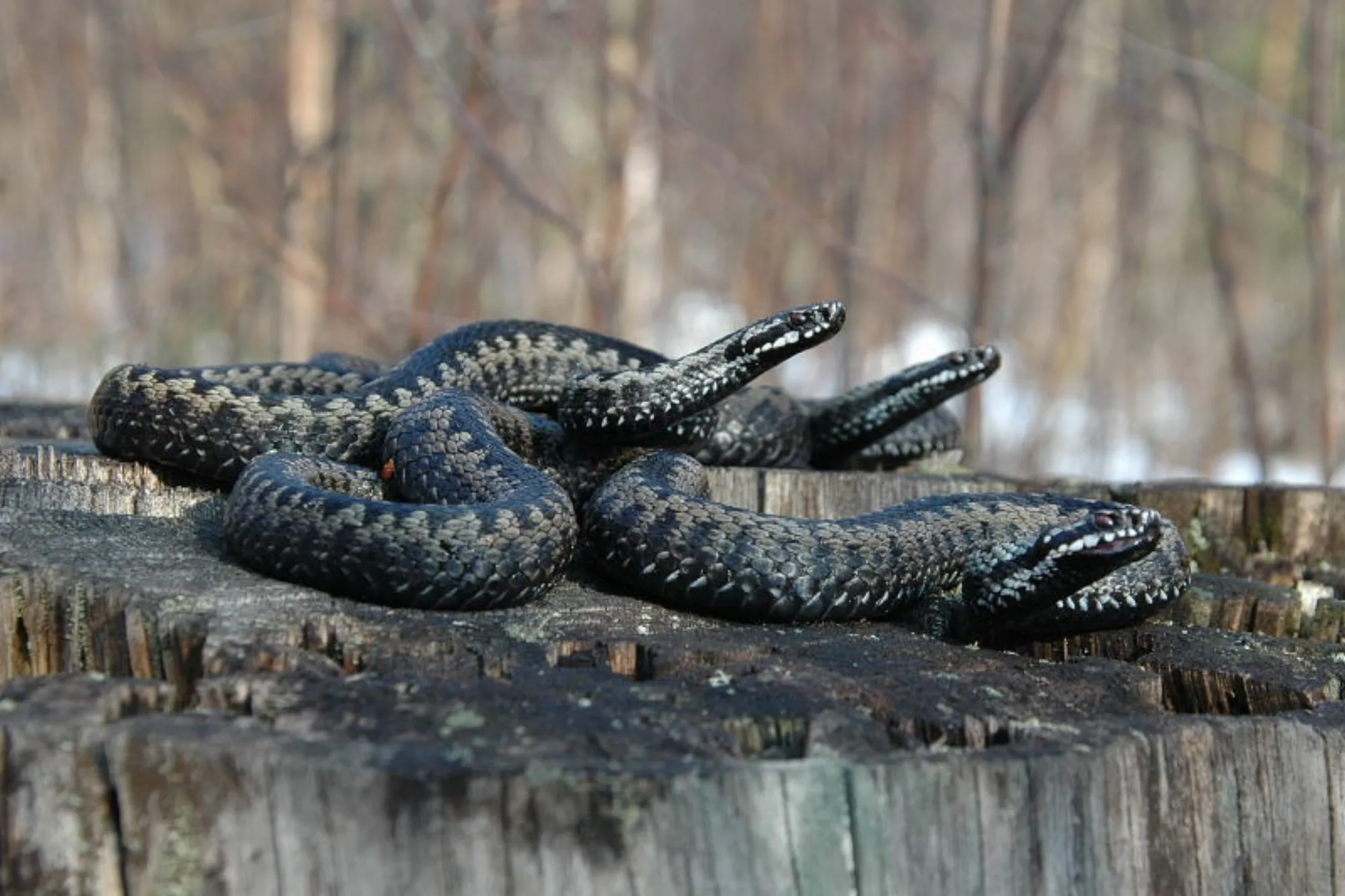
A dark zigzag running along the back and tail is the most familiar pattern of the Adder, a thick-bodied venomous snake. Colour varies: females are typically brown with darker brown markings, while males are usually grey with black markings. Some individuals are entirely black, with no visible pattern on the back. Adults usually reach 60 cm in total length, including the tail, although the largest specimens have been found in Scandinavia.
The Adder ranges across much of Europe and through Russia to the Pacific Ocean, as well as parts of East Asia. It lives farther north than any other snake species, reaching beyond the Arctic Circle. Look for it in places with a mix of features for basking, hunting and hibernating, from heath and moorland to woodland edges, clearings and coastal dunes. Where dry ground is close, it also ventures into wetlands beside ponds, lakes and streams. In the Swiss Alps, it can occur at around 3,000 m.
Adders are mainly active by day, especially in the north, though farther south they may emerge in the evening or on summer nights. They often retreat into undergrowth when disturbed, returning to the same spot when it is quiet. Their diet includes small mammals, lizards, amphibians and birds. They hibernate in winter, sometimes emerging to bask on mild days. Females generally breed every two or three years and give birth to live young, usually in late summer or early autumn. The young may stay near their mother for several days. Habitat loss and fragmentation, intensive agriculture and collection for the pet trade or venom extraction contribute to declines; disturbance and poor habitat management are also considered causes in the UK.
Written from the English Wikipedia article Adder (CC BY-SA 4.0).
- Records
- 17,432
- Countries
- 12
No atlas park has a record of the Adder in or around it yet.
These are open occurrence records, so they show where people looked for and recorded the Adder as much as where it lives. Cells are up to 25 km across, and every location is generalised to its cell.
Generalised encounter areas, not exact locations. Each shape is a grid cell coloured by how likely the species is there.
- Very likelyUnited Kingdom25 km zone · high confidence · 6297 records · updated 80 days ago
- Very likelyNorway25 km zone · high confidence · 3633 records · updated 80 days ago
- Very likelyFinland25 km zone · medium confidence · 2813 records · updated 80 days ago
- Very likelyFrance25 km zone · high confidence · 2356 records · updated 80 days ago
- Very likelyDenmark25 km zone · medium confidence · 1124 records · updated 80 days ago
- Very likelyNetherlands25 km zone · high confidence · 632 records · updated 80 days ago
- Very likelyAustria25 km zone · high confidence · 297 records · updated 80 days ago
- Very likelySweden25 km zone · high confidence · 107 records · updated 80 days ago
- Very likelyRussia25 km zone · high confidence · 71 records · updated 80 days ago
- Very likelyPoland25 km zone · high confidence · 63 records · updated 80 days ago
Conservation status not assessed here yet, so every location is generalised to its grid cell.