Asp Viper
Vipera aspis
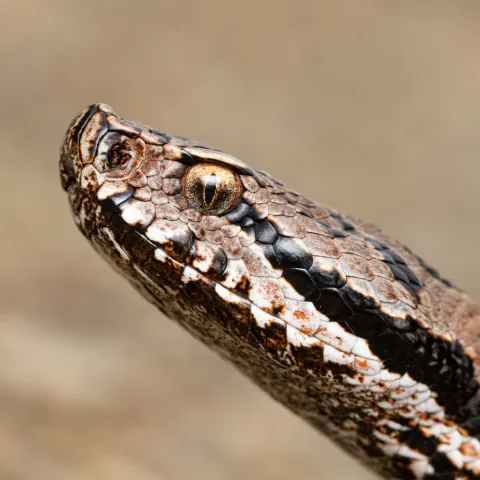
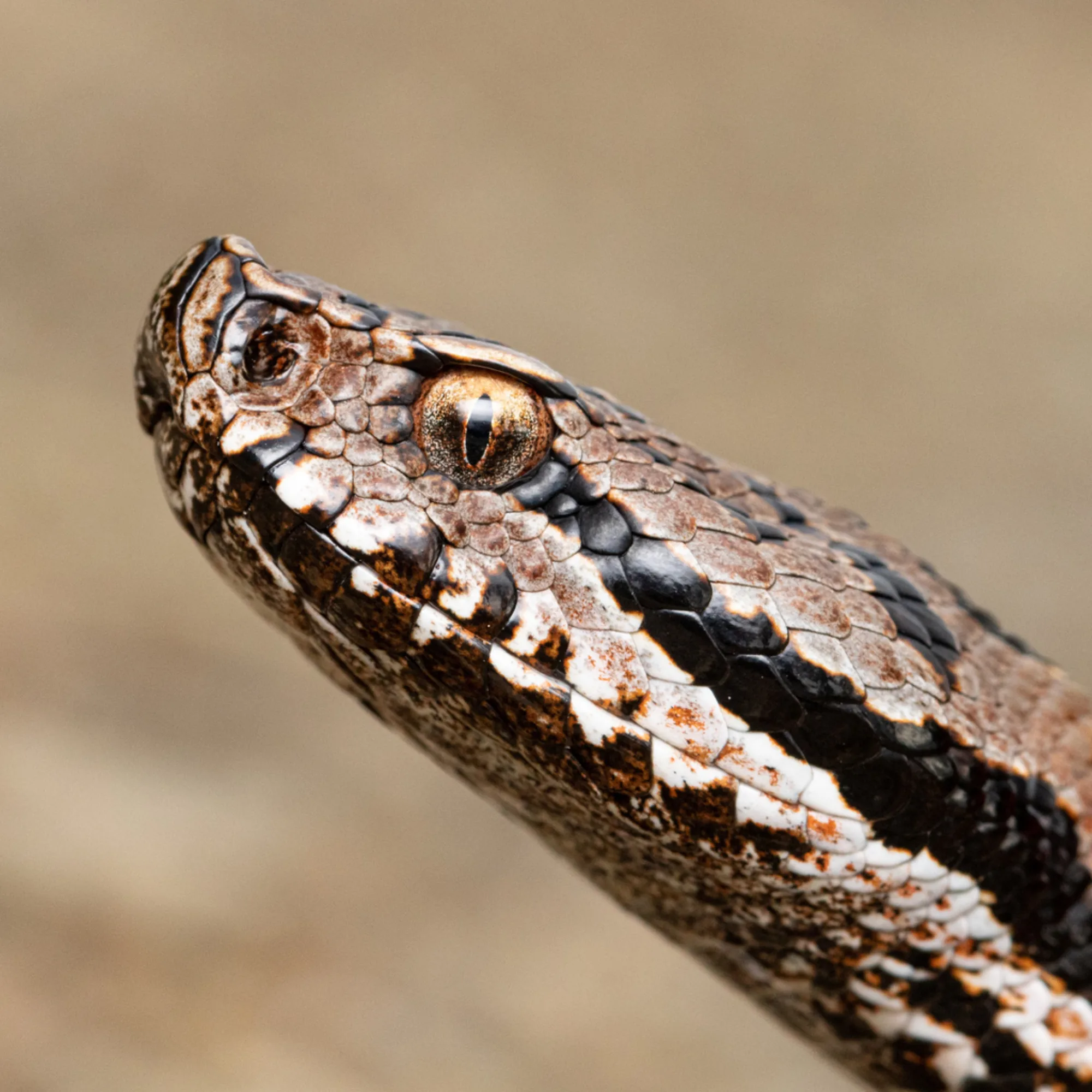
With a broad triangular head, a short tail and a slightly upturned snout, the Asp Viper has a distinctive profile. Its head stands out clearly from its neck, while the markings along its back vary considerably and rarely form a clear zigzag. Adults average 60 to 65 centimetres in total length. Males can reach 85 cm, while females rarely exceed 75 cm and are somewhat less slender. This venomous snake occurs in southwestern Europe, and its bite can be very painful.
Its native range includes France, Andorra, north-eastern Spain, Switzerland, Italy and north-western Slovenia, as well as the southern Black Forest in extreme south-western Germany. It has disappeared from Bulgaria. In Italy and France, it often lives in hills and low mountains, particularly in limestone country, though it also occurs on lower plains. It favours warm, sunny places with relatively dry soil and vegetation that provides some cover. Sunny slopes, scrubland, glades, mountain meadows, forest clearings and woodland edges are among the places where it can be found. It also occurs in stone quarries and rubbish dumps. In Italy, it lives in moist chestnut and oak woodland, often near streams. Although it is not closely tied to high elevations, it has been recorded above 2,100 m in the Pyrenees.
The species has specific habitat requirements, and its population has probably declined by more than 30% over the last 24 years. Its venom varies in toxicity, and bites can be more severe than those of the European adder. Approximately 4% of untreated bites are fatal.
Written from the English Wikipedia article Vipera aspis (CC BY-SA 4.0).
- Records
- 14,840
- Countries
- 5
No atlas park has a record of the Asp Viper in or around it yet.
These are open occurrence records, so they show where people looked for and recorded the Asp Viper as much as where it lives. Cells are up to 25 km across, and every location is generalised to its cell.
Generalised encounter areas, not exact locations. Each shape is a grid cell coloured by how likely the species is there.
- Very likelyFrance25 km zone · high confidence · 14406 records · updated 81 days ago
- Very likelyItaly25 km zone · medium confidence · 192 records · updated 81 days ago
- Very likelySpain25 km zone · medium confidence · 160 records · updated 81 days ago
- Very likelySwitzerland25 km zone · medium confidence · 42 records · updated 81 days ago
- LikelyAndorra25 km zone · medium confidence · 40 records · updated 81 days ago
Conservation status not assessed here yet, so every location is generalised to its grid cell.