Nose-horned Viper
Vipera ammodytes
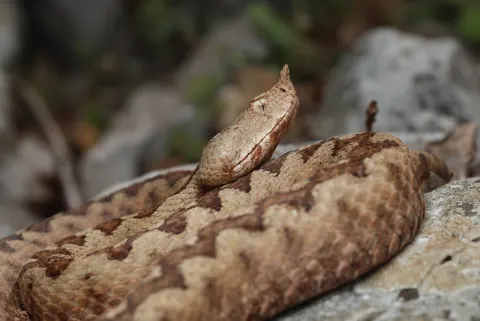
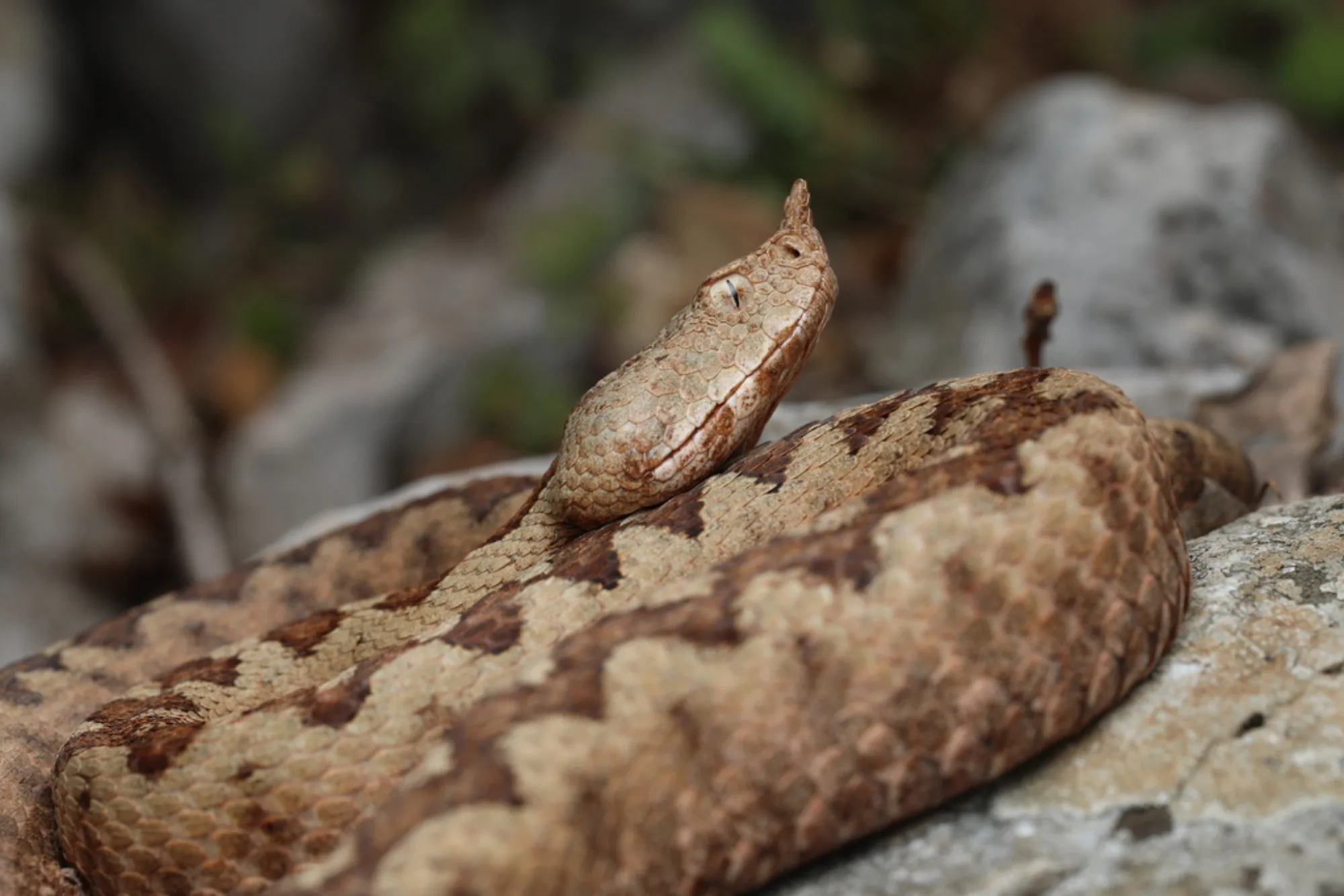
A soft, flexible horn on the snout gives the Nose-horned Viper its most distinctive feature. This venomous snake usually measures less than 75 cm, although its average total length is 85 cm. Both sexes have a dark zigzag along the back against a lighter ground, sometimes broken into separate markings. Males tend to be grey or yellowish brown, while females often have browner or bronze tones and a less distinct pattern.
Its range extends from north-eastern Italy and the Balkans to Turkey, Georgia and Syria. Look for it chiefly on dry, rocky hillsides with sparse vegetation, rather than in the sandy places suggested by one of its common names. It can also occur at woodland edges and in clearings, or around railway embankments, farmland and vineyards with stone walls and piles of rubble. At lower latitudes it may live above 2000 m.
Activity varies with altitude and temperature: at higher elevations it is more active by day, while in warmer lowlands it becomes more nocturnal as daytime temperatures rise. Generally sluggish and reluctant to bite without considerable provocation, a surprised snake may stay still and hiss, flee, or try to bite immediately. It spends 2 to 6 months hibernating in winter, depending on conditions. Adults usually eat small mammals and birds, while young vipers mainly take lizards; other snakes and large arthropods are also eaten. After mating in spring, females give birth to between one and twenty live young from late summer to autumn. The snake is farmed for venom used to make antivenin for bites from other European vipers; no specific threats are described here.
Written from the English Wikipedia article Vipera ammodytes (CC BY-SA 4.0).
- Records
- 90
- Countries
- 14
No atlas park has a record of the Nose-horned Viper in or around it yet.
These are open occurrence records, so they show where people looked for and recorded the Nose-horned Viper as much as where it lives. Cells are up to 25 km across, and every location is generalised to its cell.
Generalised encounter areas, not exact locations. Each shape is a grid cell coloured by how likely the species is there.
- Very likelyCroatia25 km zone · medium confidence · 27 records · updated 80 days ago
- Very likelyGreece25 km zone · medium confidence · 17 records · updated 80 days ago
- Very likelyBulgaria25 km zone · medium confidence · 13 records · updated 80 days ago
- Very likelySlovenia25 km zone · medium confidence · 13 records · updated 80 days ago
- Very likelyAlbania25 km zone · medium confidence · 7 records · updated 80 days ago
- Very likelyRomania25 km zone · medium confidence · 5 records · updated 80 days ago
- Very likelyFinland25 km zone · medium confidence · 3 records · updated 80 days ago
- LikelyItaly25 km zone · medium confidence · 3 records · updated 80 days ago
- LikelyAustria25 km zone · medium confidence · 1 record · updated 80 days ago
- LikelyMontenegro25 km zone · medium confidence · 1 record · updated 80 days ago
Conservation status not assessed here yet, so every location is generalised to its grid cell.