Vicugna
Vicugna vicugna
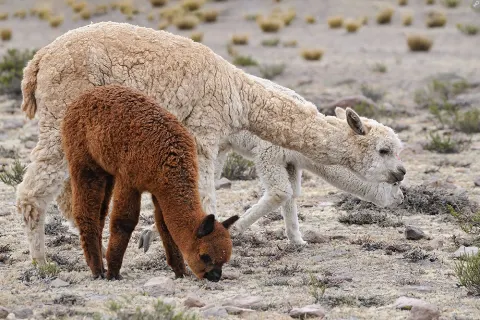
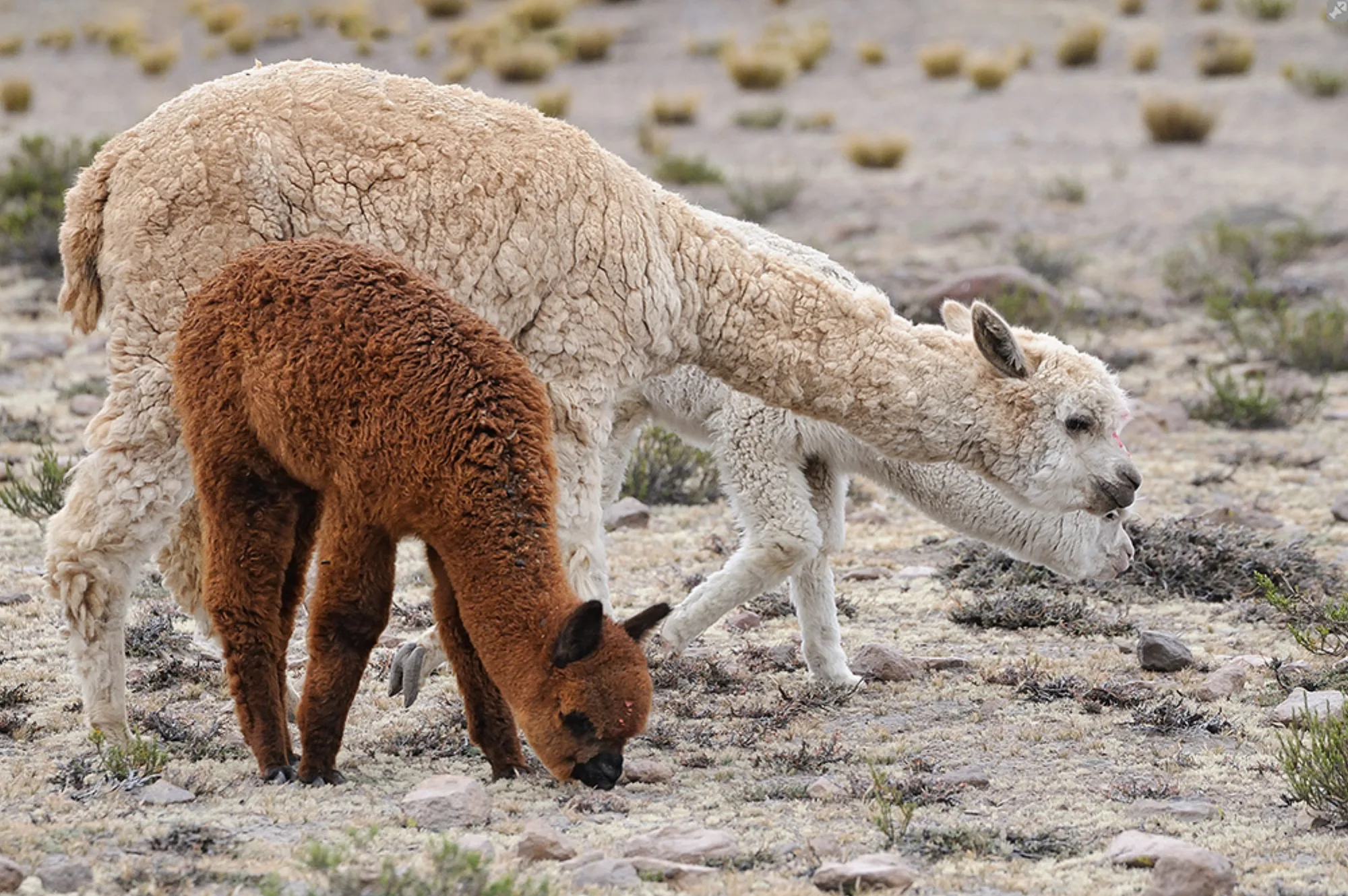
High in the Andes, the Vicugna is a wild South American camelid and a relative of the llama. Smaller and more delicate than the guanaco, it has a long, woolly coat that is tawny brown on the back, with long white hair on the throat and chest. Its head and body measure 1.45 to 1.60 m, and it stands 75 to 85 cm at the shoulder. The thick, soft coat traps warm air close to its body, helping it cope with freezing nights.
Vicugnas live in the central Andes of Peru, northwestern Argentina, Bolivia and northern Chile, with a smaller introduced population in central Ecuador. They inhabit elevations of 3,200 to 4,800 m, feeding on grassy plains by day and spending the night on slopes. Their diet consists mainly of low grasses growing in clumps, and they lick rocks and drink salt water for salt. Timid and quick to react to intruders, they live in families with one male, their young and 5 to 15 females. Each group occupies a territory whose size can change with food availability.
Mating usually takes place in March or April, and after a gestation of about 11 months, a female gives birth to a single fawn. The youngster nurses for about ten months and is independent when it is roughly 12 to 18 months old. Young males then form bachelor groups, while young females look for a group of females to join. Heavy hunting once reduced Vicugna numbers to about 6,000, and although the population has recovered, poaching and habitat loss remain threats. Pumas, culpeos and domestic dogs are among their main predators.
Written from the English Wikipedia article Vicuña (CC BY-SA 4.0).
- Records
- 198
- Countries
- 2
No atlas park has a record of the Vicugna in or around it yet.
These are open occurrence records, so they show where people looked for and recorded the Vicugna as much as where it lives. Cells are up to 25 km across, and every location is generalised to its cell.
Generalised encounter areas, not exact locations. Each shape is a grid cell coloured by how likely the species is there.
- Very likelyEcuador25 km zone · medium confidence · 116 records · updated 80 days ago
- LikelyChile25 km zone · medium confidence · 82 records · updated 80 days ago
Conservation status not assessed here yet, so every location is generalised to its grid cell.