Bandy Bandy
Vermicella annulata
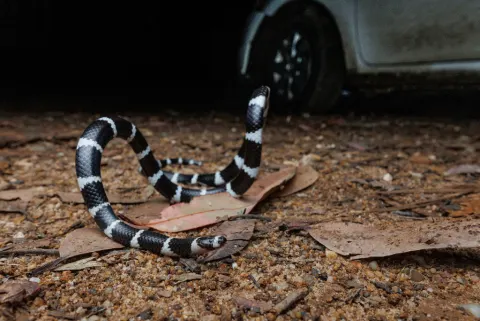
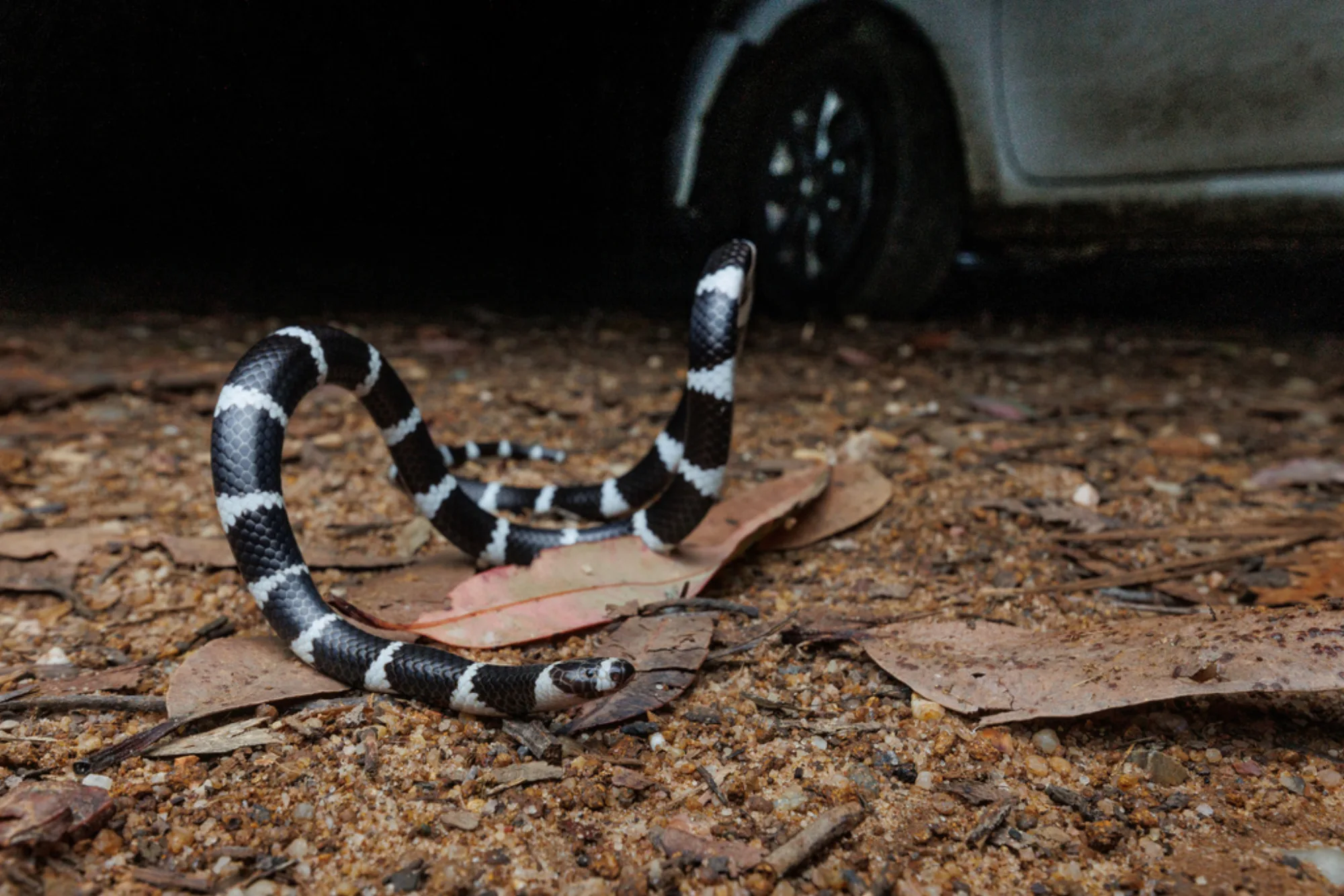
Black and white rings circle the Bandy Bandy from its glossy body to its short, blunt-tipped tail. This venomous snake averages 50 to 60 cm in total length, though males and females differ considerably in size. Its distinctive banding sets it apart from other Australian land snakes. It is weakly venomous, with symptoms localised around the bite, and is generally considered harmless because of its small mouth and inoffensive nature.
Vermicella annulata occurs across northern and eastern Australia, including the east coast, and is also found in south-eastern South Australia. Its habitats range from wet coastal forests and woodland to scrub and desert sandhills. Around Brisbane, it lives in woodland suburbs and is most common in remaining habitat, including Brisbane Forest Park and the lower slopes of Mt Glorious. Encounters are infrequent: by day, this burrowing snake shelters beneath soil, stumps, rocks and logs, favouring refuges under large rocks or deeply set timber. It comes out to forage at night, particularly after rain or in warm, humid weather.
Its diet consists mostly, if not entirely, of blind snakes, whose chemical trails it can follow. Some blind snakes are larger than the Bandy Bandy itself, and prey has been seen protruding from its mouth during slow digestion. Females lay eggs in late summer, and as many as 13 offspring have been recorded in one clutch. Owls, larger reptiles, feral cats and foxes prey on bandy-bandys. When threatened, the snake can raise its body into one or more loops while keeping its head and tail on the ground. Its head remains behind the loops, away from the perceived threat.
Written from the English Wikipedia article Bandy-bandy (CC BY-SA 4.0).
- Records
- 688
- Countries
- 1
- Atlas places
- 4
These are open occurrence records, so they show where people looked for and recorded the Bandy Bandy as much as where it lives. Cells are up to 25 km across, and every location is generalised to its cell.
Generalised encounter areas, not exact locations. Each shape is a grid cell coloured by how likely the species is there.
- Very likelyAustralia25 km zone · medium confidence · 688 records · updated 80 days ago
Conservation status not assessed here yet, so every location is generalised to its grid cell.