Red Ruffed Lemur
Varecia rubra
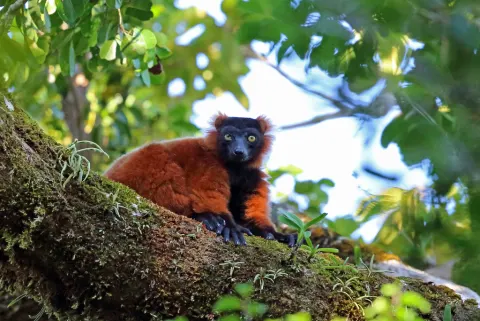
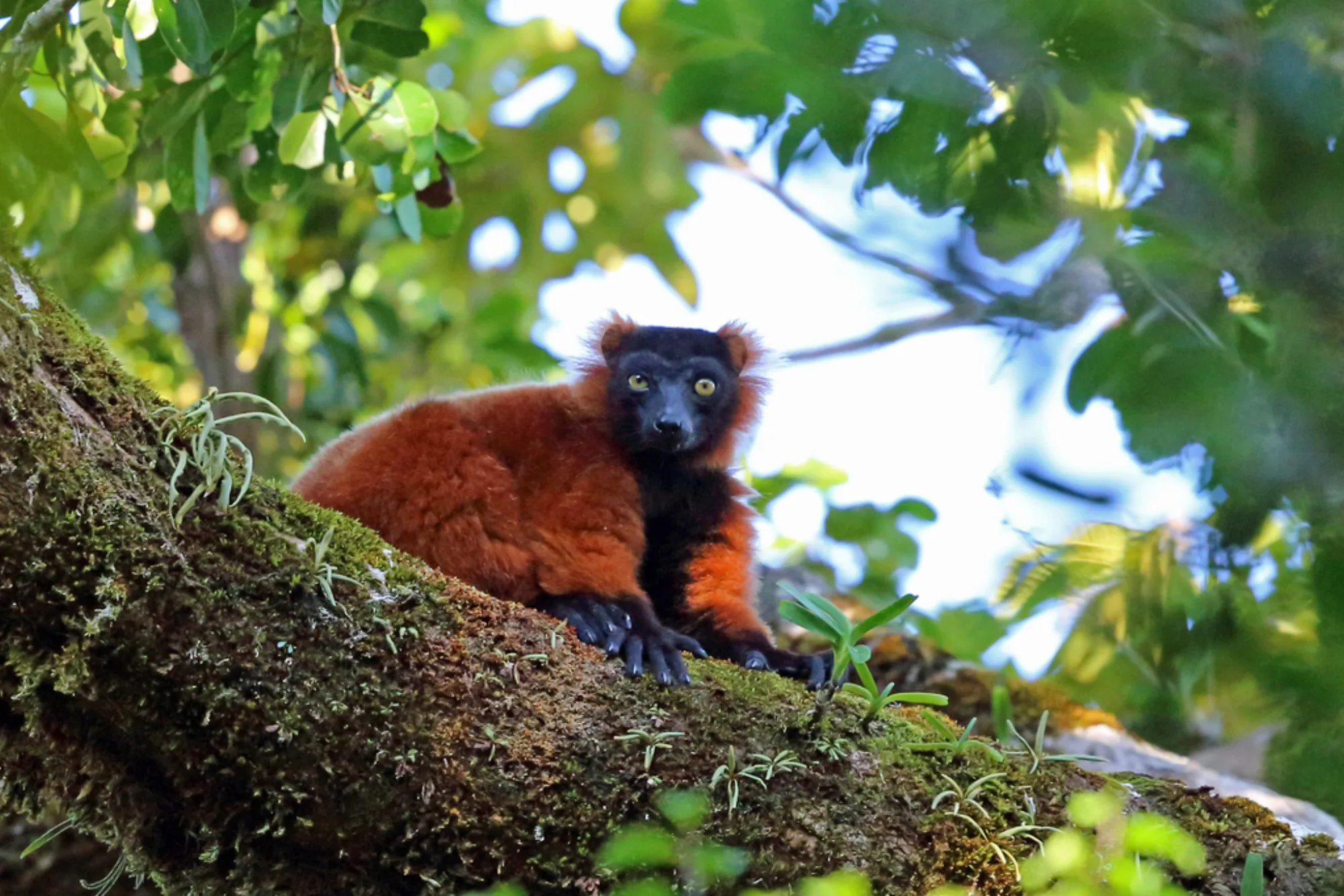
Rust-coloured fur and a pale patch at the back of the neck make the Red Ruffed Lemur distinctive among Madagascar's primates. Its head, belly, tail and feet are black, as are the inner sides of its legs. This large lemur has a body about 53 cm long and a 60 cm tail, with females slightly larger than males. Its forest home is confined to Masoala, a rainforest region in northeastern Madagascar.
Active by day, it is most often busy in the morning and evening. It usually lives in female-led groups of 2 to 16, although groups of up to 32 have been recorded. Loud, booming calls carry across the forest, and scent marking also helps individuals communicate. Fruit, nectar and pollen make up much of its diet, with figs a particular favourite; it also eats leaves and shoots. When food is abundant in the wet season, lemurs sometimes gather in larger groups to feed at the same source. In the dry season, when fruit is scarce, they often split up and forage alone.
Females keep their young in nests built from twigs, leaves, vines and fur, 10 to 20 m above the forest floor. Two or three young are typical, and mothers usually take them from the nest when they are a week or two old. Threats include logging, forest burning and cyclones, as well as mining, hunting and capture for the illegal pet trade. Masoala National Park offers some protection, but many red ruffed lemurs live outside its boundaries. Illegal logging for valuable hardwoods, including rosewood, has reduced the forest available to them.
Written from the English Wikipedia article Red ruffed lemur (CC BY-SA 4.0).
- Records
- 15
- Countries
- 1
No atlas park has a record of the Red Ruffed Lemur in or around it yet.
These are open occurrence records, so they show where people looked for and recorded the Red Ruffed Lemur as much as where it lives. Cells are up to 25 km across, and every location is generalised to its cell.
Generalised encounter areas, not exact locations. Each shape is a grid cell coloured by how likely the species is there.
- Very likelyMadagascar25 km zone · medium confidence · 15 records · updated 80 days ago
Conservation status not assessed here yet, so every location is generalised to its grid cell.