Lace Monitor
Varanus varius
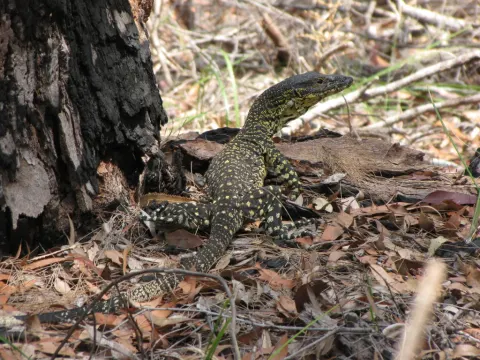
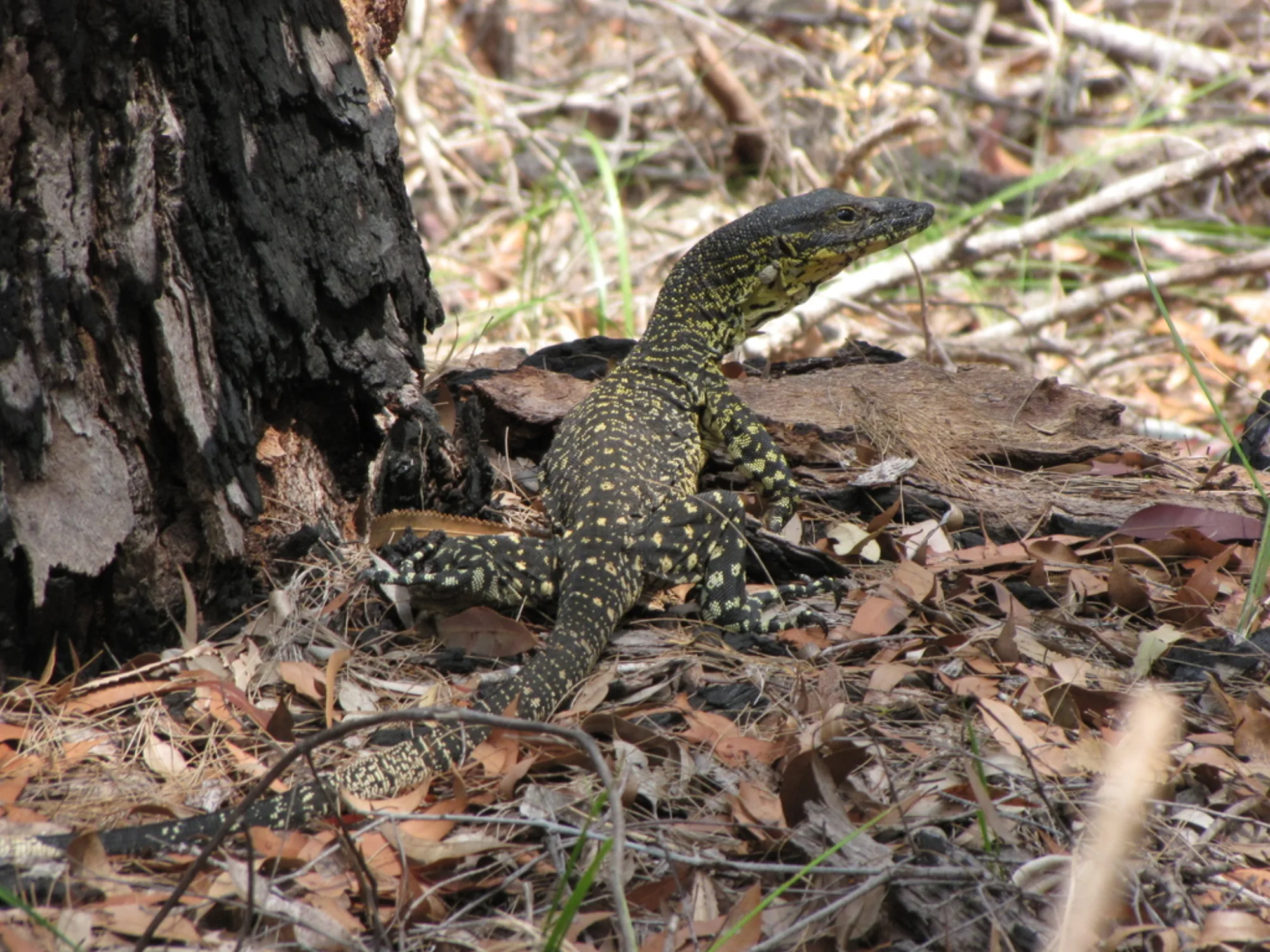
A long, slender tail trails behind the Lace Monitor as it moves through the forests of eastern Australia. Also called the tree goanna, this large monitor lizard can reach 2 metres in total length and weigh up to 14 kilograms. Most are dark grey to dull bluish-black, scattered with cream spots, with black and yellow bands across the snout and under the chin. Another form, known as Bell's form, has a yellow or yellow-brown base colour with broad dark bands running from the shoulders to the tail. Both forms occur in parts of eastern Australia, with the species found as far north as Cape Bedford on the Cape York Peninsula and as far south as south-eastern South Australia.
Lace monitors use both open and closed forests, travelling up to 3 km a day as they forage. They are capable climbers, and young animals spend even more time in trees than adults. Most activity takes place from September to May, while cooler weather sends them into shelter in tree hollows or beneath fallen trees or large rocks. They feed mainly on carrion, as well as insects, reptiles, small mammals and birds, and retreat to a nearby tree if disturbed while searching for food on the ground. Females usually lay eggs in active termite nests, and the young hatch after 6 to 7 months.
Cane toads have been linked to declines, especially among larger monitors, although the lizards have remained abundant in some places where toads have been established for years. Food scraps and rubbish can also cause harm: a bone from a T-bone steak lodged in one monitor's throat, while a plastic fork was found inside another's stomach. Predators include dingo packs, wild boars and wedge-tailed eagles, though they take lace monitors only occasionally.
Written from the English Wikipedia article Lace monitor (CC BY-SA 4.0).
- Records
- 15,909
- Countries
- 1
- Atlas places
- 5
These are open occurrence records, so they show where people looked for and recorded the Lace Monitor as much as where it lives. Cells are up to 25 km across, and every location is generalised to its cell.
Generalised encounter areas, not exact locations. Each shape is a grid cell coloured by how likely the species is there.
- Very likelyAustralia25 km zone · high confidence · 15909 records · updated 80 days ago
Conservation status not assessed here yet, so every location is generalised to its grid cell.